SKU: IOWC-1809
📋 GST Invoice Available

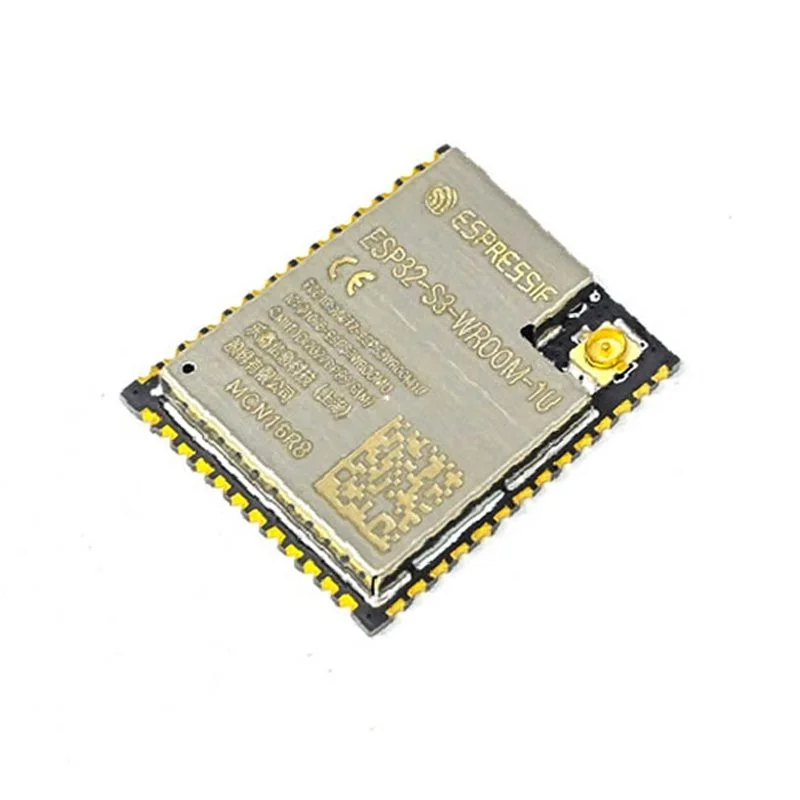
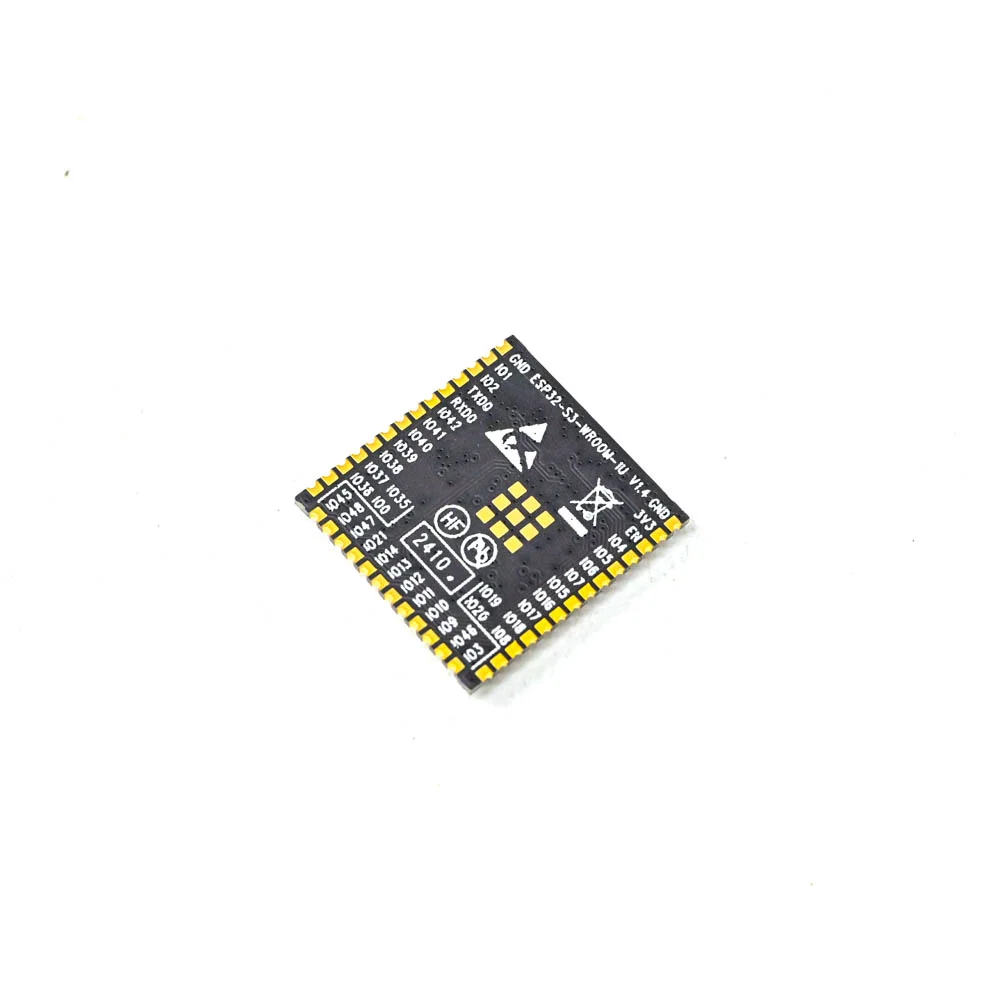
Espressif ESP32-S3-WROOM-1U-N16R8 Wi-Fi & Bluetooth LE Module

₹469.00 (Inclusive of all taxes)
Out of Stock

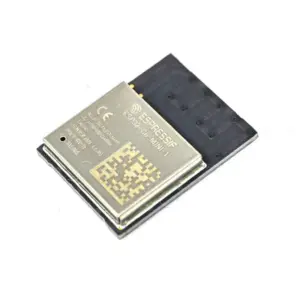
The Espressif ESP32-S3-WROOM-1U-N16R8 is a surface-mount wireless MCU module featuring dual-core Xtensa LX7 processors, 2.4GHz Wi-Fi 4, and Bluetooth 5 LE. It integrates 16MB flash and 8MB PSRAM for AIoT applications, supporting neural network acceleration and an external antenna connector for enhanced range.

Features

  • Dual-core ESP32-S3 SoC with AI-accelerated neural network processing for wake-word detection and voice commands.
  • Integrated 2.4GHz Wi-Fi (802.11 b/g/n) and Bluetooth 5 LE with -103.5dBm receiver sensitivity.
  • 16MB flash memory and 8MB SRAM for complex AIoT firmware and data buffering.
  • External U.FL antenna connector for flexible, high-gain antenna deployment.
  • Surface-mount design (25.5 x 18.0 x 3.1 mm) for compact, volume-optimized PCB integration.

Out of stock

Description

The ESP32-S3-WROOM-1U-N16R8 is Espressif’s flagship AIoT module, built around the powerful dual-core Xtensa LX7 microcontroller. It delivers robust 2.4GHz Wi-Fi connectivity with a high data rate of 150Mbps and superior RF sensitivity, paired with Bluetooth Low Energy 5 for short-range device pairing and control. The module’s substantial 16MB of flash and 8MB of PSRAM provide ample storage for over-the-air updates, TensorFlow Lite Micro models, and complex application logic.

Designed for surface-mount assembly, the module includes a U.FL connector for an external antenna, enabling designers to optimize signal strength and range for specific deployments. Its 3.0-3.6V operating voltage and comprehensive peripheral set, including SPI, I2C, I2S, UART, and USB OTG, make it a versatile core for smart home control panels, voice-enabled smart speakers, industrial sensor gateways, and edge AI vision applications.

Key Features

  • AI Acceleration: Hardware-accelerated neural network and signal processing for efficient AIoT workloads.
  • High-Performance Connectivity: Combines Wi-Fi 4 and Bluetooth 5 LE with excellent link budget.
  • Expanded Memory: Large 16MB flash and 8MB PSRAM support advanced firmware and machine learning models.
  • Flexible Antenna Option: Integrated U.FL connector allows for easy external antenna attachment.
  • Rich Peripheral Interface: Multiple GPIOs, USB OTG, touch sensors, and serial communication buses.
  • Robust Power Management: Supports multiple low-power sleep modes for battery-operated designs.
  • Secure Boot & Flash Encryption: Built-in hardware security features for secure IoT deployments.
  • Certified Module: Pre-certified for RF compliance, simplifying product certification.

Applications

  • AIoT smart home devices: voice-controlled assistants, smart displays, and control panels.
  • Industrial IoT gateways for wireless sensor data aggregation and cloud connectivity.
  • Advanced human-machine interfaces with touch sensing and voice recognition.
  • Edge computing devices for on-device machine learning inference.
  • Wireless camera systems and smart vision appliances.

Technical Specifications

Microcontroller / SoCEspressif ESP32-S3 Dual-Core Xtensa LX7
Wireless ProtocolsWi-Fi 802.11 b/g/n (2.4GHz), Bluetooth 5 LE
Frequency Range2.4GHz ISM Band
RF Transmit PowerUp to +20dBm (Wi-Fi)
Receiver Sensitivity-103.5dBm
Data RateUp to 150Mbps
Supply Voltage3.0V to 3.6V
Operating CurrentApprox. 240mA (average Wi-Fi TX)
InterfacesGPIO, SPI, I2C, I2S, UART, USB OTG, Touch Sensors, ADC, DAC, PWM
Antenna ConnectorU.FL (External)
Memory16MB Flash, 384KB ROM, 8MB PSRAM
Operating Temperature-40°C to +85°C
Dimensions25.5 x 18.0 x 3.1 mm

Frequently Asked Questions

What is the main difference between the ESP32-S3-WROOM-1U and the standard ESP32-S3-WROOM-1 module?

The primary difference is the antenna configuration. The ESP32-S3-WROOM-1U variant features a U.FL connector for an external antenna, providing greater flexibility for signal optimization and range extension. The standard WROOM-1 model typically uses an integrated PCB antenna. Both share the same ESP32-S3 SoC, memory, and core features, but the 1U is preferred for applications requiring specific antenna placement or higher gain.

How do I program the ESP32-S3-WROOM-1U module, and what development frameworks are supported?

You can program the module using the ESP-IDF (Espressif IoT Development Framework), which is the official SDK providing full access to hardware features and RTOS capabilities. It is also widely supported by the Arduino Core for ESP32, PlatformIO, and MicroPython. Development typically involves connecting the module's UART0 (GPIO43/44) to a USB-to-serial adapter for flashing and debugging, using the standard esptool.py utility provided by Espressif.

What are the power supply requirements, and what is the typical operating current for Wi-Fi transmission?

The module requires a stable 3.3V power supply within the 3.0V to 3.6V range. Power should be supplied via the VDD pin, capable of delivering peak currents up to 500mA. During active Wi-Fi transmission at maximum power, the average current draw can be around 240mA. The module supports various deep sleep modes, reducing current consumption to microamps, which is critical for battery-powered IoT sensor nodes.

Can I use the ESP32-S3's AI acceleration features with popular machine learning frameworks?

Yes, the ESP32-S3's neural network acceleration is accessible through Espressif's ESP-NN library, which is integrated with TensorFlow Lite for Microcontrollers. Developers can convert and deploy models trained in TensorFlow or Keras. The hardware acceleration significantly speeds up operations like convolutional layers and activation functions, making real-time audio processing (wake-word detection) and lightweight image classification feasible on the edge.

Package Includes

  • 1 x Espressif ESP32-S3-WROOM-1U-N16R8 Module

Additional Information

Weight 0.01 kg
Dimensions 2.55 × 1.8 × 0.31 cm