SKU: IOWC-0155
📋 GST Invoice Available

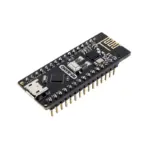
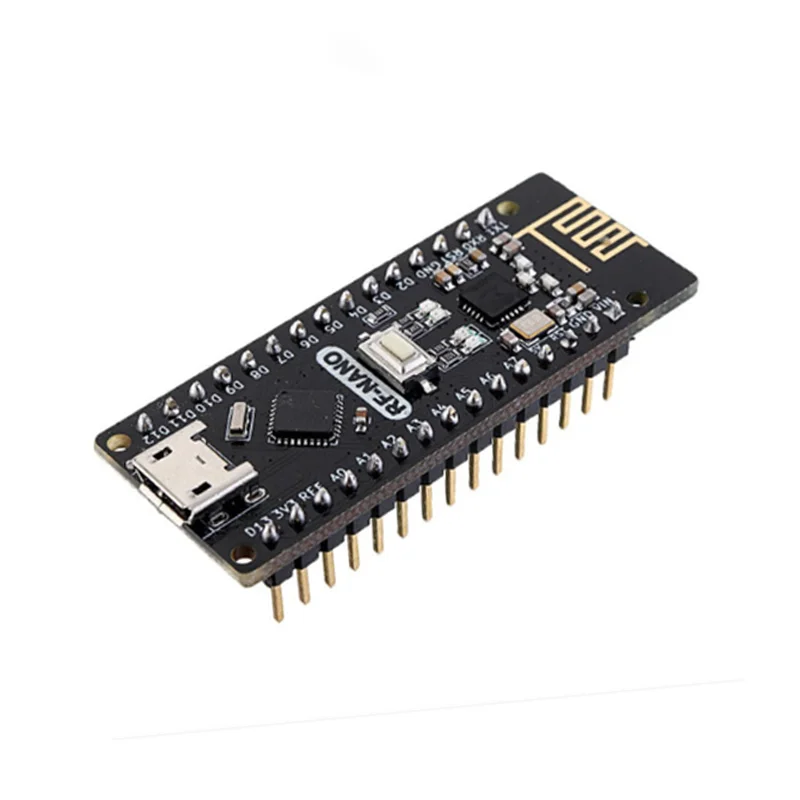
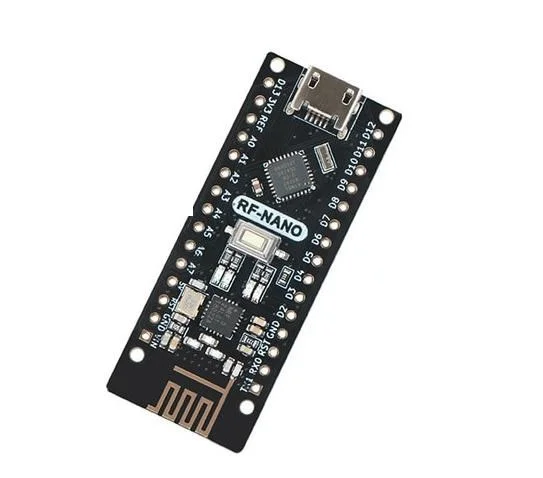
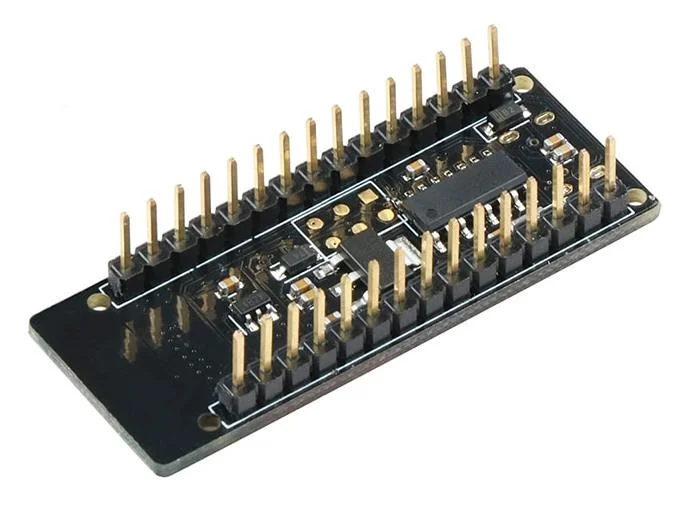
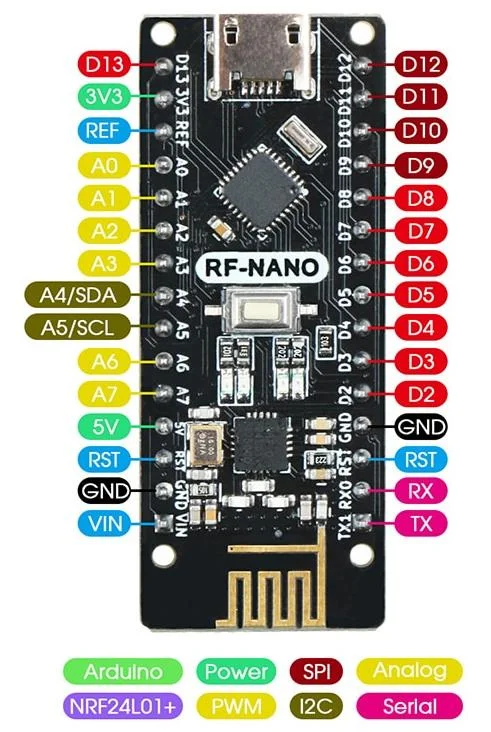
RF Nano Integrated NRF24L01 Wireless Module with ATmega328P

₹1,159.00 (Inclusive of all taxes)
Out of Stock

The RF Nano is an integrated 2.4GHz wireless development board combining an Arduino Nano-compatible ATmega328P microcontroller with a pre-soldered NRF24L01+ transceiver, enabling compact IoT and remote control projects without external wiring.

Features

  • Integrated Arduino Nano V3.0 footprint with ATmega328P MCU and NRF24L01+ 2.4GHz wireless transceiver, eliminating external module connections.
  • Full Arduino IDE compatibility with pre-loaded bootloader for rapid 2.4GHz wireless application development using standard libraries.
  • Compact form factor (9×6 cm) ideal for space-constrained embedded systems, drones, and portable sensor nodes.
  • Provides 22 digital I/O pins, 8 analog inputs, 6 PWM outputs, and hardware UART/SPI/I2C for extensive peripheral interfacing.
  • Operates on 5V logic with 7-12V input voltage range, supporting flexible power supply configurations for field deployments.

Out of stock

Description

The RF Nano Integrated NRF24L01 Wireless Module merges a fully-featured Arduino Nano clone with a surface-mounted NRF24L01+ 2.4GHz RF transceiver onto a single PCB. This integration provides a complete wireless node solution, removing the need for separate microcontroller and radio module connections. The ATmega328P microcontroller, running at 16 MHz with 32KB Flash and 2KB SRAM, executes your Arduino sketches while directly controlling the integrated NRF24L01+ chip via SPI for reliable 2.4GHz communication.

Designed for developers seeking a compact, plug-and-play wireless platform, the board includes an onboard FT232RL USB-to-serial converter for programming and serial debugging. The integrated NRF24L01+ supports the 2.4GHz ISM band with GFSK modulation, offering a practical range for indoor and short-range outdoor applications. Its low-power architecture and direct pin compatibility with standard Arduino Nano shields and peripherals make it a versatile foundation for remote sensor networks, telemetry systems, and wireless controller prototypes.

Key Features

  • Fully integrated Arduino Nano V3.0 compatible development board with pre-soldered NRF24L01+ 2.4GHz transceiver module.
  • Direct pin-to-pin compatibility with existing Arduino Nano codebase, libraries, and peripheral shields for seamless project migration.
  • Onboard FTDI FT232RL USB-to-UART bridge provides stable virtual COM port connectivity for programming and serial monitoring.
  • Comprehensive I/O set includes 22 digital pins (6 capable of PWM), 8-channel 10-bit ADC, and hardware UART, SPI, and I2C interfaces.
  • Compact, single-board design reduces project footprint and improves reliability by eliminating inter-module wiring and connectors.
  • Powered via USB or 7-12V DC input, regulated to 5V for the MCU and radio, suitable for both bench testing and deployed systems.

Applications

  • Compact wireless sensor nodes for home automation, environmental monitoring, and industrial telemetry.
  • Remote control systems for drones, robotics, and RC models using 2.4GHz communication.
  • Wireless data loggers and portable measurement devices requiring minimal footprint.
  • Educational platforms for teaching embedded systems, wireless networking, and IoT prototyping.
  • Mesh network nodes and low-rate personal area network (PAN) devices.

Technical Specifications

Microcontroller/SoCATmega328P (AVR architecture)
Wireless ProtocolNRF24L01+ 2.4GHz RF Transceiver
Operating Voltage5V (regulated from 7-12V input)
Clock Speed16 MHz
Flash Memory32 KB (2 KB used by bootloader)
SRAM2 KB
EEPROM1 KB
Digital I/O Pins22
Analog Input Pins8
PWM Outputs6
DC Current per I/O Pin40 mA
Communication InterfacesUART, SPI, I2C (TWI)
USB InterfaceFTDI FT232RL (Virtual COM Port)
Dimensions (approx.)9 x 6 x 1 cm

Frequently Asked Questions

How do I program the RF Nano board with the Arduino IDE?

Connect the RF Nano via its micro-USB port. In the Arduino IDE, select 'Arduino Nano' as the board and the correct COM port. The integrated FTDI chip and pre-loaded bootloader allow you to upload sketches directly, just like a standard Nano. Use the SPI-based RF24 library to control the onboard NRF24L01+ transceiver for wireless communication.

What is the power supply requirement and typical current consumption?

The board requires a 7-12V DC input, which is regulated down to 5V for the ATmega328P and NRF24L01+. You can also power it directly via the 5V pin or the USB port. The NRF24L01+ has low-power modes; typical active current is around 12mA, while the ATmega328P can enter sleep modes to further reduce overall system power consumption for battery-operated nodes.

How do I interface with the integrated NRF24L01+ module?

The NRF24L01+ is connected to the ATmega328P's hardware SPI pins (MOSI, MISO, SCK) and uses digital pins for Chip Enable (CE) and Chip Select (CSN). You must install the 'RF24' library in the Arduino IDE. Initialize the radio object with the correct pin assignments, then use the library's functions for configuring channels, data rates, and sending/receiving packets over the 2.4GHz band.

Package Includes

  • 1 x RF Nano Integrated NRF24L01 Wireless Module

Additional Information

Weight 0.009 kg
Dimensions 6 × 9 × 1 cm