SKU: SENS-1044
📋 GST Invoice Available

7Semi ADXL335 3-Axis Accelerometer Analog Output Breakout Module

₹949.00 (Inclusive of all taxes)
Out of Stock

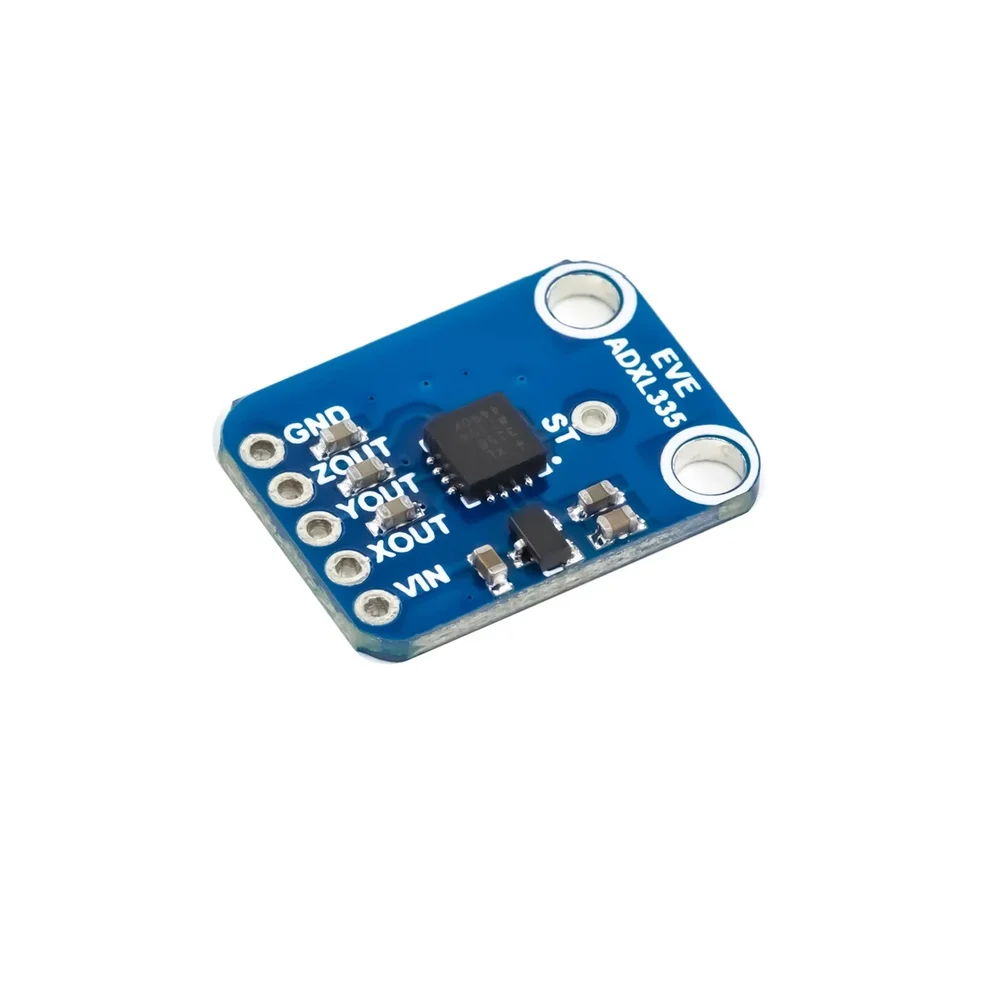
The 7Semi ADXL335 breakout module is a low-power, 3-axis MEMS accelerometer providing analog voltage outputs for X, Y, and Z axes. Designed for easy integration with 3.3V/5V microcontrollers like Arduino, Raspberry Pi, and ESP32 via external ADC, it enables precise motion, tilt, and vibration sensing.

Features

  • Tri-axis (±3g) MEMS accelerometer with analog voltage outputs.
  • Low power consumption (~350µA) for battery-powered applications.
  • Wide bandwidth (X/Y: 0.5Hz–1600Hz, Z: 0.5Hz–550Hz) for dynamic motion capture.
  • Compact breakout board (21×11 mm) with unsoldered header pins for flexible mounting.
  • Simple interface requiring only a 3V–5V supply and ADC inputs for data acquisition.

Out of stock

Description

The ADXL335 is a complete, signal-conditioned accelerometer module based on the industry-standard Analog Devices MEMS sensor. It outputs three separate analog voltages proportional to the acceleration experienced on each orthogonal axis, with a sensitivity of approximately 300mV/g when powered at 3V. The module includes all necessary support components, such as a voltage regulator and bypass capacitors, ensuring a stable 1.8V–3.6V supply to the core sensor IC.

This breakout is engineered for reliable performance in motion detection, inclination sensing, and vibration analysis applications. Its analog output simplifies system integration, requiring only basic microcontroller ADC channels for data reading, making it suitable for educational projects, robotics, and embedded system prototyping where digital communication buses are unavailable or reserved.

Key Features

  • High-performance MEMS accelerometer with ±3g measurement range.
  • Three independent analog outputs (Xout, Yout, Zout) for direct ADC connection.
  • Ultra-low current draw (~350µA) enables long-term portable operation.
  • On-board 3.3V LDO regulator allows flexible 3V–5V module input.
  • User-selectable bandwidth via external capacitors on CX, CY, CZ pins.
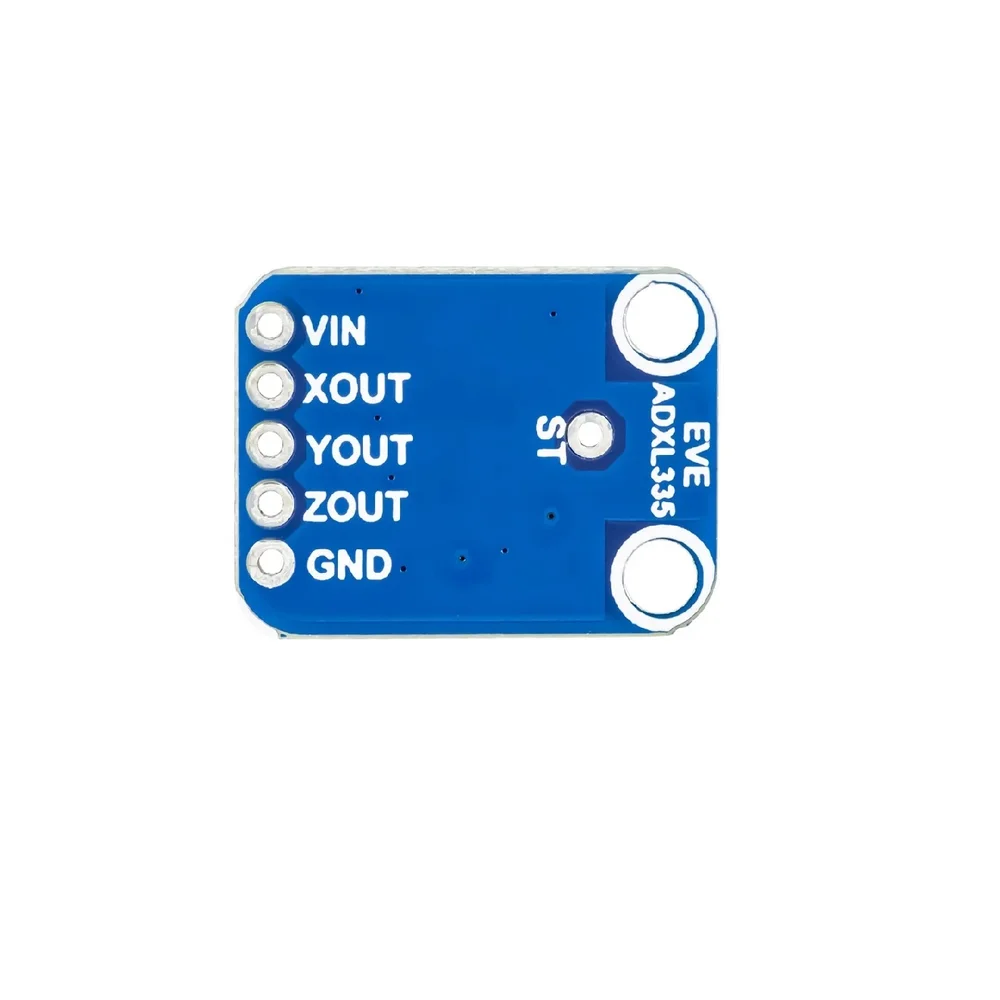
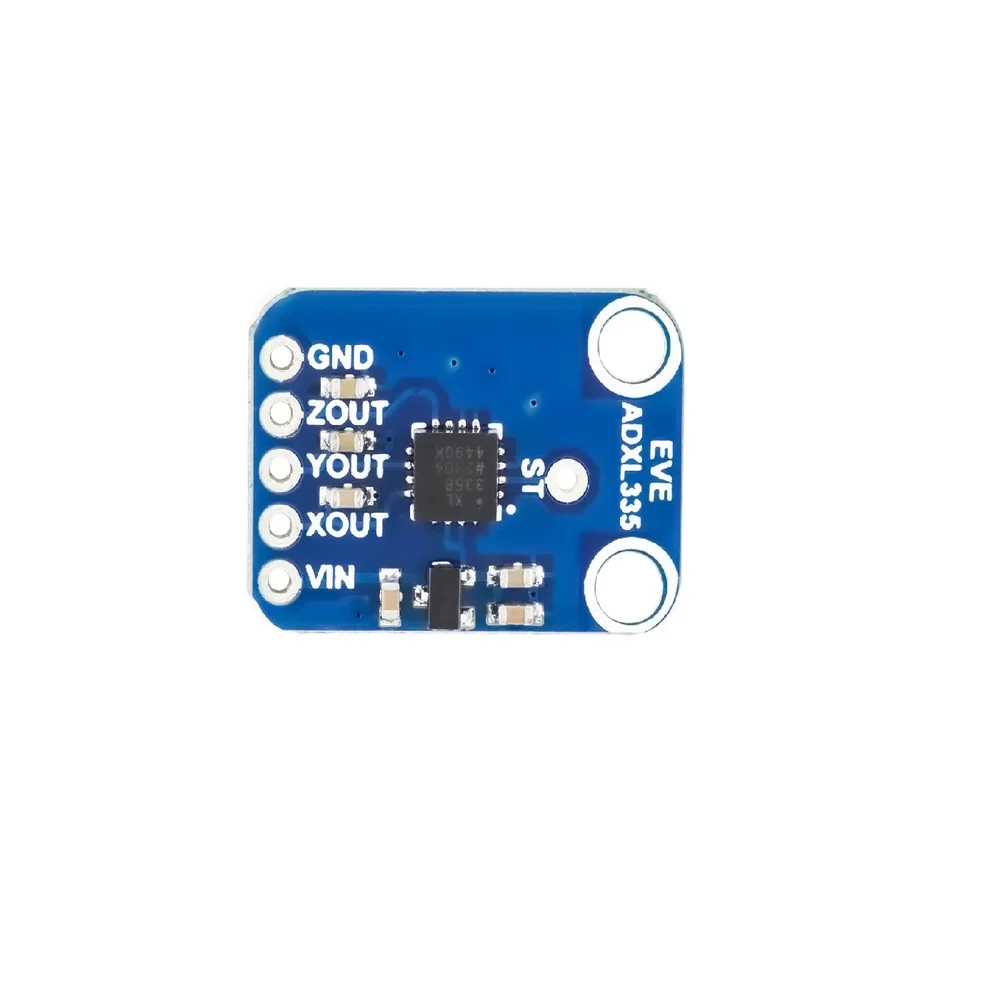
  • Compact PCB footprint with clearly labeled test points and pinouts.
  • Robust design suitable for prototyping, robotics, and industrial vibration monitoring.

Applications

  • Robotics platform stabilization and tilt compensation.
  • Industrial equipment vibration monitoring and predictive maintenance.
  • Wearable device motion tracking and gesture recognition.
  • Drone flight controller inertial measurement unit (IMU) supplementation.
  • Educational projects for physics experiments and embedded systems labs.

Technical Specifications

Sensor ModelADXL335
Measurement Range±3g
InterfaceAnalog Output (X, Y, Z)
Module Supply Voltage3V – 5V DC
Sensor Operating Voltage1.8V – 3.6V
Sensitivity (@ 3V)~300 mV/g
Zero-g Output (@ 3V)~1.5V
Current Consumption~350 µA
X/Y Axis Bandwidth0.5 Hz – 1600 Hz
Z Axis Bandwidth0.5 Hz – 550 Hz
Board Dimensions21 x 11 mm
Mounting TypeBreakout Board

Frequently Asked Questions

What is the operating voltage range for this ADXL335 breakout module?

The module itself accepts a supply voltage between 3V and 5V DC via its VCC pin. An onboard low-dropout regulator then provides the required 1.8V to 3.6V to the core ADXL335 MEMS sensor IC. Always ensure your power source is within this 3V-5V range for proper operation.

How do I read data from the analog outputs with an Arduino?

Connect the module's Xout, Yout, and Zout pins to three separate analog input pins on your Arduino (e.g., A0, A1, A2). Provide 3.3V or 5V to VCC and connect GND. Use the analogRead() function to sample the voltage. The reading will correspond to acceleration, with the zero-g point typically around 1.5V when powered at 3V.

Can I adjust the sensor's bandwidth?

Yes, the bandwidth for each axis is set by connecting external capacitors between the CX, CY, and CZ pins and ground. The datasheet provides a formula (Bandwidth (Hz) = 1 / (2π * 32kΩ * C)). Larger capacitors lower the bandwidth, reducing noise, while smaller capacitors allow higher frequency response.

Is this sensor suitable for high-frequency vibration measurement?

The ADXL335 offers a maximum bandwidth of 1600Hz for X/Y axes and 550Hz for the Z axis, making it suitable for measuring vibrations and dynamic motions within this frequency range. For very high-frequency shock or vibration analysis beyond 2kHz, a digital accelerometer with a higher bandwidth would be recommended.

Package Includes

  • 1 x 7Semi ADXL335 3-Axis Accelerometer Breakout Module
  • 1 x 15-pin Male Header Strip (unsoldered)

Additional Information

Weight 0.005 kg
Dimensions 3 × 3 × 3 cm