SKU: SENS-1193
📋 GST Invoice Available

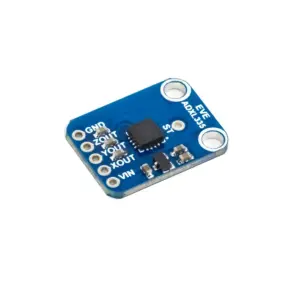
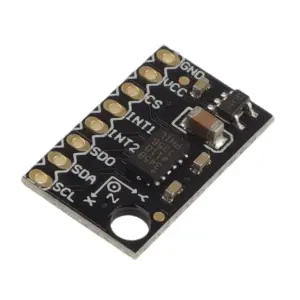
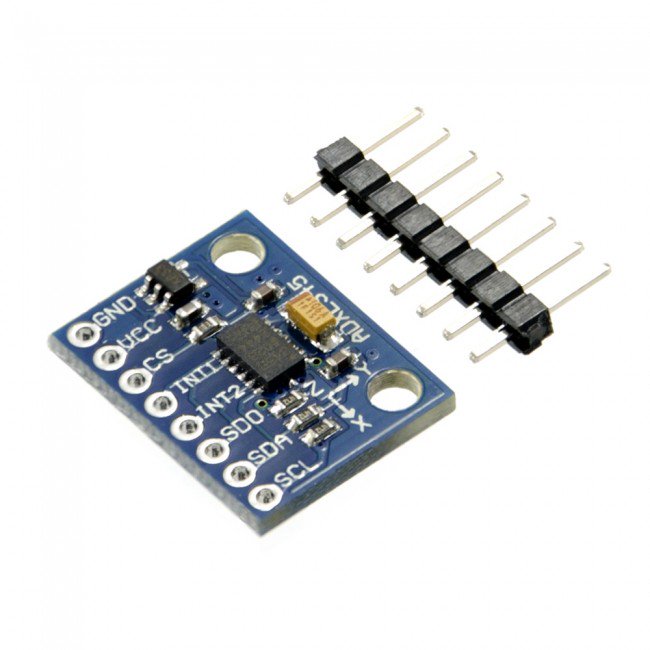
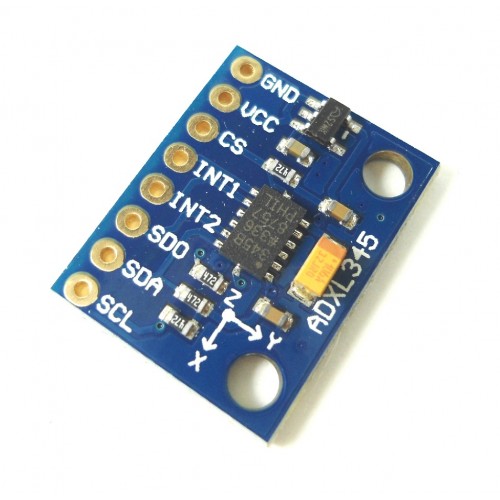
ADXL345 Triple-Axis Accelerometer Sensor Module - I2C/SPI Interface

₹187.00 (Inclusive of all taxes)
Out of Stock

The ADXL345 digital accelerometer module provides high-resolution (±2g to ±16g) 3-axis acceleration measurement via I2C or SPI interface, compatible with 3.3V/5V systems like Arduino, Raspberry Pi, ESP32, and STM32 for tilt sensing, motion detection, and impact analysis.

Features

  • High-resolution digital 3-axis accelerometer with user-selectable ranges from ±2g to ±16g.
  • Ultra-low power operation: 40µA in measurement mode and 0.1µA in standby.
  • Integrated intelligent motion detection features: free-fall, single/double-tap, and activity/inactivity sensing.
  • Dual digital interface support: I2C and SPI for flexible microcontroller integration.
  • Robust 10,000g shock survival rating and wide operating temperature range (-40°C to +85°C).

Out of stock

Description

The ADXL345 is a low-power, 3-axis MEMS accelerometer providing digital output via I2C or SPI serial interfaces. It measures both static acceleration (for tilt sensing) and dynamic acceleration (from motion or shock) with a high resolution of up to 13 bits (4 mg/LSB). The module includes an onboard RT9161 voltage regulator for stable 3.3V/5V operation in noisy electrical environments.

Advanced embedded functions such as free-fall detection, tap sensing, and activity monitoring can be mapped to hardware interrupt pins, minimizing host processor load. A built-in 32-level FIFO buffer further reduces system overhead by storing data samples. Its robust design ensures reliable performance in industrial, consumer, and embedded applications.

Key Features

  • High-performance MEMS accelerometer with digital I2C and SPI output.
  • Selectable measurement ranges: ±2g, ±4g, ±8g, and ±16g.
  • Ultra-low power consumption ideal for battery-powered devices.
  • Integrated motion detection algorithms (free-fall, tap, activity/inactivity).
  • Onboard voltage regulator supports 3.3V and 5V logic systems.
  • Wide operating temperature range from -40°C to +85°C.
  • High shock survivability rating of 10,000g.
  • Compact module footprint for space-constrained designs.

Applications

  • Robotics and drone stabilization and orientation sensing.
  • Industrial equipment vibration monitoring and predictive maintenance.
  • Wearable fitness trackers and medical instrumentation for activity monitoring.
  • Consumer electronics for screen orientation, gesture, and tap controls.
  • Hard disk drive (HDD) protection and free-fall detection in portable devices.

Technical Specifications

ParameterSpecification
Sensor ModelADXL345
InterfaceI2C, SPI
Supply Voltage3.3V to 5V DC
Measurement Range±2g, ±4g, ±8g, ±16g (selectable)
Sensitivity (Typical)X: 28.6 LSB/g, Y: 31.2 LSB/g, Z: 34.5 LSB/g
Resolution10-bit fixed, up to 13-bit (full resolution)
Operating Current40 µA (measurement), 0.1 µA (standby)
Operating Temperature-40°C to +85°C
Shock Survival10,000g
Special FunctionsFree-fall, Tap/Double-Tap, Activity/Inactivity Detection
Module Dimensions (L x W)20.5 mm x 15.5 mm
Module Weight0.6 g

Frequently Asked Questions

What is the operating voltage range for this ADXL345 module?

The module is designed for 3.3V to 5V DC input, thanks to an onboard RT9161 voltage regulator. This allows direct compatibility with both 3.3V logic microcontrollers (like ESP32) and 5V systems (like standard Arduino boards) without requiring an external level shifter.

How do I select between the I2C and SPI communication interfaces?

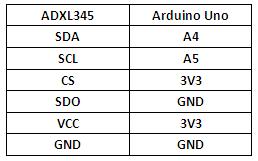
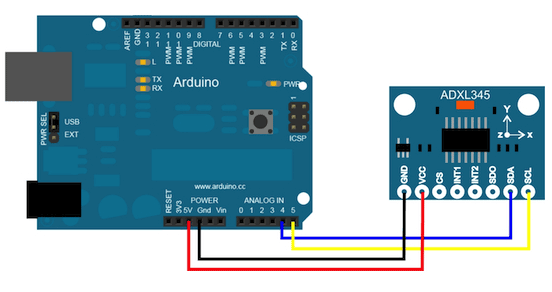
The interface is selected via hardware pin configuration. The ADXL345 module typically has dedicated pins for both protocols. For I2C, connect the SDA and SCL pins. For SPI, use the CS, SDO, SDA (as MOSI), and SCL (as SCLK) pins. Ensure the CS pin is pulled high for I2C mode or controlled by your microcontroller for SPI mode.

Can this sensor detect free-fall and tap events?

Yes, the ADXL345 has built-in algorithms for free-fall, single-tap, and double-tap detection. These features are configurable via its registers and can be mapped to one of two interrupt output pins to alert your host processor, enabling efficient event-driven system design without constant polling.

What is the accuracy and resolution of the acceleration measurements?

The sensor offers a fixed 10-bit resolution or a full-resolution mode where resolution scales with the selected G-range, reaching up to 13-bit resolution at the ±16g setting. The typical scale factor is 4 mg/LSB, allowing detection of inclination changes of less than 1.0°.

Is this module suitable for high-vibration industrial environments?

Yes, the ADXL345 sensor itself has a 10,000g shock survival rating and operates from -40°C to +85°C, making it robust for industrial settings. The module's onboard regulator also provides stable operation in electrically noisy environments. For mounting, secure the module firmly to minimize resonance effects.

Package Includes

  • 1 x ADXL345 Triple-Axis Accelerometer Module

Additional Information

Weight 0.0006 kg
Dimensions 2.05 × 1.55 cm