SKU: IOWC-0981
📋 GST Invoice Available

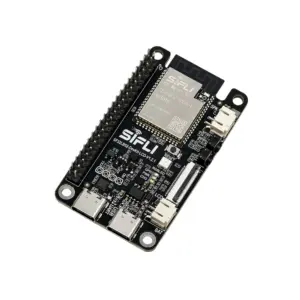
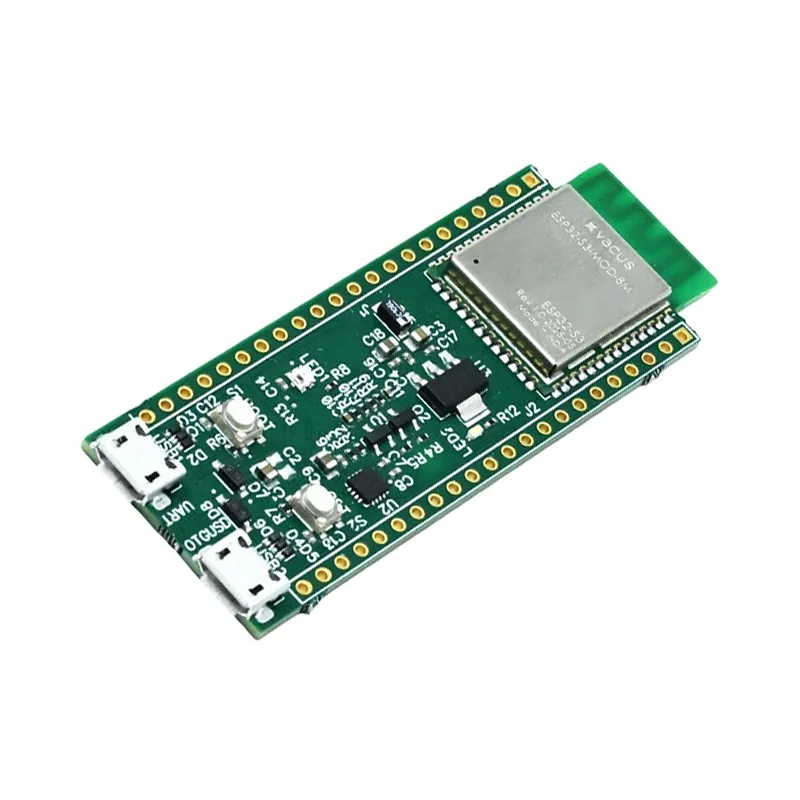
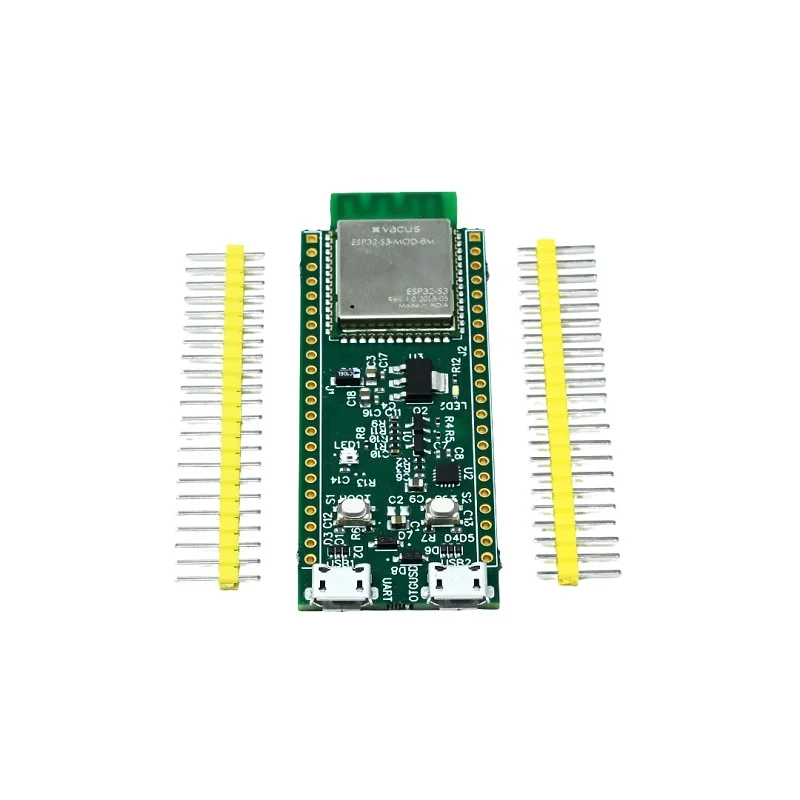
Vacus ESP32-S3 Development Module w/ Dual USB

₹1,888.00 (Inclusive of all taxes)
Out of Stock

The Vacus ESP32-S3 Development Module is a feature-rich IoT prototyping board based on the ESP32-S3-MOD8M, offering dual USB ports for UART programming and OTG connectivity. It is fully compatible with Arduino IDE, ESP-IDF, and MicroPython for building Wi-Fi, BLE, and low-power embedded applications.

Features

  • Powered by the ESP32-S3-MOD8M, a 240 MHz dual-core MCU with integrated 2.4 GHz Wi-Fi and Bluetooth LE 5.0 for robust wireless connectivity.
  • Dual USB interfaces: CH343P USB-to-UART for reliable flashing/debugging and a native USB OTG port for host/device peripheral development.
  • Ultra-low power operation with deep sleep currents as low as ~10 µA, ideal for battery-powered IoT sensors and wearables.
  • Onboard RGB LED and dedicated Boot/Reset buttons simplify firmware development, testing, and system control workflows.
  • Generous 8MB PSRAM and 16MB flash memory support complex applications, AIoT edge processing, and data logging.

Out of stock

Description

The Vacus ESP32-S3 Development Module is a comprehensive platform built around the Espressif ESP32-S3-MOD8M system-in-package. It provides a balanced mix of processing performance, wireless capability, and developer-friendly features for rapid IoT prototyping and deployment. The board’s dual-core Xtensa LX7 processor runs at 240 MHz, enabling efficient handling of wireless stacks, sensor data fusion, and light machine learning tasks.

Power management is a core strength, with the ESP32-S3 supporting multiple low-power modes. The module achieves a deep sleep current of approximately 10 µA, extending operational life in solar-powered or battery-based field deployments. For active wireless communication, typical operating currents are 120 mA (TX) and 80 mA (RX), managed via the onboard 3.3V regulator which accepts a 5V USB input. The inclusion of a high-quality CH343P USB-to-UART bridge ensures stable serial communication and reliable firmware uploads from development environments like Arduino IDE or ESP-IDF.

Key Features

  • High-performance dual-core ESP32-S3 processor (240 MHz) with 8MB PSRAM and 16MB flash for demanding applications.
  • Integrated 2.4 GHz Wi-Fi 4 and Bluetooth 5.0 (BLE) with support for Bluetooth Mesh networking protocols.
  • Dedicated USB OTG port enables development of USB host or device applications (keyboards, storage, HID).
  • Professional-grade CH343P USB-to-UART converter provides reliable baud rates and robust driver support for flashing and serial monitoring.
  • User-controllable RGB LED connected to GPIO pins offers visual status feedback for debugging or application states.
  • Convenient Boot and Reset tactile buttons facilitate easy entry into firmware download mode and system restarts.
  • Wide operating voltage range (3.3V logic) with onboard regulation from 5V USB input, simplifying power supply design.
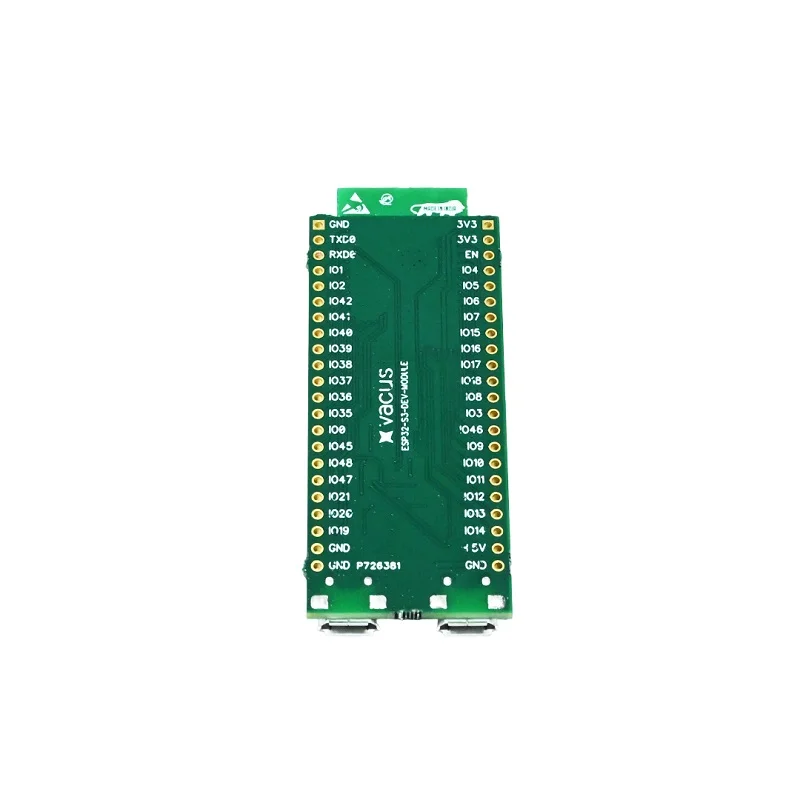
  • Compact form factor (70mm x 27mm) with pre-soldered header pins for easy integration into breadboards and custom enclosures.

Applications

  • IoT and AIoT sensor nodes for environmental monitoring (temperature, humidity, air quality).
  • Prototyping platform for USB host/device applications like HID controllers or data loggers.
  • Smart home automation hubs and wireless control systems using Wi-Fi or BLE Mesh.
  • Battery-powered wearables, fitness trackers, and portable smart gadgets.
  • Edge computing devices for lightweight machine learning inference and data processing.

Technical Specifications

Microcontroller/SoCESP32-S3-MOD8M (Dual-core Xtensa LX7 @ 240 MHz)
Wireless ProtocolsWi-Fi 802.11 b/g/n (2.4 GHz), Bluetooth 5.0 LE & BLE Mesh
Memory8MB PSRAM, 16MB Flash
Supply Voltage5V (via USB) / 3.3V (Operating Voltage)
Operating Current (Typical)Wi-Fi TX: 120 mA, Wi-Fi RX: 80 mA
Deep Sleep Current~10 µA
USB InterfacesCH343P USB-to-UART, Native USB OTG
User I/OGPIO (exposed via headers), RGB LED, Boot/Reset buttons
Operating Temperature-20°C to +70°C
Dimensions70 mm (L) x 27 mm (W)

Frequently Asked Questions

How do I program the Vacus ESP32-S3 Development Module?

Connect the board's USB-UART port (via the CH343P chip) to your computer using a USB-C cable. Install the CP210x/CH34x drivers if required. In the Arduino IDE, add the ESP32 board support URL, select 'ESP32S3 Dev Module' as the target, choose the correct COM port, and upload your sketch. For ESP-IDF, set up the toolchain and flash using the idf.py command-line tools.

What is the purpose of the dual USB ports on this board?

The board features two separate USB ports. One is a USB-to-UART bridge (using the CH343P) dedicated to firmware flashing and serial communication debugging. The other is a native USB OTG port, which allows the ESP32-S3 to act as a USB host or device, enabling connections to peripherals like keyboards, mice, or flash drives for more advanced embedded applications beyond simple serial communication.

What is the power supply requirement and how do I achieve the lowest sleep current?

The module is designed to be powered via its USB ports (5V input, regulated to 3.3V onboard). To achieve the specified deep sleep current of ~10 µA, ensure all unused GPIOs are set to a defined state (output low or input with pull-up/down). Use the ESP-IDF's deep sleep API or Arduino's `esp_deep_sleep_start()` function. Disconnect the USB OTG port if not in use, as it may draw additional leakage current.

Package Includes

  • 1 x Vacus ESP32-S3 Development Module
  • 2 x Header Pin Strips

Additional Information

Weight 0.01 kg
Dimensions 7 × 2.7 cm