SKU: IOWC-1288
📋 GST Invoice Available

Sipeed Tang Nano 9K FPGA Development Board (GW1NR-9)

₹2,039.00 (Inclusive of all taxes)
Out of Stock

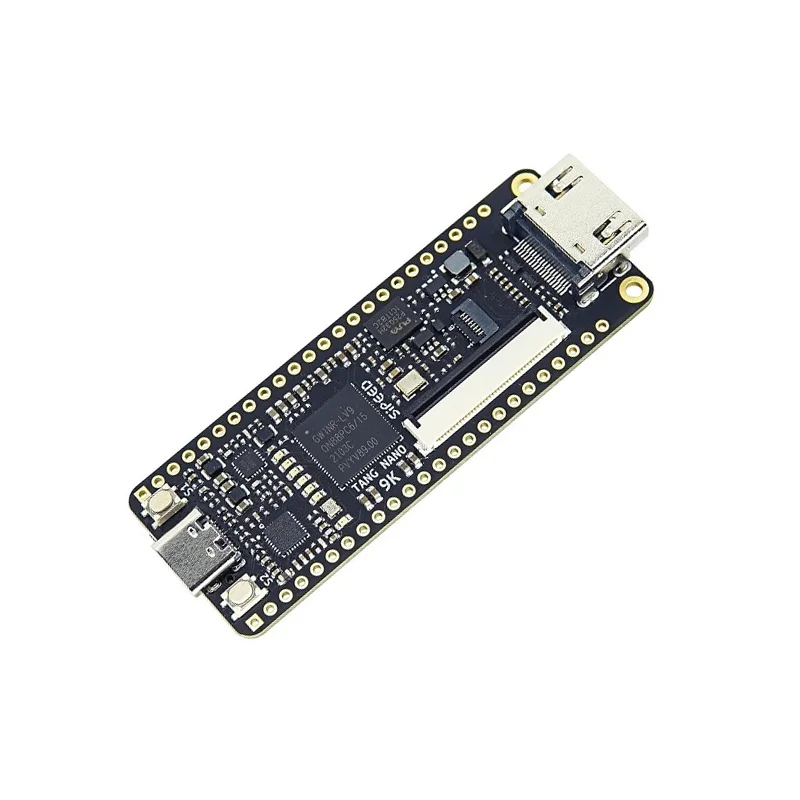
The Sipeed Tang Nano 9K is a compact FPGA development board based on the Gowin GW1NR-9 chip, featuring 8640 LUT4 logic units, 468Kb block SRAM, and integrated HDMI, RGB, and SPI display interfaces for embedded vision and RISC-V softcore prototyping.

Features

  • Powered by Gowin GW1NR-9 FPGA with 9K logic elements (8640 LUT4) and 6480 registers for complex digital designs.
  • Integrated HDMI, RGB, and SPI screen interfaces for direct video output and display-based projects.
  • Onboard 32Mbit SPI flash, 64Mbit SDR SDRAM, and 468Kb block SRAM for substantial data buffering.
  • Features 2 programmable buttons, 6 user LEDs, and comprehensive I/O with configurable drive strength (4mA-24mA).
  • Includes BL702 co-processor for USB-JTAG and USB-UART programming, simplifying development workflow.

Out of stock

Description

The Sipeed Tang Nano 9K Core board is engineered around Gowin’s GW1NR-9 FPGA, delivering a robust platform for digital logic design, embedded systems, and soft-core processor implementation. Its architecture includes 8640 LUT4 logic units, 6480 flip-flops, and substantial on-chip memory with 468K bits of block SRAM and 608K bits of user flash, enabling the development of complex state machines and data-processing pipelines.

Equipped with dedicated HDMI, RGB, and SPI display interfaces, the board is particularly suited for video processing and embedded GUI applications. The integrated BL702 microcontroller handles USB-to-JTAG and USB-to-UART bridging, providing a seamless connection for programming and serial communication directly via a Type-C cable. With its compact form factor, dual PLLs for clock management, and a rich set of peripheral pads including UART, SPI, I2C, and GPIO, the Tang Nano 9K serves as a versatile foundation for prototyping IoT edge computing nodes, custom display controllers, and educational FPGA projects.

Key Features

  • High-density FPGA core with 8640 LUTs and 6480 registers for implementing complex digital logic and soft processors like PicoRV.
  • Direct video output support via onboard HDMI, parallel RGB, and SPI screen interfaces for multimedia and HMI applications.
  • Substantial memory resources including 64Mbit SDR SDRAM, 32Mbit SPI flash, and 468Kb block SRAM for data-intensive operations.
  • Integrated USB programming and debug via the BL702 co-processor, eliminating the need for an external JTAG probe.
  • Flexible I/O bank with configurable drive strength, bus keeper, pull-up/pull-down resistors, and open-drain output options.
  • Onboard 27MHz oscillator and two PLLs for precise clock generation and frequency synthesis.
  • Developer-friendly features include six programmable LEDs, two user buttons, and accessible 2.54mm header pads.

Applications

  • Digital logic design education and FPGA prototyping for students and engineers.
  • Embedded video processing systems, HDMI output devices, and custom display controllers.
  • Implementation of RISC-V and other soft-core processors for IoT edge computing.
  • Development of custom communication interfaces, signal processors, and hardware accelerators.
  • Prototyping for industrial control systems, test equipment, and embedded HMI projects.

Technical Specifications

FPGA / SoCGowin GW1NR-9
Logic Units (LUT4)8640
Registers (FF)6480
Block SRAM (BSRAM)468K bits (26 blocks)
Shadow SRAM (SSRAM)17280 bits
User Flash608K bits
Onboard SDRAM64Mbit
SPI Flash32Mbit
Clock Source27MHz Crystal
PLLs2
Multipliers20 (18x18)
Programming InterfaceUSB-JTAG/USB-UART (via BL702)
Display InterfacesHDMI, RGB Screen, SPI Screen
Other InterfacesUART, SPI, I2C, GPIO, TF Card Slot
I/O Drive Strength4mA, 8mA, 16mA, 24mA
User LEDs6 Programmable
User Buttons2 Programmable
Connectors2x24-pin 2.54mm Headers, Type-C USB

Frequently Asked Questions

How do I program the Sipeed Tang Nano 9K FPGA board?

The board is programmed using Gowin's FPGA design software (Gowin EDA). Connect the provided Type-C cable to your PC; the onboard BL702 chip provides both USB-JTAG for bitstream programming and USB-UART for serial communication. Install the Gowin software, create or open your project, synthesize your design, and use the Programmer tool to download the .fs file to the FPGA via the detected JTAG interface.

What display interfaces are supported and how do I connect them?

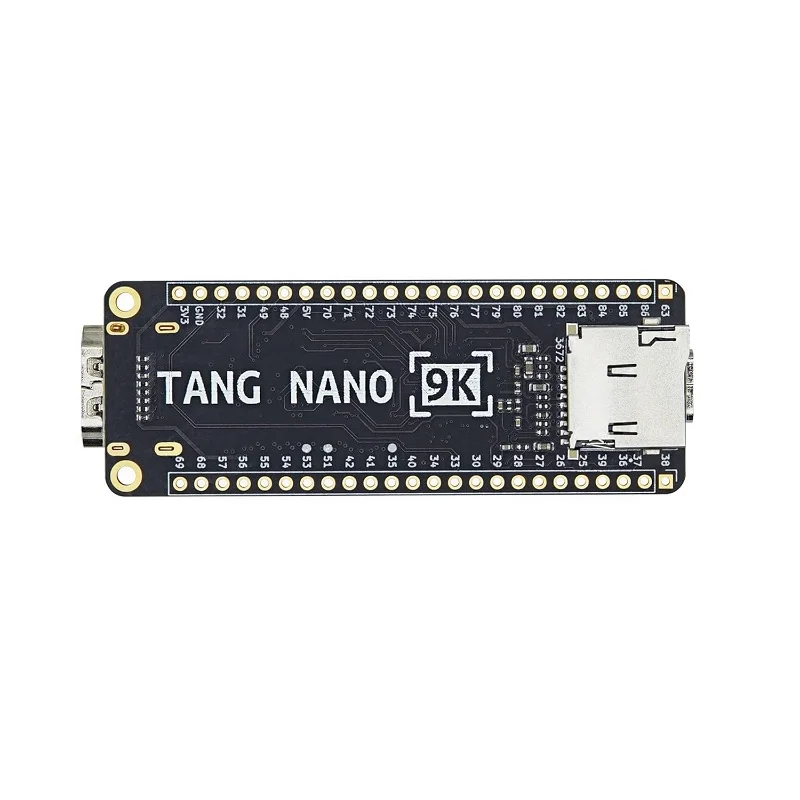
The board natively supports HDMI, parallel RGB, and SPI screen interfaces. For HDMI, use a standard HDMI cable connected to the micro HDMI port. For RGB or SPI displays, solder the provided 24-pin headers and connect your display module to the corresponding GPIO pins as defined in the board's pinout diagram. You will need to configure the FPGA's I/O constraints and implement the correct display controller IP or logic in your design.

Can I run a RISC-V processor on this FPGA, and what resources are available?

Yes, the Tang Nano 9K's 8640 LUTs and substantial block RAM are sufficient to implement a soft-core RISC-V processor like PicoRV. You will need to integrate the processor core within your Gowin EDA project, connect it to the onboard SDRAM controller for memory, and map its peripherals to the board's GPIO, UART, or other interfaces. Example projects and constraints files are often provided by the community to accelerate this process.

Package Includes

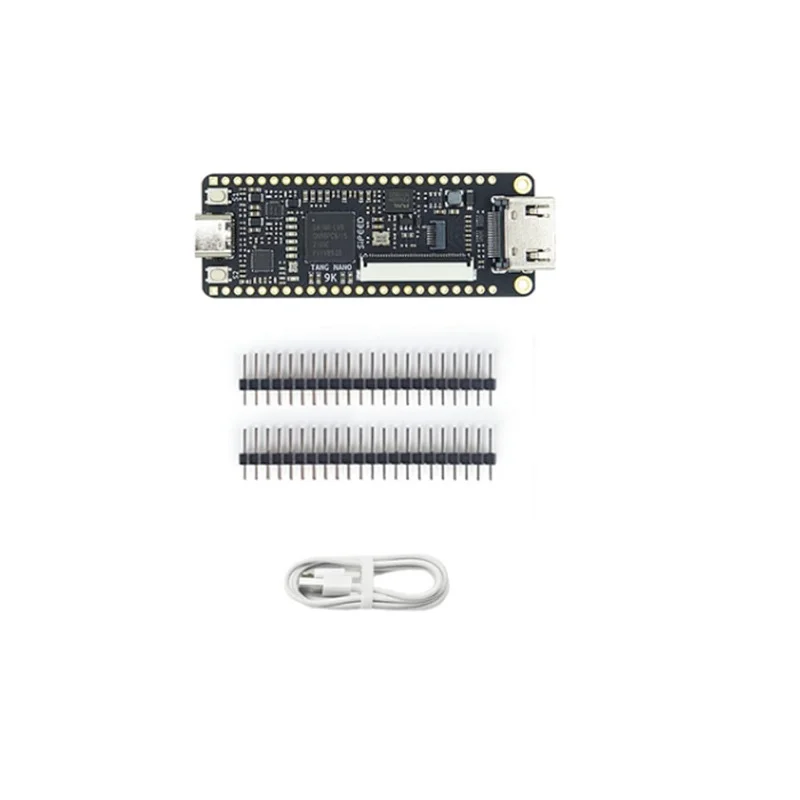
  • 1 x Sipeed Tang Nano 9K Core Board
  • 1 x Type-C Data Cable
  • 2 x 24-pin Header (2.54mm)

Additional Information

Weight 0.05 kg
Dimensions 9 × 6 × 4 cm