SKU: IOWC-0185
📋 GST Invoice Available

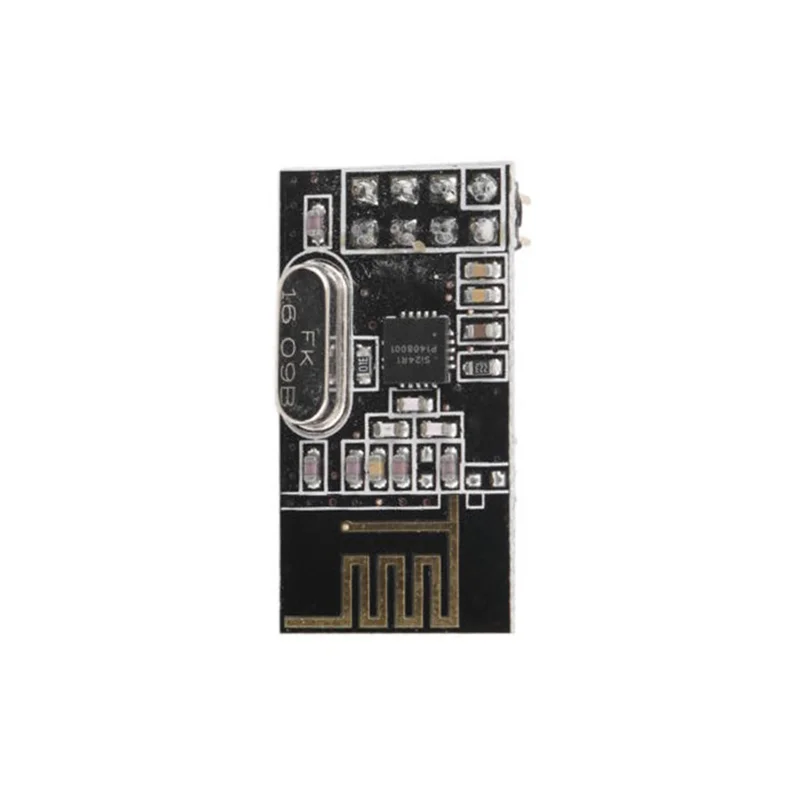
NRF24L01 2.4GHz Wireless Transceiver Module

₹67.00 (Inclusive of all taxes)
Out of Stock

The M177 NRF24L01 is a 2.4GHz ISM band RF transceiver module offering 2Mbps data rates and ultra-low power operation, ideal for SPI-based wireless control and sensor networks interfacing with Arduino, Raspberry Pi, or STM32 microcontrollers.

Features

  • Ultra-low power 2.4GHz transceiver operates from 1.9V to 3.6V with only 1µA current in power-down mode for battery-powered IoT nodes.
  • High-speed 2Mbps GFSK modulation with 125 channels and hardware CRC ensures reliable, interference-resistant data links for industrial control.
  • Integrated PCB antenna and on-board voltage regulator simplify design, requiring only an SPI interface and minimal external components.
  • Standard DIP-pitch pin header enables direct plug-in to breadboards or solderless connection for rapid prototyping and embedded applications.
  • Multi-point communication with address control and frequency hopping supports scalable wireless mesh or star network topologies.

Out of stock

Description

The M177 module integrates the Nordic Semiconductor Semiconductor nRF24L01+ RF IC into a compact, ready-to-use transceiver board. It provides a complete 2.4GHz wireless solution with an embedded PCB antenna, voltage regulator, and all necessary passive components, delivering robust performance for short-range data links up to 2Mbps. The module’s GFSK modulation and hardware CRC deliver strong anti-interference characteristics suitable for electrically noisy industrial environments.

Communication is managed via a simple 4-wire SPI interface, making it directly compatible with most microcontrollers like Arduino, ESP32, STM32, and Raspberry Pi. The ultra-low power architecture, featuring multiple power-down and standby modes, is engineered for years of operation on coin-cell or small LiPo batteries in remote sensor applications. Its standard DIP footprint allows for easy integration into existing designs without complex RF layout considerations.

Key Features

  • Ultra-Low Power RF Transceiver: Optimized for battery-operated IoT nodes with a wide 1.9V–3.6V supply range and deep sleep currents as low as 1µA.
  • High-Speed 2Mbps Data Rate: Enables fast data transfer for control signals, sensor telemetry, or digital audio streaming using efficient GFSK modulation.
  • Enhanced Interference Immunity: 125 selectable channels and built-in frequency hopping spread spectrum (FHSS) combat Wi-Fi and Bluetooth congestion.
  • Hardware-Based Error Handling: Integrated CRC generation and checking improves data integrity without burdening the host microcontroller's CPU.
  • Plug-and-Play Connectivity: On-board PCB antenna and 3.3V regulator eliminate external matching circuits and provide a stable power supply.
  • Multi-Node Network Support: Configurable 5-byte addresses enable point-to-point, star, or mesh networks with up to 6 simultaneous data pipes.
  • Developer-Friendly Interface: Standard SPI protocol with interrupt pin allows for straightforward integration with popular development frameworks and libraries.

Applications

  • Wireless Sensor Networks: Deploy for environmental monitoring (temperature, humidity, PIR motion) in smart homes, agriculture, or industrial telemetry.
  • Remote Control Systems: Implement in DIY RC models, drone telemetry, robotic controllers, or industrial machine remote command links.
  • IoT Device Connectivity: Create low-power mesh networks for smart lighting, battery-operated switches, or asset tracking beacons.
  • Wireless Data Logging: Transfer data from remote data loggers or portable measurement equipment to a central gateway.
  • HMI and Gaming Peripherals: Develop custom wireless keyboards, game controllers, or human-machine interface devices.

Technical Specifications

RF Transceiver ICNordic Semiconductor nRF24L01+
Wireless Protocol2.4GHz ISM Band
Frequency Range2400–2525 MHz
Data RateUp to 2 Mbps
RF Output Power0 dBm (Typical)
Supply Voltage1.9 – 3.6 VDC
Operating Current~11.3 mA at 0 dBm output
Power-Down Current~1 µA
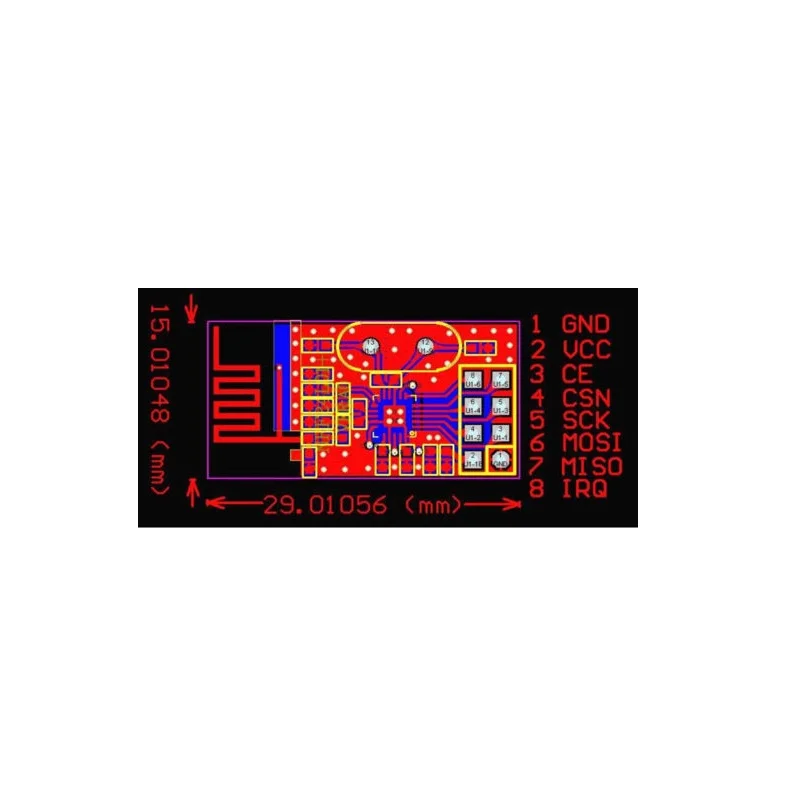
InterfaceSPI (CE, CSN, SCK, MOSI, MISO, IRQ)
AntennaIntegrated PCB Antenna
ModulationGFSK
Channels125
Dimensions15 mm x 15 mm (Estimated)

Frequently Asked Questions

How do I interface the NRF24L01 module with an Arduino Uno?

Connect the module's VCC (3.3V), GND, CE, CSN, SCK, MOSI, and MISO pins to the Arduino's corresponding 3.3V power, ground, and digital pins (e.g., pins 7, 8, 13, 11, 12). Use the RF24 library by installing it via the Arduino IDE Library Manager. Initialize the radio object in your sketch, set the channel, data rate, and payload size. Ensure your power supply is stable, as the module is sensitive to voltage noise during transmission.

What is the typical outdoor line-of-sight range of this module?

With the integrated PCB antenna and default 0 dBm output power, expect a reliable range of approximately 30-100 meters in open, line-of-sight conditions. Range is significantly reduced by obstacles like walls or interference from Wi-Fi networks. For extended range, you can solder an external 2.4GHz antenna (with proper impedance matching) to the designated pad, which may improve performance. Using lower data rates (250kbps) instead of 2Mbps also increases link margin and effective range.

Can I use this module to create a multi-point network with several nodes?

Yes, the nRF24L01+ IC supports multi-point communication through its 6 data pipe architecture. Configure one module as a Primary Receiver (PRX) with up to 6 unique addresses for its data pipes. Other modules act as Primary Transmitters (PTX), each transmitting to a specific pipe address on the PRX. Use the RF24Network or RF24Mesh libraries to simplify managing such star or mesh network topologies, handling acknowledgments, and retransmissions automatically.

What are the power requirements and how do I minimize current consumption?

Supply the module with a clean 1.9V to 3.6V DC source; the on-board regulator provides 1.8V to the IC. Current draw peaks at ~11.3mA during transmission at 0dBm. To minimize consumption, leverage the chip's power modes: set it to POWER_DOWN mode (1µA) when idle for long periods, use standby-I (~26µA) between quick transactions, and ensure your microcontroller puts the module's CE pin low when not actively transmitting or receiving. Power cycling via the VCC pin is not recommended.

Package Includes

  • 1 x M177 NRF24L01 2.4GHz Antenna Wireless Transceiver Module

Additional Information

Weight 0.002 kg
Dimensions 1.5 × 1.5 cm