SKU: IOWC-1749
📋 GST Invoice Available

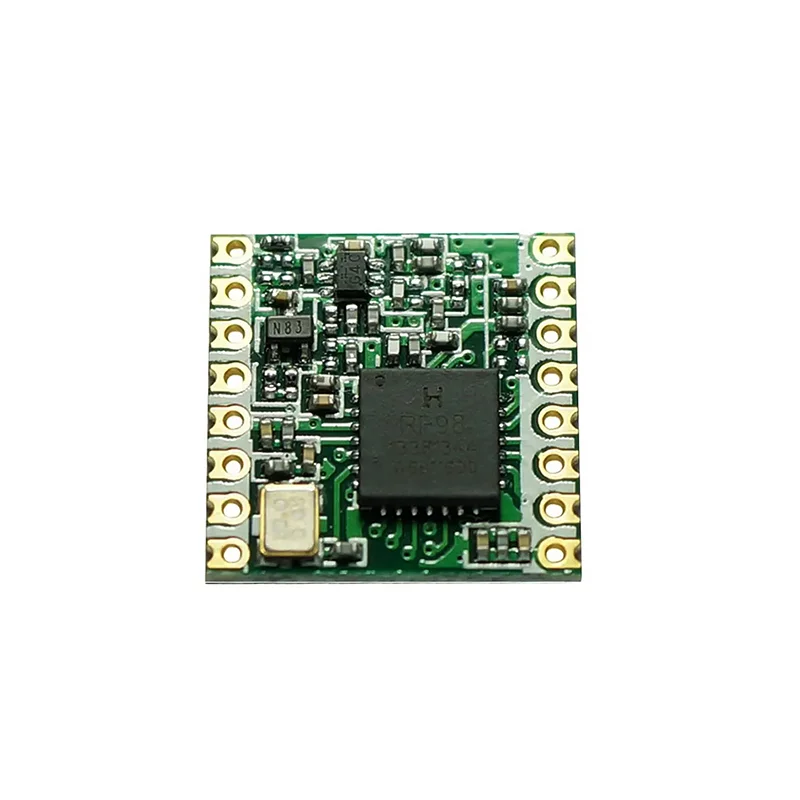
HopeRF RFM98W-433S2R LoRa Module 433MHz

₹729.00 (Inclusive of all taxes)
Out of Stock

The HopeRF RFM98W-433S2R is a 433MHz LoRa transceiver module featuring Semtech’s long-range spread spectrum modem for ultra-low power, high-interference immunity communication in IoT sensor networks, compatible with Arduino and other MCU platforms.

Features

  • Ultra-long range LoRa modem achieving sensitivity down to -144 dBm for robust communication in challenging RF environments.
  • Integrated +14 dBm high-efficiency power amplifier (PA) for strong signal transmission while maintaining low current consumption.
  • Supports multiple modulation schemes including LoRa, (G)FSK, MSK, GMSK, and OOK for flexible protocol compatibility (e.g., WMBus, IEEE 802.15.4g).
  • Low power operation with 10.3 mA RX current and 200 nA register retention sleep current, ideal for battery-powered remote sensors.
  • Compact 16x16mm form factor with built-in packet engine (256-byte FIFO with CRC), temperature sensor, and automatic channel activity detection (CAD).

Out of stock

Description

The RFM98W-433S2R transceiver module from HopeRF implements Semtech’s LoRa modulation technology, providing a robust, long-range communication link for IoT deployments. Its architecture delivers exceptional phase noise, selectivity, and receiver linearity, resulting in industry-leading link budget performance. The module is designed for ultra-low power consumption, featuring fast wake-up times and deep sleep modes to maximize battery life in field applications.

Engineered for reliability, the module offers excellent blocking immunity and a bullet-proof RF front end with an IIP3 of -12.5 dBm, ensuring stable operation even in noisy spectral environments. The fully integrated frequency synthesizer with 61 Hz resolution allows for precise channel control. Its comprehensive feature set, including preamble detection, automatic RF sensing, and AFC, simplifies firmware development for secure, long-range telemetry systems.

Key Features

  • Implements Semtech LoRa long-range spread spectrum modem for exceptional range and interference immunity.
  • High-efficiency +14 dBm integrated power amplifier maximizes transmission distance while optimizing power usage.
  • Ultra-low current consumption with 10.3 mA during active reception and 200 nA in sleep mode for battery-operated designs.
  • Programmable data rate up to 300 kbps and support for FSK, GFSK, MSK, GMSK, LoRa, and OOK modulations.
  • Built-in packet engine handles up to 256-byte payloads with hardware CRC for reliable data framing.
  • Integrated features include automatic Channel Activity Detection (CAD), a temperature sensor, and a low-battery indicator.
  • Compact 16x16mm surface-mount module (SMD) footprint for space-constrained PCB designs.

Applications

  • Automated Meter Reading (AMR) and smart utility metering networks.
  • Home and building automation systems for sensor and control data backhaul.
  • Wireless alarm, security, and environmental monitoring systems.
  • Industrial monitoring and control (IIoT) for telemetry and sensor data aggregation.
  • Long-range agricultural applications such as irrigation control and soil monitoring.
  • Asset tracking and remote sensor networks in logistics and supply chain management.

Technical Specifications

Wireless ProtocolLoRa, FSK, GFSK, MSK, GMSK, OOK
Frequency Range433 MHz
RF Transmit PowerUp to +14 dBm
Receiver SensitivityDown to -144 dBm (LoRa)
Supply VoltageMax 3.7V
Operating Current (RX)10.3 mA
Sleep Current (Register Retention)200 nA
InterfacesSPI
Packet Engine256-byte FIFO with CRC
Operating Temperature-20°C to +70°C
Dimensions (LxW)16 x 16 mm

Frequently Asked Questions

How do I interface the RFM98W module with an Arduino or ESP32 microcontroller?

The RFM98W module communicates via an SPI interface. Connect the module's SCK, MISO, MOSI, and NSS pins to the corresponding SPI pins on your microcontroller (e.g., Arduino Uno: pins 13, 12, 11, and a digital pin for NSS). Use a library like RadioHead or LoRa by Sandeep Mistry to handle the SPI protocol and LoRa modulation. Ensure you provide a stable 3.3V power supply and properly initialize the SPI bus and chip select pin in your setup() function before sending configuration registers or data packets.

What is the typical wiring and power supply setup for this LoRa module?

Power the RFM98W module with a regulated 3.3V supply connected to VCC and GND pins, ensuring it does not exceed the maximum 3.7V. Decoupling capacitors (e.g., 10uF and 100nF) placed close to the module's power pins are recommended for stability. For SPI connections, use short wires to minimize noise. The NRESET pin can be connected to a GPIO for hardware resets. An external 433MHz antenna must be connected via a matching network; a simple quarter-wave wire antenna (~16.5cm) can be used for testing, but a proper 50-ohm antenna with matching connector is advised for optimal range.

What are the key configuration steps for setting up the RFM98W for LoRa communication?

First, initialize the SPI bus and set the NSS pin as an output. Perform a hardware reset by toggling the NRESET pin. Then, write configuration values to the module's registers via SPI. Essential settings include selecting LoRa mode (RegOpMode), setting the carrier frequency (RegFrMsb/Mid/Lsb for 433MHz), configuring bandwidth, spreading factor, and coding rate (RegModemConfig), and setting the output power (RegPaConfig). Enable CRC checking (RegModemConfig2) and set the preamble length. Finally, put the module in standby mode, write your payload to the FIFO, and switch to TX mode to transmit. For reception, set the module to RX continuous or single mode and read the FIFO upon interrupt.

Package Includes

  • 1 x HopeRF RFM98W-433S2R LoRa Module

Additional Information

Weight 0.01 kg
Dimensions 1.6 × 1.6 cm