SKU: IOWC-1750
📋 GST Invoice Available

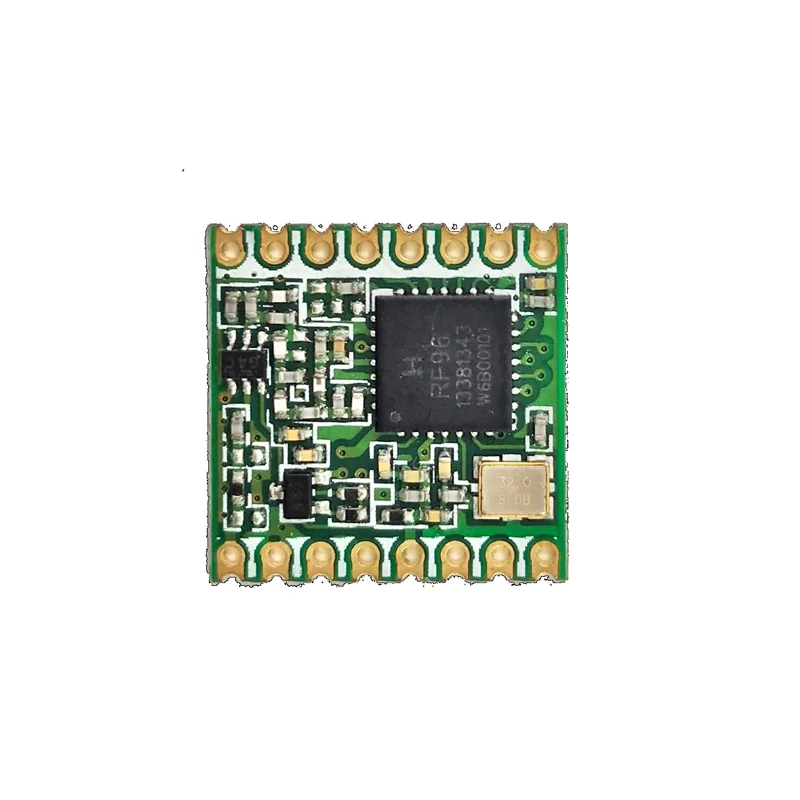
HopeRF RFM95W-915S2R LoRa Module

₹849.00 (Inclusive of all taxes)
Out of Stock

The HopeRF RFM95W-915S2R is a 915MHz LoRa transceiver module featuring Semtech’s long-range modem for ultra-long-range, low-power wireless communication, compatible with FSK, GFSK, and LoRa modulation schemes.

Features

  • Ultra-long-range LoRa modem with a maximum link budget of 164 dB for exceptional penetration and reach.
  • High-efficiency +14 dBm power amplifier combined with sensitivity down to -144 dBm ensures robust communication links.
  • Low power consumption with just 10.3 mA RX current and 200 nA register retention current for battery-operated IoT nodes.
  • Supports multiple modulations including FSK, GFSK, MSK, GMSK, LoRa, and OOK for flexible protocol integration.
  • Integrated packet engine with CRC, preamble detection, and automatic Channel Activity Detection (CAD) for simplified firmware development.

Out of stock

Description

The RFM95W-915S2R module integrates Semtech’s SX1276 LoRa transceiver chip, providing a complete RF front-end solution for sub-GHz ISM band applications. Its LoRa modulation technique enables spread spectrum communication with high interference immunity and significantly extended range compared to conventional FSK, all while maintaining minimal current draw. The module’s excellent receiver linearity and blocking immunity make it resilient in noisy RF environments.

Designed for low-power operation, the module features multiple sleep modes and a built-in temperature sensor, making it ideal for remote, battery-powered sensing and telemetry. The integrated +14 dBm PA eliminates the need for external amplification in most scenarios. Its programmable bit rate up to 300 kbps and support for standard FSK protocols like WM-Bus and IEEE 802.15.4g offer versatility for both proprietary and standardized wireless networks.

Key Features

  • Semtech SX1276-based LoRa long-range spread spectrum modem.
  • Industry-leading 164 dB maximum link budget for exceptional range.
  • High interference immunity and excellent blocking performance.
  • Integrated packet engine with CRC, up to 256-byte FIFO, and address filtering.
  • Automatic RF Sense, Channel Activity Detection (CAD), and fast AFC.
  • Built-in temperature sensor and low-battery voltage indicator.
  • Supports FSK, GFSK, MSK, GMSK, LoRa, and OOK modulation for protocol flexibility.
  • Ultra-low power consumption with programmable operating modes.

Applications

  • Automated Meter Reading (AMR) and smart utility networks.
  • Home and building automation sensors and controls.
  • Wireless alarm, security, and environmental monitoring systems.
  • Industrial telemetry, monitoring, and control (IIoT).
  • Long-range agricultural and irrigation system monitoring.
  • Asset tracking and fleet management in logistics.

Technical Specifications

Transceiver ICSemtech SX1276 (RFM95W)
Wireless ProtocolLoRa, FSK, GFSK, MSK, GMSK, OOK
Frequency Range915 MHz (ISM Band)
RF Output PowerUp to +14 dBm (High-Efficiency PA)
Receiver SensitivityDown to -144 dBm (LoRa)
Supply Voltage1.8V to 3.7V
Operating Current (RX)10.3 mA
Sleep Current (Register Retention)200 nA
InterfaceSPI
Antenna ConnectorPCB Pad / Solder Point
Operating Temperature-20°C to +70°C
Dimensions16 mm x 16 mm (approx.)

Frequently Asked Questions

What microcontroller interface does the RFM95W module use, and how do I connect it?

The RFM95W module communicates via a standard 4-wire SPI interface (MOSI, MISO, SCK, NSS/CS). You must connect these pins to your host microcontroller's SPI peripheral, ensuring the NSS pin is configured as a GPIO output for chip selection. Additionally, connect the RESET and DIO0-DIO5 pins as needed for interrupt-driven operation and hardware reset. Proper power supply decoupling with a 1uF and 100nF capacitor near the module's VCC pin is critical for stable RF performance.

How do I configure the module's frequency and LoRa parameters like spreading factor and bandwidth?

Configuration is performed via SPI register writes. First, put the module in Sleep mode, then set the OpMode register to LoRa mode. Key parameters like carrier frequency (set for 915 MHz), spreading factor (SF7 to SF12), bandwidth (125 kHz, 250 kHz, etc.), and coding rate are written to specific registers (e.g., Frf, ModemConfig1/2/3). Use established libraries like RadioLib or the Semtech reference driver to simplify this process. Always calibrate the RC oscillator and perform a full calibration sequence after initial power-up or frequency changes.

What is the typical current consumption in TX and deep sleep modes?

Current consumption varies with output power and mode. In transmit mode at +14 dBm output, expect approximately 85-100 mA peak current. In continuous receive (Rx Single) mode, consumption is around 10-12 mA. For lowest power, use Sleep mode, where the core shuts down but SPI registers are retained, drawing about 200 nA. To achieve microamp-level sleep, you can physically power down the module using a MOSFET switch, as the deep sleep current with power applied is in the range of 1-2 uA.

What antenna should I use, and how do I match the impedance for the 915MHz band?

Use a 915 MHz antenna with a 50-ohm impedance, such as a quarter-wave whip or PCB trace antenna. The module's RF output is designed for 50 ohms. For optimal performance, keep the antenna feed line as short as possible. If using a cable, ensure it is 50-ohm RF coaxial (like RG174). A matching network (typically an LC pi-network) may be required between the module's RF pad and the antenna connector to fine-tune return loss (VSWR), which can be designed using an RF simulator or a vector network analyzer for best efficiency.

Package Includes

  • 1 x HopeRF RFM95W-915S2R LoRa Module

Additional Information

Weight 0.01 kg
Dimensions 1.6 × 1.6 cm