SKU: IOWC-1610
📋 GST Invoice Available

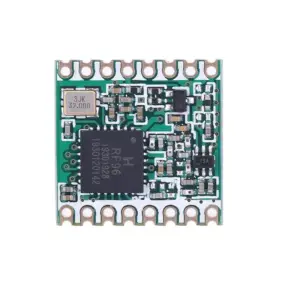
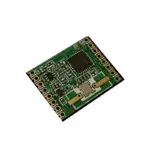
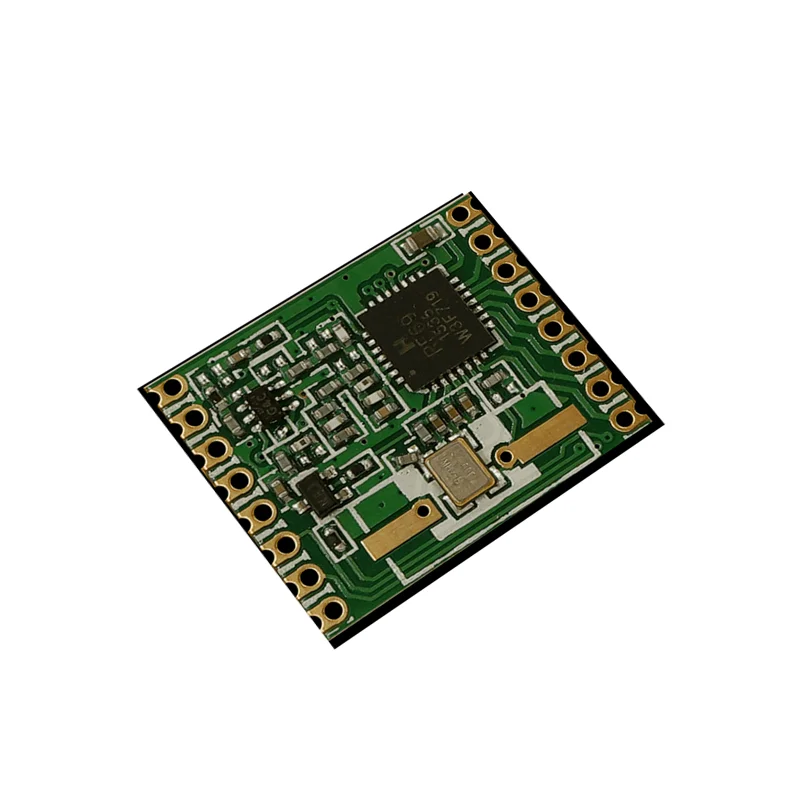
HopeRF RFM69HW-915S2 Sub-1GHz RF Transceiver Module

₹279.00 (Inclusive of all taxes)
Out of Stock

The HopeRF RFM69HW-915S2 is a high-performance, license-free 915MHz ISM band transceiver module, ideal for building robust, low-power wireless sensor networks and industrial telemetry systems using FSK/GFSK modulation.

Features

  • 915MHz ISM Band Transceiver: Operates in the license-free 915MHz frequency band, suitable for long-range wireless sensor networks and industrial monitoring.
  • High RF Output Power: Programmable output power from -18 dBm to +20 dBm, with up to 20 dBm at 3.3V for extended communication range.
  • Ultra-Low Power Consumption: Features a low 16 mA receive current and a deep sleep mode with 100 nA register retention for battery-powered IoT nodes.
  • Advanced Packet Engine: Built-in 66-byte FIFO, CRC-16, and AES-128 encryption for secure, reliable data transmission with automatic sync word recognition.
  • Robust RF Performance: High sensitivity down to -120 dBm at 1.2 kbps and a bullet-proof front end (IIP3 = -18 dBm) for stable operation in noisy RF environments.

Out of stock

Description

The HopeRF RFM69HW-915S2 is a fully integrated sub-1GHz RF transceiver module designed for demanding wireless telemetry and control applications. Its core RF69H chip provides programmable narrow-band and wide-band communication modes, offering flexibility for various data rate and range requirements. The module delivers constant RF performance across a wide supply voltage range from 1.8V to 3.6V, making it compatible with both 3.3V and lower-voltage battery systems.

Engineered for low-power operation, the module supports multiple modulation schemes including FSK, GFSK, MSK, GMSK, and OOK, with bit rates up to 300 kb/s. Its integrated synthesizer with 61 Hz resolution and a 16-tap FIR channel filter ensures high selectivity and stable frequency operation. The built-in temperature sensor and automatic RF sense with ultra-fast AFC further enhance system reliability for industrial IoT deployments in varying environmental conditions.

Key Features

  • Operates on the global 915MHz ISM band for license-free deployment.
  • Supports FSK, GFSK, MSK, GMSK, and OOK modulations for flexible protocol design.
  • Integrated packet engine with 66-byte FIFO, hardware CRC-16, and AES-128 encryption.
  • Built-in bit synchronizer for clock recovery and automatic sync word recognition.
  • High dynamic range RSSI (115 dB+) for accurate link quality assessment.
  • Programmable RF output power in 1 dB steps from -18 dBm to +20 dBm.
  • Ultra-low sleep current (100 nA) for long battery life in sensor nodes.
  • Compliant with FCC and ETSI regulations for commercial use.

Applications

  • Wireless Sensor Networks (WSN) for environmental monitoring (temperature, humidity, pressure).
  • Home and Building Automation systems for lighting, HVAC, and security control.
  • Industrial Monitoring and Control (IIoT) for telemetry and machine data acquisition.
  • Automated Meter Reading (AMR) for utility consumption tracking.
  • Wireless Alarm and Security Systems for intrusion detection and alerts.
  • Wireless M-BUS implementations for smart metering infrastructure.

Technical Specifications

Wireless ProtocolSub-1GHz RF (FSK/GFSK/MSK/GMSK/OOK)
Operating Frequency915 MHz
RF Output Power-18 dBm to +20 dBm (Programmable)
Receiver Sensitivity-120 dBm (at 1.2 kbps)
Supply Voltage1.8V - 3.6V
Operating Current (Rx)16 mA
Sleep Current100 nA (Register Retention)
Maximum Data Rate300 kb/s
ModulationFSK, GFSK, MSK, GMSK, OOK
Crystal Frequency32 MHz
Operating Temperature-20°C to +70°C
DimensionsApprox. 5 x 4 x 1 cm

Frequently Asked Questions

What is the typical wiring and power supply setup for the RFM69HW-915S2 module?

Connect VCC to a stable 1.8V to 3.6V DC power source, with GND to common ground. Decoupling capacitors (e.g., 10uF and 0.1uF) placed close to the power pins are recommended for noise suppression. The module's SPI interface pins (MISO, MOSI, SCK, NSS) must be connected to your microcontroller's corresponding SPI pins. An external 915MHz antenna with a 50-ohm impedance should be connected via a matching network for optimal RF performance. Ensure all unused GPIOs are configured as inputs or pulled to a known state.

How do I configure the RF output power and data rate using the module's registers?

Output power is set via the PaLevel register (0x11), where values correspond to specific dBm levels from -18 to +20. The data rate is configured in the BitRateMsb and BitRateLsb registers (0x03, 0x04), calculated as FXOSC / BitRate. For FSK modulation, set the Fdev registers (0x05, 0x06) for frequency deviation. Always initialize the SPI interface at a low speed (under 10 MHz) before writing to configuration registers. Use the library provided by your platform (like RadioHead for Arduino) which abstracts these low-level register writes into simple function calls.

What are the key considerations for antenna selection and matching for the 915MHz band?

Select a 50-ohm antenna tuned for the 915MHz ISM band, such as a quarter-wave whip or PCB trace antenna. The module requires an external matching network (typically an LC circuit) between its RF output pin and the antenna connector to maximize power transfer and meet harmonic emission standards. Keep antenna feed lines short to minimize loss. For best range, use an antenna with appropriate gain, considering the module's +20dBm output power complies with regulatory limits. Always verify your final design meets local RF emission regulations (FCC/ETSI) for conducted and radiated power.

Package Includes

  • 1 x HopeRF RFM69HW-915S2 RF Transceiver Module

Additional Information

Weight 0.01 kg
Dimensions 4 × 5 × 1 cm