SKU: IOWC-1650
📋 GST Invoice Available

FS1000A 433MHz Tx & Rx RF Radio Module Pair

₹89.00 (Inclusive of all taxes)
Out of Stock

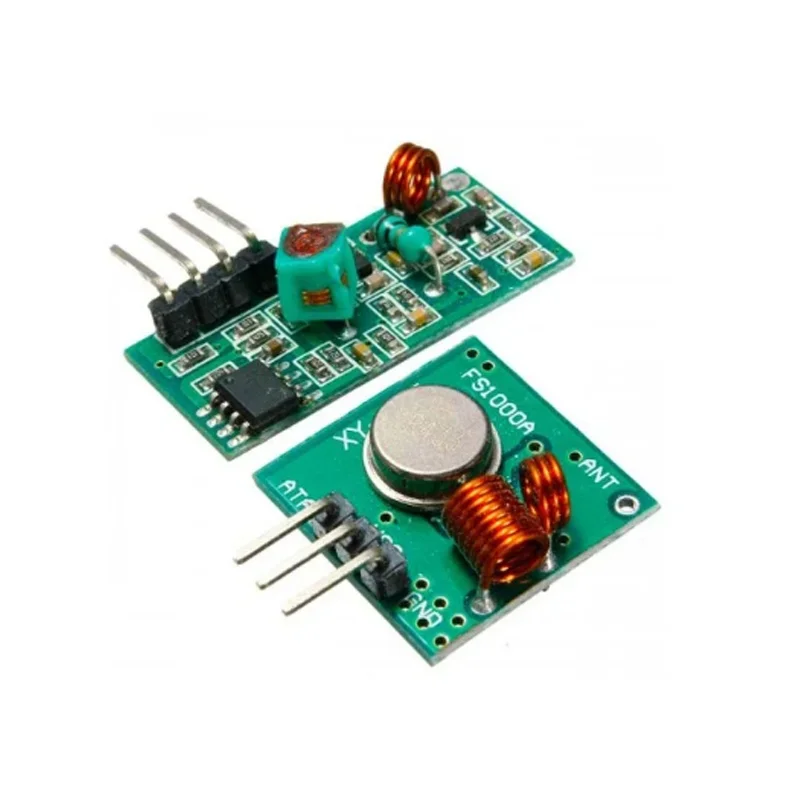
The FS1000A is a low-cost 433MHz RF transmitter and receiver module pair for simple wireless data links up to 500m, ideal for Arduino, Raspberry Pi, and DIY IoT projects requiring basic remote control or telemetry.

Features

  • 433MHz Transceiver Pair: Includes a transmitter and receiver module operating at 433.92MHz/315MHz for simple, license-free ISM band communication.
  • Long-Range Transmission: Achieves over 500 meters of open-air transmission distance with a 16dBm (40mW) output power, suitable for remote sensing.
  • Wide Voltage Compatibility: Transmitter operates from 3-12V DC, while the receiver runs on 5V, making it adaptable for both battery-powered and regulated power supply projects.
  • Low Power Consumption: Receiver draws only 4mA static current, and the transmitter enters 0mA standby when the Data pin is grounded, perfect for battery-operated devices.
  • Easy 3-Wire Interface: Simple VCC, GND, and Data pin integration allows quick connection to microcontrollers like Arduino, ESP8266, or STM32 for serial data transmission.

Out of stock

Description

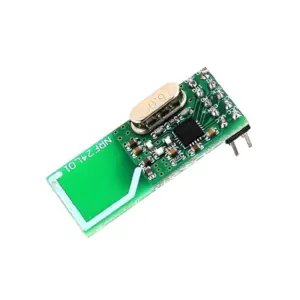
The FS1000A 433MHz RF module pair provides a fundamental wireless communication link for embedded systems and IoT prototypes. The transmitter accepts serial data from a microcontroller and modulates it onto a 433MHz carrier wave, broadcasting it via an attached wire antenna. The companion receiver, tuned to the same frequency, demodulates the incoming signal and outputs the original serial data stream.

This ASK (Amplitude Shift Keying) modulated transceiver operates in the global 433MHz ISM band, offering a balance between range and power consumption. Its straightforward three-pin interface (Power, Ground, Data) eliminates complex configuration, enabling rapid integration for remote control, sensor data telemetry, or simple wireless triggers. The modules are designed for robust performance in varied environments, though the effective range is influenced by antenna design, obstructions, and local RF noise.

Key Features

  • Dual-Frequency Operation: Supports both 433.92MHz and 315MHz frequencies, selectable via module variant, for regional ISM band compliance.
  • Integrated Sleep Mode: Grounding the transmitter's Data pin puts the device into a zero-current deep sleep state, drastically extending battery life in intermittent transmission scenarios.
  • High Receiver Sensitivity: With a sensitivity of -105dB, the receiver can reliably decode weak signals, enhancing effective communication range in suboptimal conditions.
  • Compact Form Factor: The small footprint (approx. 30x14x9mm for receiver) allows for embedding into space-constrained enclosures and portable devices.
  • Includes Wire Antennas: Each module comes with a 32cm spiral wire antenna, providing a basic radiating element for immediate testing and deployment.
  • Simple Serial Data Interface: Directly connects to microcontroller UART TX/RX pins or general-purpose digital I/O for bit-banged communication, requiring minimal firmware overhead.

Applications

  • Remote Control Systems: For garage door openers, wireless switches, and DIY RC vehicles.
  • Wireless Sensor Networks: Transmitting temperature, humidity, or door/window status from battery-powered nodes.
  • Simple Telemetry Links: Sending data from remote weather stations or agricultural sensors to a central logger.
  • Home Automation Triggers: Creating wireless push buttons or motion sensor triggers for smart home projects.
  • Educational & Prototyping: Learning basic RF principles and building first wireless projects with Arduino or Raspberry Pi.

Technical Specifications

Wireless ProtocolASK/OOK RF
Frequency Range433.92 MHz, 315 MHz (Selectable)
RF Transmit Power16 dBm (40 mW)
Receiver Sensitivity-105 dB
Data RateUp to 10 Kbps
Transmitter Supply Voltage3 - 12 V DC
Receiver Supply Voltage5 V DC
Transmitter Operating Current20 - 28 mA
Receiver Static Current4 mA
InterfacesVCC, GND, DATA (3-pin)
Antenna ConnectorSolder pad for wire antenna
Dimensions (Tx approx.)19 x 19 x 8 mm
Dimensions (Rx approx.)30 x 14 x 9 mm

Frequently Asked Questions

How do I connect the FS1000A modules to an Arduino Uno for basic communication?

Connect the transmitter's VCC to 3.3V or 5V (for lower power, use 3.3V), GND to GND, and DATA to a digital pin (e.g., D12). For the receiver, connect VCC to 5V, GND to GND, and DATA to another digital pin (e.g., D11). Use a library like VirtualWire or RCSwitch to handle the ASK modulation. Ensure you attach the provided wire antennas to the ANT pads. The transmitter voltage affects range; higher voltage (up to 12V) increases output power and distance. (49 words)

What is the effective real-world range I can expect from these modules?

The advertised 500m range is achievable in open, line-of-sight conditions with ideal antenna positioning. In typical urban or indoor environments with walls and interference, expect 20-100m. Range is maximized by using a proper quarter-wave antenna (17.3cm for 433MHz), elevating modules, avoiding noise sources like USB cables, and running the transmitter at a higher voltage (e.g., 9V or 12V). The receiver's -105dB sensitivity helps pick up weak signals. For reliable links, design for a shorter operational distance. (50 words)

Can I use these modules to transmit data between two microcontrollers (like Arduino and ESP32)?

Yes, you can establish a wireless serial link. Configure one microcontroller with the transmitter and the other with the receiver. Use the same data encoding library on both ends (like VirtualWire) and ensure they are set to the same baud rate (typically 1-10 Kbps). Remember the ESP32's logic level is 3.3V. While the receiver requires 5V, its DATA pin output is 5V logic. Use a simple voltage divider or logic level converter to safely connect the receiver's DATA pin to the ESP32's GPIO to prevent damage. (50 words)

How do I implement the deep sleep feature on the transmitter to save battery?

The transmitter enters a zero-current sleep mode when its DATA pin is pulled and held to ground. In your circuit, connect this pin to a microcontroller GPIO. Set the GPIO to OUTPUT and HIGH when you need to transmit data. After transmission is complete, set the GPIO to OUTPUT and LOW to ground the DATA pin, putting the transmitter to sleep. This is crucial for battery-powered sensor nodes that only send data periodically, dramatically reducing average current consumption. (50 words)

Package Includes

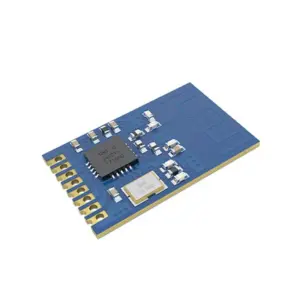
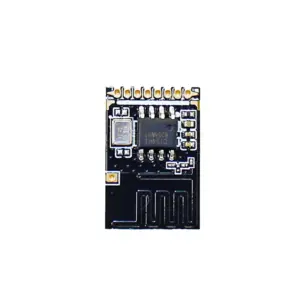
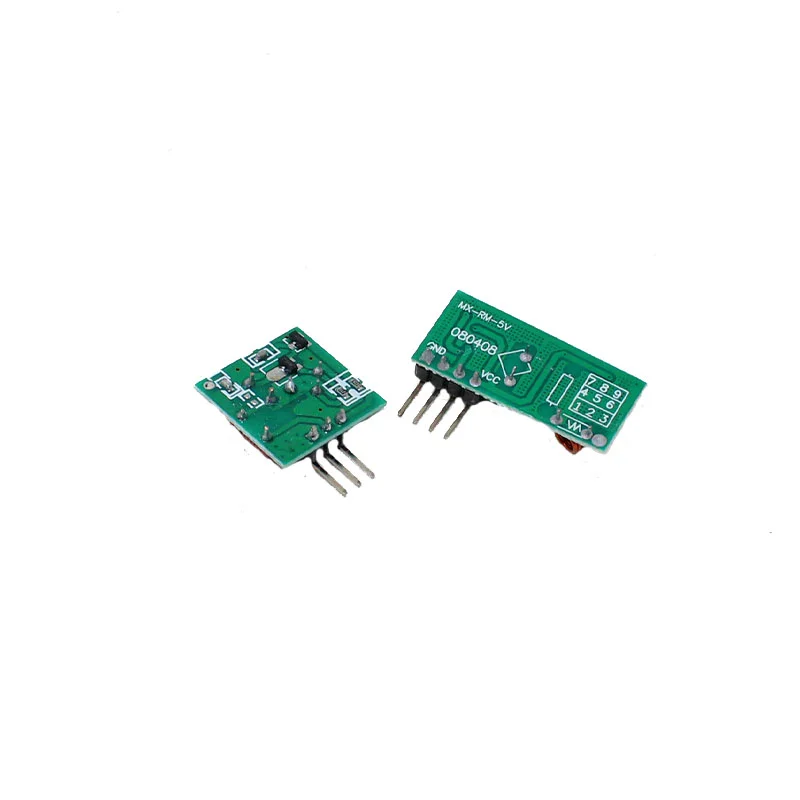
  • 1 x FS1000A 433MHz Transmitter Module
  • 1 x FS1000A 433MHz Receiver Module
  • 2 x 32cm Wire Antennas (Spiral)

Additional Information

Weight 0.06 kg
Dimensions 5 × 5 × 3 cm