SKU: SENS-0681
📋 GST Invoice Available

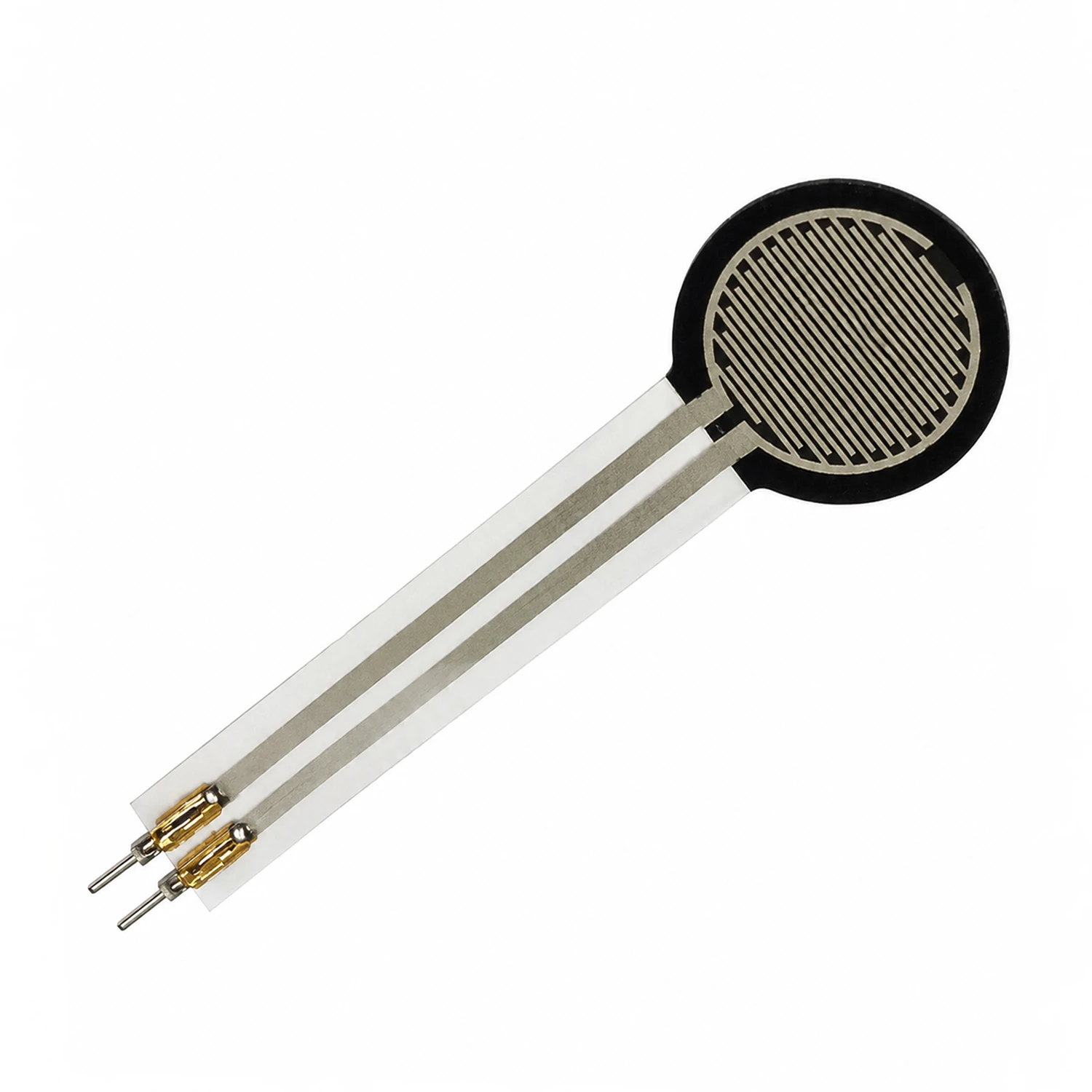
SOUSHINE FSR411 7.5mm Force Sensing Resistor (50g-10kg)

₹229.00 (Inclusive of all taxes)
Out of Stock

The SOUSHINE FSR411 is a 7.5mm diameter thin-film force sensing resistor (FSR) with a sensing range from 50g to 10kg, designed for integration into low-voltage microcontroller systems like Arduino, Raspberry Pi, and ESP32 for precise force and pressure detection.

Features

  • 7.5mm active sensing area with ultra-thin 0.3mm profile for unobtrusive integration.
  • Wide force sensing range from 50 grams up to 10 kilograms.
  • High initial resistance (>10MΩ) for low power consumption and high sensitivity.
  • Rated for over 1 million actuations, ensuring long-term reliability.
  • Operates with typical 3.3V DC test voltage for direct MCU compatibility.

Out of stock

Description

The FSR411 is a piezoresistive force sensor whose resistance decreases predictably with an increase in applied force. This analog output provides a variable voltage signal when used in a simple voltage divider circuit, making it ideal for detecting pressure, weight, or touch in embedded systems.

Constructed with a durable, flexible polymer thick film, the sensor is designed for repeated use in applications requiring compact size and high sensitivity. Its ultra-thin form factor allows for mounting in tight spaces where traditional load cells or switches cannot fit.
Key Features

  • Ultra-Thin Flexible Design: A mere 0.3mm thickness enables seamless integration into wearable devices, control panels, and slim enclosures.
  • High Sensitivity Range: Accurately measures forces from light touch (50g) up to substantial loads (10kg).
  • Excellent Durability: Engineered to withstand over 1 million actuation cycles for long-term industrial and consumer applications.
  • Simple Interface: Provides a variable analog resistance output, easily read by any microcontroller ADC pin with a basic voltage divider.
  • Low Power Operation: High off-state resistance (>10MΩ) ensures minimal current draw when no force is applied.
  • Optimized Performance-to-Cost Ratio: Delivers reliable force sensing in a compact, high-value package.

Applications

  • Robotic gripper and end-effector tactile feedback systems.
  • Wearable device pressure monitoring for gait analysis or posture correction.
  • Interactive control panels and membrane switch replacement with analog sensitivity.
  • Medical devices for measuring compression force in rehabilitation equipment.
  • Industrial process control for detecting jams, presence, or weight in assembly lines.

Technical Specifications

ModelSOUSHINE FSR411
Sensing Diameter7.5 mm
Force Range50 g - 10 kg
Thickness0.3 mm
Initial Resistance (No Load)> 10 MΩ
Durability (Actuations)> 1 million
Typical Test Voltage3.3 V DC
Output TypeAnalog Resistance (Variable)

Frequently Asked Questions

What is the operating voltage for the FSR411 sensor?

The FSR411 is typically characterized using a 3.3V DC test voltage, making it directly compatible with 3.3V logic microcontrollers like ESP32 or Raspberry Pi. It can also be used with 5V systems, but you must ensure the current through the sensor is limited, typically by using a larger series resistor (e.g., 100kΩ) in the voltage divider circuit to prevent damage.

How do I wire and read the FSR411 with an Arduino?

Connect one FSR lead to your Arduino's 3.3V or 5V pin. Connect the other lead to an analog input pin (e.g., A0) and also to ground through a fixed resistor (a 10kΩ resistor is a common starting point) to create a voltage divider. The Arduino will read a variable voltage at the junction between the FSR and the fixed resistor, which you can map to a force value using calibration.

Does the sensor require calibration, and how is it performed?

Yes, for accurate force measurement, individual calibration is required due to manufacturing variances. To calibrate, apply known weights across the sensor's range (50g to 10kg) and record the corresponding analog readings from your microcontroller. Create a lookup table or mathematical function (often logarithmic) to map sensor resistance or output voltage to the applied force.

What is the response time and accuracy of this FSR?

Force Sensing Resistors like the FSR411 generally have a fast mechanical response time (milliseconds). However, accuracy is non-linear, being most sensitive at lower forces. It is excellent for detecting thresholds, presence, or relative changes in force, but for precise, repeatable weight measurement, a traditional load cell is more suitable.

Package Includes

  • 1 x SOUSHINE FSR411 Force Sensing Resistor