SKU: SENS-0201
📋 GST Invoice Available

Generic MAX30100 Pulse Oximeter Heart Rate Sensor Module - I2C Interface

₹85.00 (Inclusive of all taxes)
Out of Stock

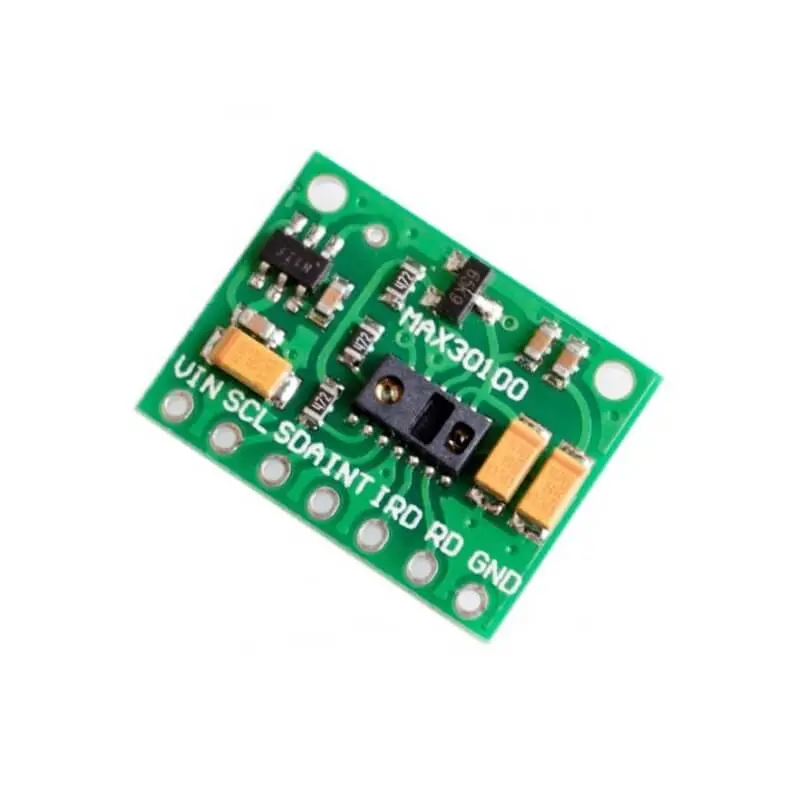
The MAX30100 sensor module is a complete integrated pulse oximetry and heart-rate monitoring solution, designed for easy integration with 3.3V microcontroller systems like Arduino, ESP32, and Raspberry Pi via its I2C interface.

Features

  • Integrated PPG Sensor: Combines red (660nm) and infrared (880nm) LEDs with a photodetector for SpO2 and heart rate measurement.
  • I2C Digital Interface: Simplifies wiring and communication with microcontrollers; includes a programmable interrupt (INT) pin.
  • Optimized Analog Front-End: Features low-noise signal processing with ambient light cancellation for reliable readings.
  • 3.3V Single-Supply Operation: Ultra-low power consumption ideal for battery-powered wearable and portable medical devices.
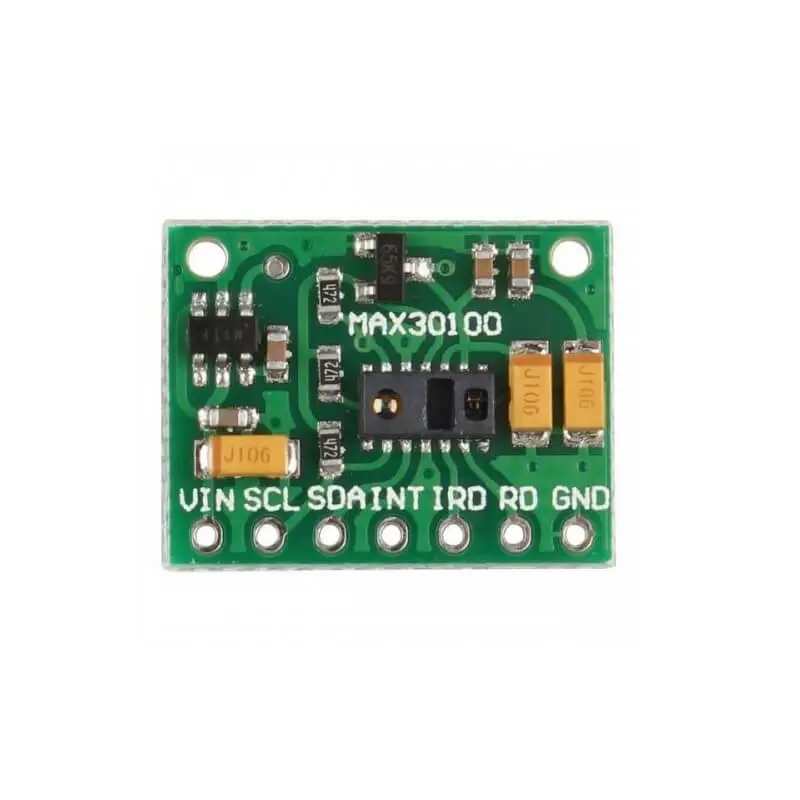
  • Compact Module Design: Ready-to-use PCB with exposed pads for soldering, measuring just 19mm x 14.5mm.

Out of stock

Description

The MAX30100 operates on the principle of photoplethysmography (PPG). It emits red and infrared light into biological tissue (typically a fingertip or earlobe) and measures the light absorption by pulsating arterial blood with its integrated photodetector. The absorbed signal is processed by a high-performance, low-noise analog front-end before being digitized and made available via the I2C bus.

This sensor module provides a complete, calibrated solution that simplifies the design of heart rate and blood oxygen saturation monitoring systems. Its integrated design mitigates challenges related to optical alignment and signal conditioning. Developers should note that measurement accuracy can be affected by significant subject motion, extreme ambient temperature shifts, or excessive physical pressure on the sensing site.

Key Features

  • Dual-Wavelength PPG Sensor: Utilizes red (660nm) and infrared (880nm) LEDs optimized for SpO2 calculation and heart rate detection.
  • High-SNR Analog Front-End: Delivers robust signal integrity with built-in ambient light cancellation to enhance motion artifact resilience.
  • Digital I2C Communication: Provides a simple, two-wire interface for data readout and configuration, plus a dedicated interrupt output pin.
  • Ultra-Low Power Operation: Engineered for wearable applications, extending battery life in fitness trackers and medical monitors.
  • Integrated Solution: Combines optical components, drivers, and signal processing in one module, reducing design complexity and BOM count.
  • Programmable Sampling Rate: Allows adjustment of LED pulse width and sampling rate to balance power consumption and data fidelity.
  • Compact and Lightweight Build: The small-form-factor PCB (19x14.5mm) is ideal for space-constrained portable device designs.

Applications

  • Wearable Fitness Trackers & Smartwatches for continuous heart rate and SpO2 monitoring.
  • Portable Medical Devices such as fingertip pulse oximeters for patient health screening.
  • Fitness Equipment Integration for real-time performance and recovery metrics.
  • Health & Wellness IoT Devices for remote patient monitoring and telemedicine applications.
  • Biometric Security Systems utilizing heart rate patterns for authentication.

Technical Specifications

Sensor TypePhotoplethysmogram (PPG), Pulse Oximeter
Core ICMAX30100
Measurement ParametersHeart Rate, Blood Oxygen Saturation (SpO2)
WavelengthsRed LED (660nm), Infrared LED (880nm)
InterfaceI2C (SCL, SDA) + Interrupt (INT) Pin
Supply Voltage3.3V DC
Operating CurrentUltra Low Power (typical)
Module Dimensions19mm (L) x 14.5mm (W)
Module Weight2 grams
Output FormatDigital (I2C)
Primary ApplicationsWearable Devices, Medical Monitors, Fitness Equipment

Frequently Asked Questions

What is the operating voltage for the MAX30100 module, and can I use it with 5V Arduino boards?

The MAX30100 module requires a strict 3.3V power supply. While the I2C communication lines are typically 5V tolerant, you must power the module's VIN pin with 3.3V. For use with 5V microcontrollers like some Arduino models, a logic level converter on the I2C lines is recommended for safety, though many users connect directly. Never apply 5V to the VIN pin.

How do I connect and read data from the MAX30100 sensor?

Connect the module's VIN to 3.3V and GND to ground. Link the SDA and SCL pins to the corresponding I2C pins on your microcontroller (e.g., Arduino Uno: A4/SDA, A5/SCL). The INT pin is optional for interrupt-driven operation. You will need a dedicated library (e.g., "MAX30100" or "SparkFun MAX3010x") to initialize the sensor, configure parameters like LED current and sample rate, and read the processed heart rate and SpO2 values via I2C.

What factors can affect the accuracy of heart rate and SpO2 readings from this sensor?

Accuracy can be compromised by excessive motion (motion artifacts), significant ambient temperature changes, and improper sensor placement. Applying too much pressure can constrict capillary blood flow, diminishing signal quality. For best results, ensure the sensor is firmly attached to a vascularized area (like a fingertip) with minimal movement, and implement software filtering or use the sensor's built-in algorithms designed to mitigate these effects.

Does the module come with pre-soldered headers or connectors?

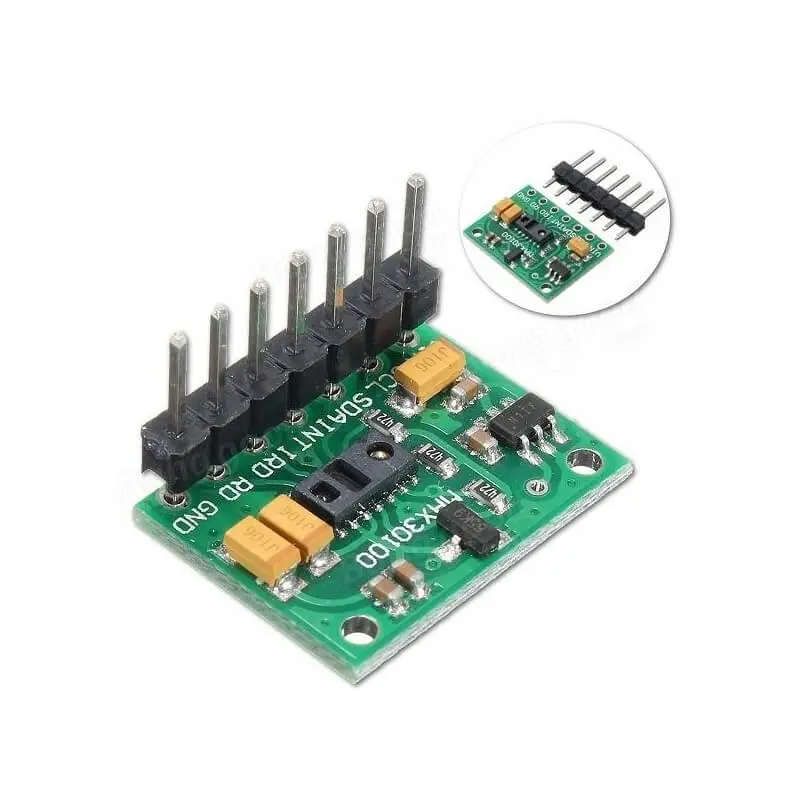
No, this module is typically supplied as a bare PCB with exposed solder pads. You will need to solder your own pin headers, wires, or a suitable connector to interface with a breadboard or your project's main board. The pinout includes VIN, SCL, SDA, INT, IRD (IR LED drive), RD (Red LED drive), and GND.

Package Includes

  • 1 x MAX30100 Pulse Oximeter Heart Rate Sensor Module

Additional Information

Weight 0.002 kg
Dimensions 1.9 × 1.45 cm