SKU: IOWC-1067
📋 GST Invoice Available

Waveshare ESP32-C6 Dev Board w/ WiFi 6, BLE 5, Zigbee & Thread

₹899.00 (Inclusive of all taxes)
Out of Stock

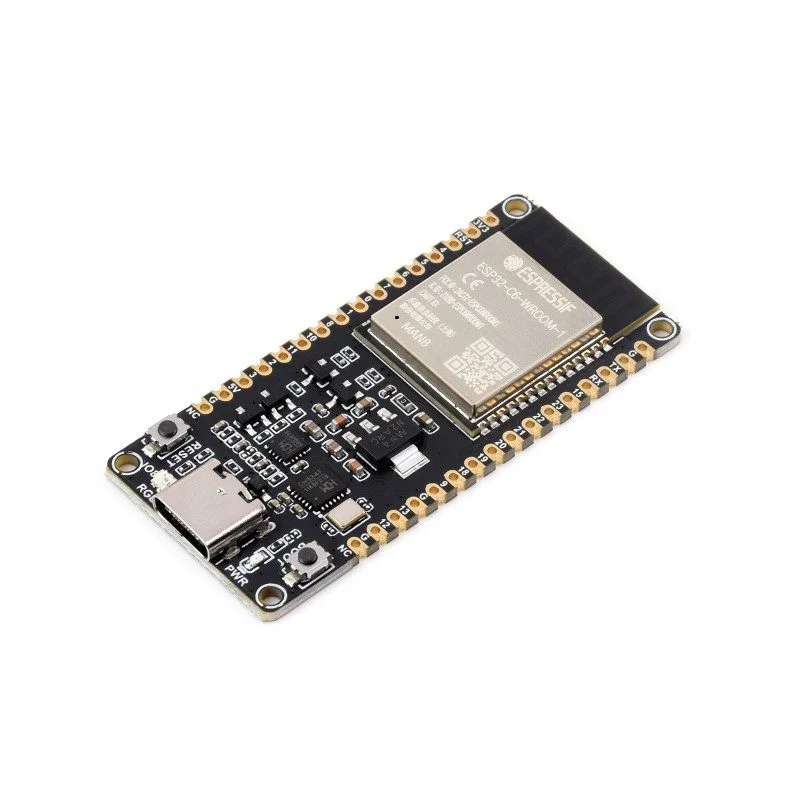
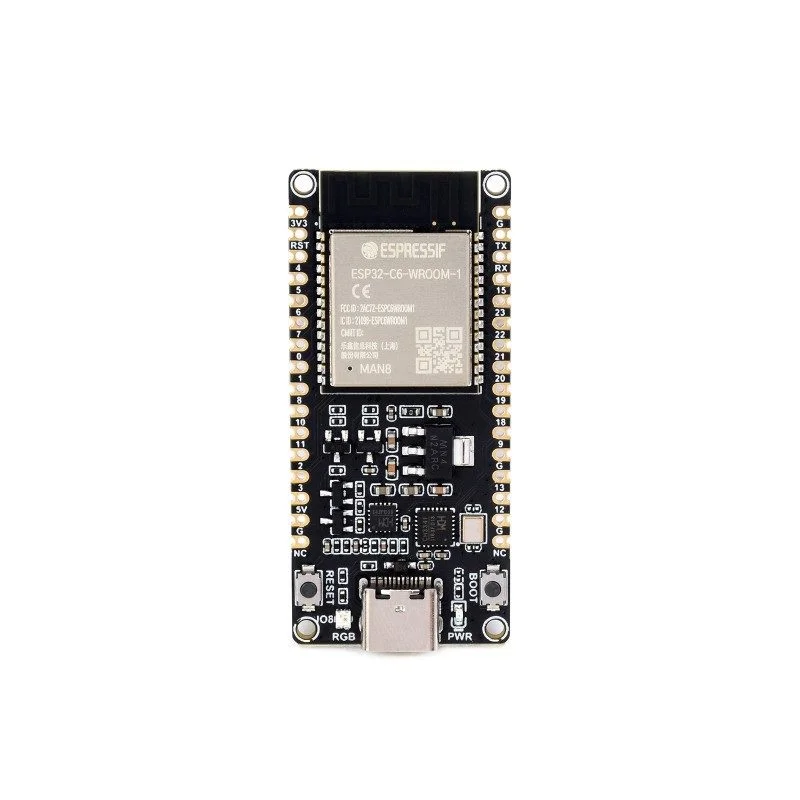
The Waveshare ESP32-C6 development board integrates an ESP32-C6-WROOM-1-N16 module, featuring a 160MHz RISC-V core, 16MB flash, and concurrent support for WiFi 6, Bluetooth 5, Zigbee 3.0, and Thread protocols. It’s fully compatible with the ESP-IDF framework and Arduino IDE for rapid IoT prototyping.

Features

  • Multi-Protocol Wireless SoC: Features the ESP32-C6-WROOM-1-N16 module with integrated WiFi 6 (802.11ax), Bluetooth 5, Zigbee 3.0, and Thread (IEEE 802.15.4) for versatile IoT connectivity.
  • RISC-V Processing Power: Driven by a 32-bit single-core RISC-V processor clocked up to 160MHz, paired with 400KB SRAM and 16MB of flash memory for complex applications.
  • Enhanced USB Interface: Onboard CH343 and CH334 USB hub chips enable simultaneous USB and UART communication via a single USB-C port for streamlined development and debugging.
  • Full Hardware Compatibility: Pinout is fully compatible with the official ESP32-C6-DevKitC-1, allowing direct use of existing shields, expansion boards, and peripheral modules.
  • Compact & Embeddable Design: Features castellated module edges for direct soldering onto custom carrier boards, making it ideal for space-constrained, final product integration.

Out of stock

Description

The Waveshare ESP32-C6 development board is a compact yet powerful platform built around Espressif’s latest ESP32-C6-WROOM-1-N16 wireless module. It combines a high-performance 160MHz RISC-V processor with robust multi-protocol RF capabilities, including WiFi 6 for efficient, high-throughput local networking, Bluetooth 5 for short-range device communication, and IEEE 802.15.4 radios for low-power mesh networks using Zigbee 3.0 and Thread standards.

Engineered for developer convenience, the board incorporates a dedicated USB hub circuit using CH343 and CH334 chips. This design allows a single USB-C connection to provide both a programming/debugging UART channel and a general-purpose USB host/device interface. The board exposes a comprehensive set of peripherals including SPI, I2C, UART, I2S, LED PWM, and SDIO, matching the pinout of the official Espressif devkit for maximum ecosystem compatibility. Its castellated module form factor provides the flexibility for both prototyping and direct integration into end-product PCB designs.

Key Features

  • Multi-Standard Wireless Convergence: Integrates 2.4GHz WiFi 6 (802.11ax), Bluetooth 5 Low Energy (BLE), and IEEE 802.15.4 (Zigbee/Thread) in a single chip for flexible network topology design.
  • High-Efficiency RISC-V Core: Leverages an open-architecture RISC-V CPU for optimized power-performance ratio, suitable for battery-operated edge devices.
  • Unified USB-C Development Port: Onboard USB hub enables concurrent firmware flashing via UART and USB peripheral communication without external adapters.
  • Direct Carrier Board Integration: Castellated edges allow the module to be reflow-soldered directly onto a custom PCB, reducing final product size and BOM cost.
  • Rich Peripheral Set: Provides multiple GPIOs configurable for SPI, I2C, UART, I2S, PWM, ADC, and touch sensor interfaces to connect sensors, displays, and actuators.
  • ESP-IDF & Arduino IDE Support: Fully supported by Espressif's official IoT Development Framework (ESP-IDF) and the Arduino core, with extensive online libraries and examples.

Applications

  • Smart Home Automation Hubs: Acts as a central coordinator for WiFi, BLE, and Zigbee/Thread devices like lights, locks, and sensors.
  • Industrial IoT Gateways: Bridges wireless sensor data (via Zigbee/Thread) to cloud platforms over WiFi or Ethernet for monitoring and control.
  • Advanced Wearables & Healthcare: Enables low-power biometric data collection via BLE with local processing and WiFi 6 for high-speed data uploads.
  • Consumer Electronics Prototyping: Ideal for developing next-gen connected products requiring multi-protocol support and efficient WiFi.
  • Mesh Network Nodes: Serves as a router or end-device in Thread or Zigbee mesh networks for robust, scalable sensor deployments.

Technical Specifications

Microcontroller / SoCESP32-C6-WROOM-1-N16 (RISC-V 32-bit Single-Core, up to 160MHz)
Wireless ProtocolsWiFi 6 (802.11ax), Bluetooth 5, Zigbee 3.0, Thread (IEEE 802.15.4)
Flash Memory16 MB
SRAM400 KB
USB InterfaceUSB-C with CH343 (UART) & CH334 (USB Hub)
Peripheral InterfacesSPI, I2C, UART, I2S, LED PWM, SDIO, GPIO, ADC
Form FactorCastellated Module on Development Board
Dimensions (Board)55mm (L) x 25.36mm (W)

Frequently Asked Questions

How do I program the Waveshare ESP32-C6 development board?

You can program the board using Espressif's official ESP-IDF framework or the Arduino IDE. First, install the ESP32 board support package in Arduino IDE or set up the ESP-IDF toolchain. Connect the board via the provided USB-C cable. The onboard CH343 chip provides a USB-to-serial interface; select the correct COM port and upload your code. The board is fully compatible with examples and libraries for the ESP32-C6-DevKitC-1. Ensure you have the latest ESP32 Arduino core or IDF version that supports the C6 chip for all features.

Can I use Zigbee and Thread simultaneously on this board?

The ESP32-C6's IEEE 802.15.4 radio hardware supports both Zigbee 3.0 and Thread protocols, but they cannot operate concurrently on the same network interface. You must choose and configure the desired protocol stack in your firmware using the ESP-IDF's Zigbee or OpenThread components. The radio can switch between them, allowing a single device to be part of either a Zigbee mesh or a Thread network. Development requires building your application with the specific SDK component (ESP-Zigbee-SDK or ESP-Thread-SDK) and configuring the network parameters accordingly.

What is the purpose of the castellated edges on the module?

The castellated (half-hole) edges on the ESP32-C6-WROOM-1-N16 module allow for direct surface-mount soldering onto a custom PCB or carrier board. This design eliminates the need for a separate socket or connector, reducing the overall height, cost, and footprint in a final product. For prototyping, you use the provided development board. For production, you can de-solder the module or source a standalone module to integrate directly into your design, connecting its GPIOs, power, and antenna line directly to your circuit.

Does the USB-C port support both power and data communication?

Yes, the USB-C port provides 5V power to the board's onboard regulator and enables data communication. The integrated CH343 chip handles USB-to-serial conversion for programming and serial debug output. The CH334 chip functions as a USB hub controller, potentially allowing the ESP32-C6 to act as a USB host or device for additional peripherals, depending on firmware implementation. For basic use, just the USB-C connection is sufficient for power, programming, and serial monitoring without any external debuggers.

Package Includes

  • 1 x Waveshare ESP32-C6 Development Board (with ESP32-C6-WROOM-1-N16 module)

Additional Information

Weight 0.01 kg
Dimensions 5.5 × 2.536 cm