SKU: SBCD-0593
📋 GST Invoice Available

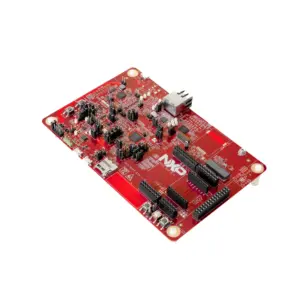
Digilent PYNQ-Z1 FPGA Dev Board - Zynq XC7Z020, 512MB DDR3

₹37,119.00 (Inclusive of all taxes)
Out of Stock

The Digilent PYNQ-Z1 FPGA Development Board integrates a Xilinx Zynq-7000 SoC, combining a 650MHz dual-core ARM Cortex-A9 processor with programmable logic, designed for Python-based embedded development using the PYNQ open-source framework.

Features

  • Features a Xilinx Zynq XC7Z020 SoC, integrating an FPGA and a 650MHz dual-core ARM Cortex-A9 processor.
  • Equipped with 512MB DDR3 RAM and 16MB Quad-SPI Flash for robust application support.
  • Designed for the PYNQ open-source framework, enabling Python-centric hardware programming for the Zynq SoC.
  • Offers versatile connectivity including Gigabit Ethernet, USB 2.0, HDMI, and multiple Pmod ports.
  • Includes Arduino-compatible headers for broad expansion and rapid prototyping flexibility.

Out of stock

Description

The Digilent PYNQ-Z1 board is engineered to leverage the PYNQ open-source framework, allowing embedded programmers to interact with the onboard System-on-Chip (SoC) using Python. This powerful platform is built around the Xilinx Zynq-7000 SoC, which uniquely merges the programmable logic capabilities of an FPGA with the processing power of a dual-core ARM Cortex-A9 processor, providing a flexible architecture for complex embedded designs.

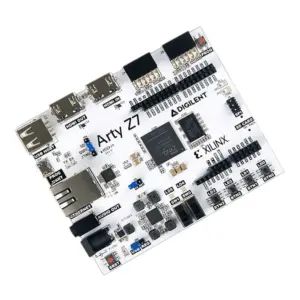
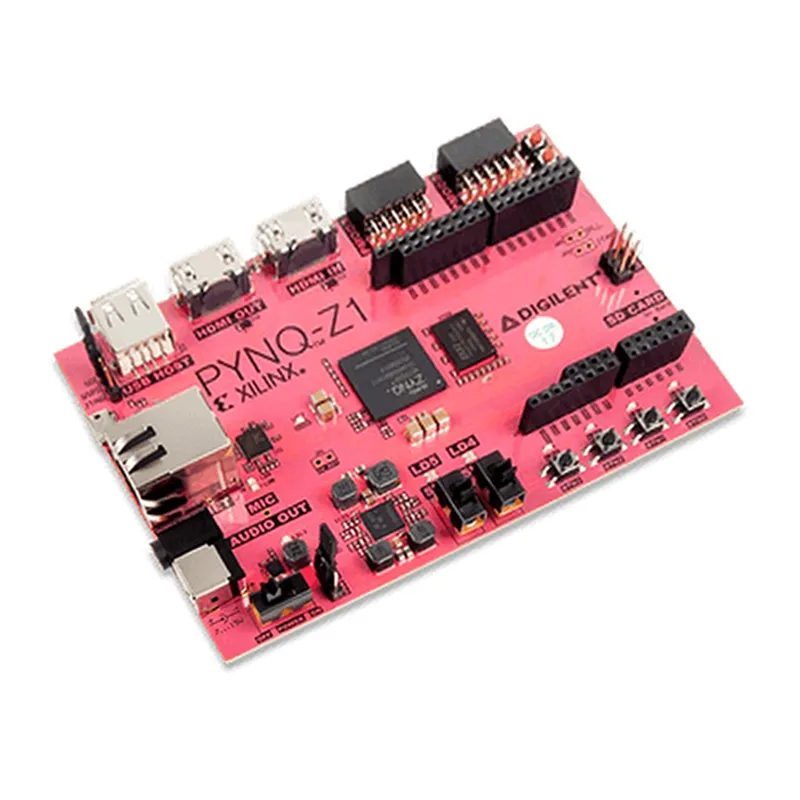
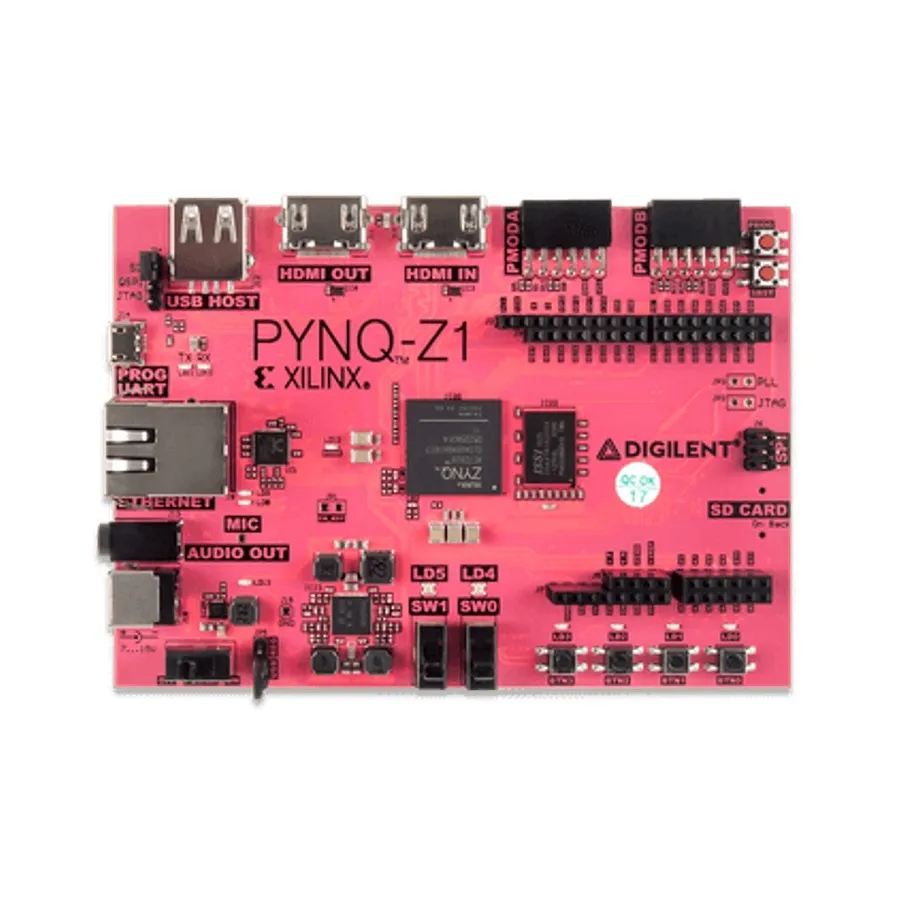
Hardware-wise, the PYNQ-Z1 offers extensive flexibility and is ready for immediate use. Its form factor and feature set are similar to Digilent’s Arty Z7, incorporating popular Arduinoâ„¢ headers, Pmod ports, integrated I/O, HDMI in/out, audio output, and comprehensive USB and Ethernet connectivity. This rich peripheral set positions the PYNQ-Z1 as a highly versatile and customizable SoC development platform.

The board’s hybrid processing capabilities make it ideal for a wide array of demanding applications. From accelerating computer vision algorithms and enabling precise industrial control to serving as a core component in IoT gateways, facilitating advanced encryption, and driving general embedded computing acceleration, the PYNQ-Z1 provides the necessary resources for high-performance embedded systems.

Key Features

  • Xilinx ZYNQ XC7Z020-1CLG400C System-on-Chip
  • 650MHz dual-core ARM Cortex-A9 processor
  • 512 MB DDR3 memory with 16-bit bus @ 525 MHz (1050 MT/s)
  • 16MB Quad-SPI Flash with factory programmed unique identifier (48-bit EUI-48/64â„¢ compatible)
  • DDR3 memory controller with 8 DMA channels and 4 high-performance AXI3 slave ports
  • High-bandwidth peripheral controllers: 1G Ethernet, USB 2.0, SDIO
  • Low-bandwidth peripheral controllers: SPI, UART, CAN, I2C
  • Programmable via JTAG, Quad-SPI flash, and microSD card
  • 13,300 logic slices, each with four 6-input LUTs and 8 flip-flops
  • 630 KB of fast block RAM
  • 4 clock management tiles, each with a phase-locked loop (PLL) and mixed-mode clock manager (MMCM)
  • 220 DSP slices for signal processing applications
  • On-chip analog-to-digital converter (XADC)
  • 16 Total FPGA I/O via Pmod ports
  • 49 Total FPGA I/O for general purpose use
  • 6 Single-ended 0-3.3V Analog inputs to XADC
  • 4 Differential 0-1.0V Analog inputs to XADC

Applications

  • Computer vision and image processing
  • Industrial control and automation systems
  • Internet of Things (IoT) gateways and edge devices
  • Cryptography and encryption systems
  • Embedded computing acceleration
  • Robotics and motor control

Technical Specifications

Model SeriesDigilent PYNQ-Z1
SoCXilinx Zynq XC7Z020-1CLG400C
Processor Clock Frequency650MHz
Communication ModesSPI, UART, CAN, I2C, 1G Ethernet, USB 2.0, SDIO
Supply Voltage7V-15V (DC Barrel Jack)
Pmod Ports16 FPGA I/O
RAM512MB DDR3
Flash16MB Quad-SPI

Frequently Asked Questions

What is the PYNQ framework and how does it relate to the Zynq-7000 SoC on the PYNQ-Z1 board?

PYNQ is an open-source framework from Xilinx that enables embedded programmers to design and develop applications for Zynq-based systems using Python. On the PYNQ-Z1, it allows high-level Python code to interact with the Zynq-7000's programmable logic (FPGA) and processing system (ARM Cortex-A9), abstracting complex hardware interactions.

What development environments and toolchains are supported for programming the ZYNQ-7000 SoC on the PYNQ-Z1?

Beyond the PYNQ Python framework, developers can utilize Xilinx Vivado for FPGA logic design, Vitis for accelerated application development (including C/C++ for the ARM cores), and SDKs like PetaLinux for embedded Linux systems. Standard ARM GCC toolchains are also compatible for bare-metal programming on the Cortex-A9.

What are the primary expansion options available on the Digilent PYNQ-Z1 board?

The PYNQ-Z1 offers extensive expansion through Arduino-compatible shield headers, enabling integration with a vast ecosystem of add-on modules. It also features multiple Pmod ports, which provide reconfigurable I/O for various peripheral modules, along with dedicated HDMI, USB, and Gigabit Ethernet ports for robust connectivity.

What are the power requirements and how is the Digilent PYNQ-Z1 typically powered?

The Digilent PYNQ-Z1 requires a DC input voltage ranging from 7V to 15V. It is typically powered via a standard DC barrel jack. The board includes onboard power regulation circuitry to provide stable voltages to its various components, ensuring reliable operation during development and deployment.

Package Includes

  • 1 x Digilent PYNQ-Z1 FPGA Development Board - Xilinx Zynq XC7Z020, 512MB DDR3, 650MHz Dual-Core ARM Cortex-A9

Additional Information

Weight 0.116 kg
Dimensions 15 × 11 × 3 cm