SKU: IOWC-1500
📋 GST Invoice Available

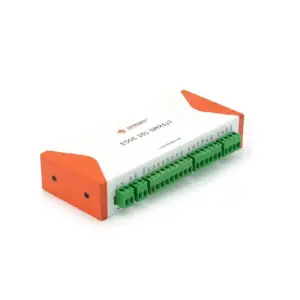
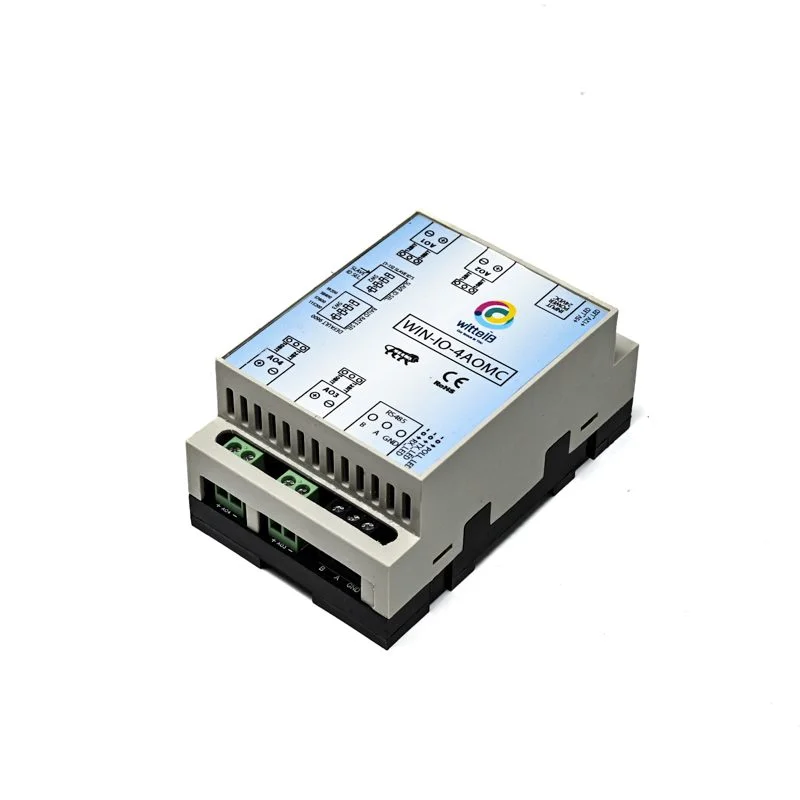
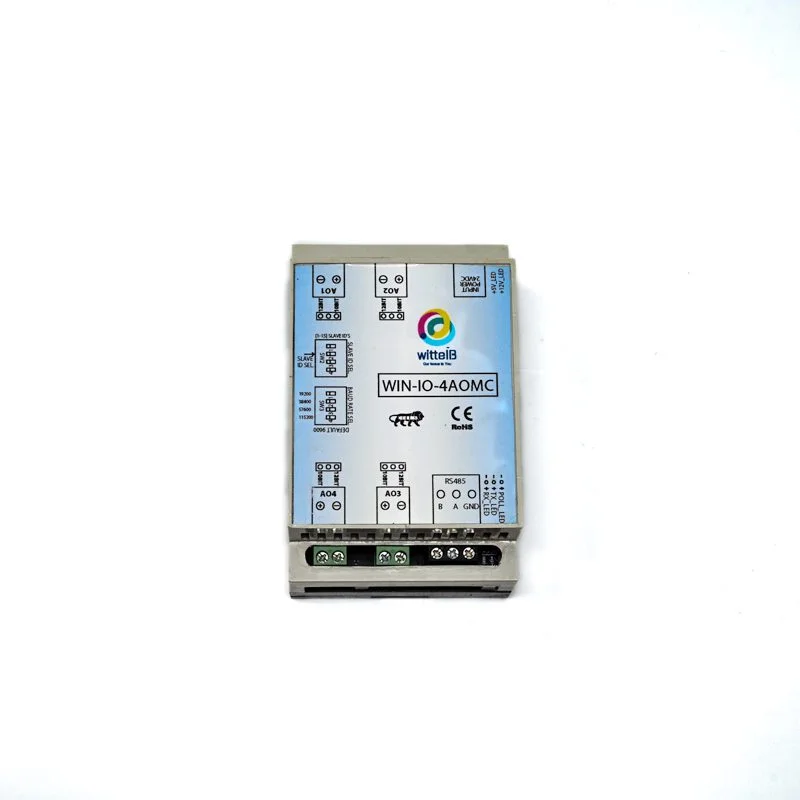
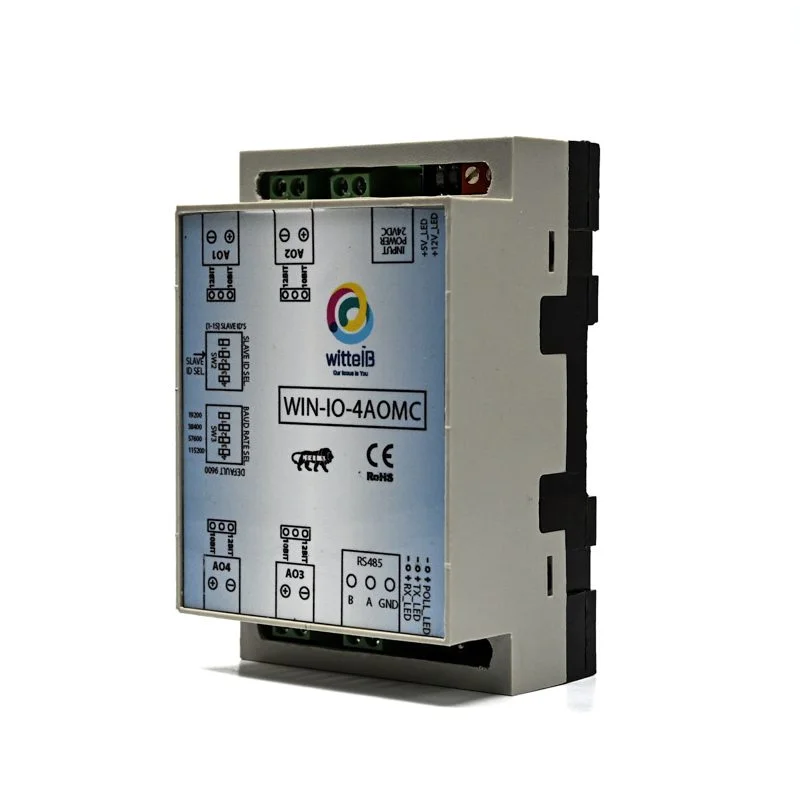
Wittelb WIN-IO-4AOMC 4-Port Analog Output to Modbus RS485 Converter

₹6,555.00 (Inclusive of all taxes)
Out of Stock

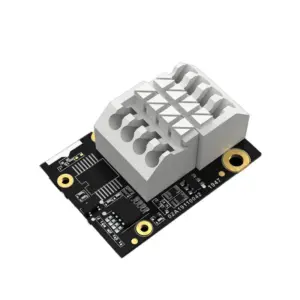
The Wittelb WIN-IO-4AOMC is a DIN-rail mountable industrial converter that translates Modbus RTU commands over RS485 into 4 independent analog output channels, supporting both 4-20 mA current loops and 0-10 V voltage signals for precise actuator and valve control.

Features

  • Provides four configurable analog output channels, each supporting both 4-20 mA current loop and 0-10 V voltage signals for flexible industrial actuator control.
  • Features robust RS485 Modbus RTU communication with a range up to 700 meters, enabling reliable integration into distributed SCADA and PLC systems.
  • Offers 12-bit resolution (10-bit standard) for high-precision analog signal generation, ensuring accurate process control in automation applications.
  • Includes DIP switches for easy on-site configuration of baud rate (9600-115200 bps) and Modbus slave ID (1-15) without requiring software tools.
  • Built with industrial-grade protection including reverse polarity, resettable fuses, and ESD safety, housed in a compact DIN-rail mountable casing.

Out of stock

Description

The Wittelb WIN-IO-4AOMC Analog Output to Modbus RS485 Converter serves as a critical interface between digital control networks and analog field devices in industrial automation environments. It receives commands via the robust Modbus RTU protocol over a two-wire RS485 bus, which supports distances up to 700 meters and multi-drop networks, and converts them into precise analog outputs. Each of its four channels can be independently configured to deliver either a 4-20 mA current signal or a 0-10 V voltage signal, providing direct compatibility with a wide range of actuators, variable frequency drives (VFDs), and valve positioners.

Engineered for reliability in harsh conditions, the module operates from a 12-24 VDC supply and features comprehensive protection circuits, including reverse polarity protection on the power and communication lines and resettable fuses. Its compact, DIN-rail mountable design simplifies installation in control cabinets, while the externally accessible DIP switches allow for rapid field configuration of communication parameters and device addressing, streamlining integration into existing Modbus networks without the need for PC configuration software.

Key Features

  • Four-channel analog output module supporting industry-standard 4-20 mA and 0-10 V signal types.
  • High-resolution 12-bit digital-to-analog conversion (DAC) for precise control signal generation.
  • Modbus RTU over RS485 interface enables seamless integration with PLCs, SCADA, and HMI systems.
  • Field-configurable baud rate and slave ID via DIP switches for flexible network setup.
  • Reverse polarity and ESD protection on all external connections enhances system durability.
  • DIN-rail mountable metal or plastic housing designed for industrial panel installation.
  • Wide operating voltage range (12-24 VDC) compatible with standard industrial power supplies.
  • Supports a maximum load of 500 ohms on current output channels.

Applications

  • Industrial process control for adjusting valve positions, pump speeds, and damper actuators via 4-20 mA signals.
  • Building automation systems (BAS) for controlling variable air volume (VAV) terminals and fan coil units.
  • SCADA and telemetry systems for remote analog output control in water/wastewater treatment plants.
  • Integration with PLCs to provide additional analog output points for machinery and conveyor speed control.
  • Renewable energy systems for controlling inverter setpoints or diversion loads based on Modbus commands.

Technical Specifications

Item TypeAnalog Output Current to Modbus Converter
Output Channels4 Channels (4-20 mA / 0-10 V)
Communication ProtocolModbus RTU over RS485
Communication RangeUp to 700 meters
Resolution12-bit (Optional, 10-bit standard)
Configurable Baud Rate9600, 19200, 38400, 57600, 115200 bps
Slave ID Range1 to 15 (via DIP Switch)
Supply Voltage12-24 VDC
Max Load (Current Output)500 ohms
Operating Temperature0°C to 60°C
Dimensions (L x W)70 mm x 50 mm
Weight137 g

Frequently Asked Questions

How do I configure the baud rate and slave ID on the WIN-IO-4AOMC converter?

The baud rate and Modbus slave ID are configured using the DIP switches located on the device. Refer to the product manual for the switch coding table. Typically, a combination of switches sets the baud rate (9600 to 115200 bps) and another set assigns a unique slave address from 1 to 15. Ensure power is cycled after changing switch positions for the new settings to take effect in your industrial network.

What is the difference between the 4-20 mA and 0-10 V output modes, and how do I select one?

The 4-20 mA current loop is used for longer-distance signal transmission with inherent noise immunity, ideal for process control valves. The 0-10 V voltage output is common for driving local speed controllers or VFDs. The selection is typically made via wiring to specific terminal blocks for each channel or potentially via internal jumpers; consult the wiring diagram in the manual to connect your field device to the correct terminals for your desired output type.

What power supply is required, and how do I wire the RS485 communication bus?

The module requires a 12-24 VDC power supply connected to the designated V+ and GND terminals, observing polarity due to the built-in protection. For the RS485 bus, connect the 'A' (or 'D+') and 'B' (or 'D-') terminals from your master device or previous node, ensuring proper termination with a 120-ohm resistor at the end of the bus line. Use shielded twisted-pair cable for the 485 communication to maximize the 700-meter range and reduce EMI.

Package Includes

  • 1 x WIN-IO-4AOMC 4-Port Analog Output to Modbus RS485 Converter

Additional Information

Weight 0.137 kg
Dimensions 7 × 5 cm