SKU: SENS-2870
📋 GST Invoice Available

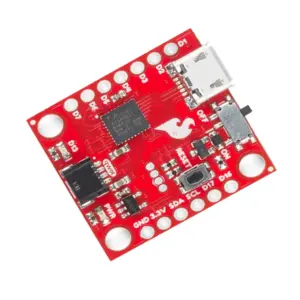
SparkFun Triad Spectroscopy Sensor - AS7265x Spectral Sensor Module

₹7,629.00 (Inclusive of all taxes)
Out of Stock

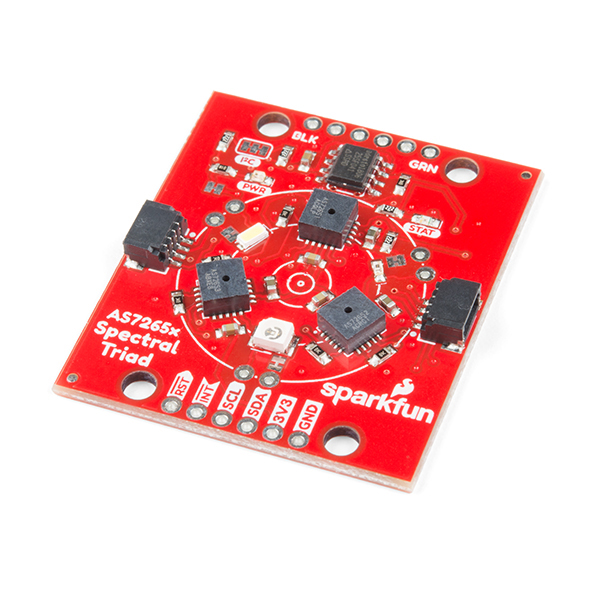
The SparkFun Triad Spectroscopy Sensor (AS7265x) is a compact spectral analysis module compatible with 3.3V systems like Arduino and Raspberry Pi via I2C or serial interface, enabling precise measurement of 18 distinct light wavelengths from 410nm to 940nm.

Features

  • Triple AS7265x sensor array for 18-channel spectral sensing from UV (410nm) to IR (940nm).
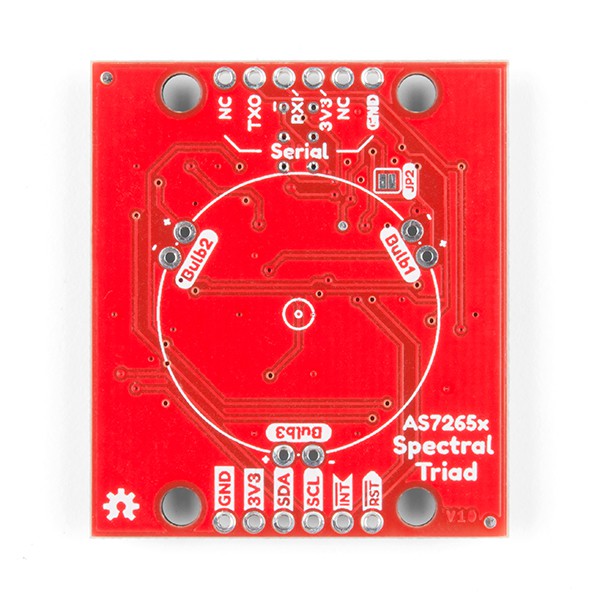
  • Selectable I2C (default) or 115200 bps serial communication interface for flexible system integration.
  • Integrated illumination LEDs: 405nm UV, 5700K white, and 875nm IR for controlled sample lighting.
  • High sensitivity with a resolution of 28.6 nW/cm² per count and typical accuracy of ±12%.
  • Qwiic connector enables solderless connection, with 0.1″-spaced breakout pins for breadboard prototyping.

Out of stock

Description

The SparkFun Triad Spectroscopy Sensor integrates three specialized ams OSRAM AS7265x spectral sensors (AS72651, AS72652, AS72653) into a single module, functioning as a compact spectrophotometer. It operates on the principle of filtered photodiode arrays, where each of the 18 channels is tuned to a specific narrowband wavelength, allowing for the characterization of light absorption and reflection properties of materials.

Communication is handled via a selectable I2C or UART serial interface (115200 bps), with an onboard level shifter ensuring 3.3V logic compatibility. The module includes software-controllable integrated LEDs (UV, white, IR) for active illumination, and features dedicated pins for optional external light source control. Pre-programmed with the latest ams OSRAM firmware, it is supported by a comprehensive Arduino library for simplified data acquisition and LED management.

Key Features

  • Multi-Sensor Array: Combines three AS7265x ICs for broad spectral coverage across visible, UV, and near-infrared bands.
  • Dual Communication Protocol: Offers both I2C (default address 0x49) and configurable serial UART for compatibility with microcontrollers and single-board computers.
  • Integrated Active Illumination: Features onboard 405nm UV, 5700K white, and 875nm IR LEDs with software-adjustable drive current for sample analysis.
  • High-Value Spectral Analysis: Delivers laboratory-grade spectral measurement capabilities in a compact, developer-friendly form factor.
  • Developer-Friendly Design: Includes a Qwiic connector for plug-and-play I2C connectivity and standard 0.1" headers for direct PCB or breadboard integration.
  • Comprehensive Software Support: Backed by a full-featured open-source Arduino library for simplified sensor configuration, data reading, and LED control.

Applications

  • Material identification and analysis based on spectral reflectance signatures.
  • Food quality and ripeness assessment through color and spectral property measurement.
  • Precision agriculture for monitoring plant health via chlorophyll and nutrient absorption.
  • Color matching and quality control in manufacturing and printing processes.
  • Scientific research and educational demonstrations in spectroscopy and light interaction.

Technical Specifications

Model / CoreSparkFun Triad Spectroscopy Sensor - AS7265x
Sensing PrincipleFiltered Photodiode Array (Spectrophotometer)
Spectral Range410 nm to 940 nm (18 discrete channels)
Sensitivity / Resolution28.6 nW/cm² per count
Typical Accuracy±12%
Supply Voltage3.3 V DC
Operating Current5 mA (typical, excluding LEDs)
Communication InterfacesI2C (default), Serial UART (115200 bps)
Integrated Illumination LEDs405 nm UV, 5700K White, 875 nm IR
Connector TypeQwiic (I2C) & 0.1" Breakout Pins
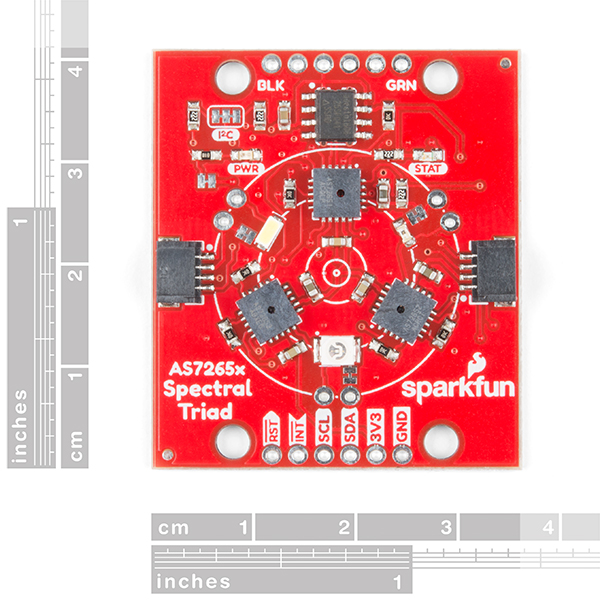
Dimensions (L x W)41.3 mm x 36 mm
Weight5 g

Frequently Asked Questions

What is the operating voltage range for the SparkFun Triad Sensor?

The module requires a strict 3.3V DC supply. Applying voltages higher than 3.6V can permanently damage the sensitive AS7265x spectral ICs. Ensure your logic levels are also 3.3V for reliable I2C or serial communication.

How do I connect and communicate with the sensor?

The sensor defaults to I2C communication (address 0x49) via the Qwiic connector or breakout pins (SDA, SCL). You can reconfigure it via I2C commands to use its serial UART interface (TX, RX pins) at 115200 bps. The provided Arduino library simplifies reading spectral data and controlling the onboard LEDs.

What are the integrated LEDs used for?

The 405nm UV, 5700K white, and 875nm IR LEDs provide controlled illumination for samples, enabling active spectroscopy measurements in low-light conditions. Each LED's brightness can be individually controlled and modulated via software through the I2C or serial interface.

Can this sensor be used for precise laboratory measurements?

While the AS7265x provides valuable spectral data across 18 channels, it is designed for embedded applications and qualitative analysis. Its ±12% accuracy and 28.6 nW/cm² resolution are suitable for material comparison, process monitoring, and education, but not for high-precision laboratory spectrometry requiring sub-nanometer resolution.

Does the module require calibration?

The sensor is factory-calibrated by ams OSRAM. For most applications, this calibration is sufficient. However, for highest accuracy across all 18 channels, especially when using the integrated LEDs, a user-level calibration against a known reference (e.g., a white standard) is recommended using the provided software library.

Package Includes

  • 1 x SparkFun Triad Spectroscopy Sensor - AS7265x Module

Additional Information

Weight 0.005 kg
Dimensions 4.13 × 3.6 cm