SKU: IOWC-1329
📋 GST Invoice Available

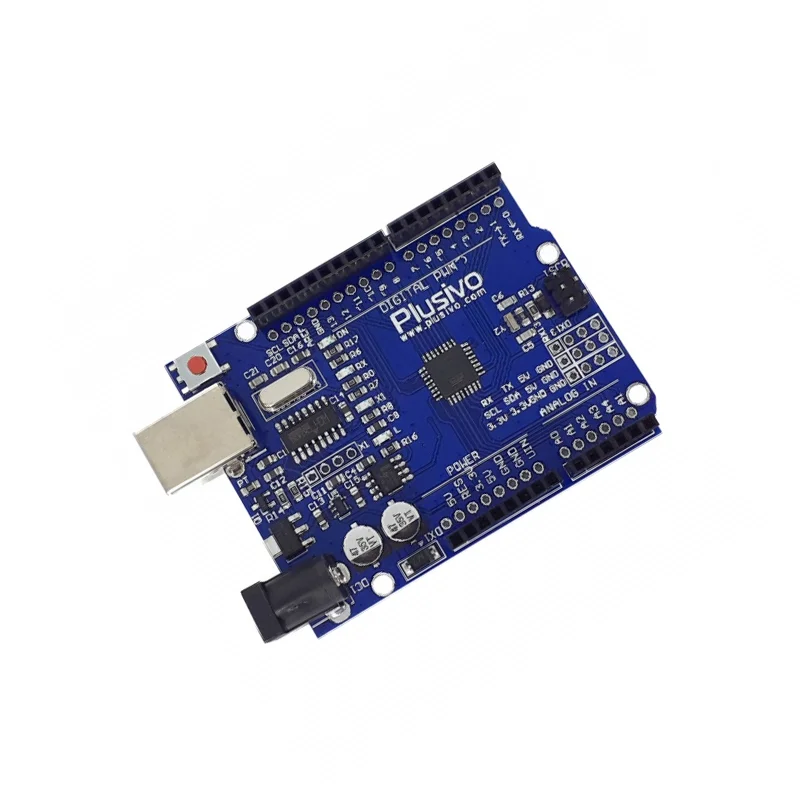
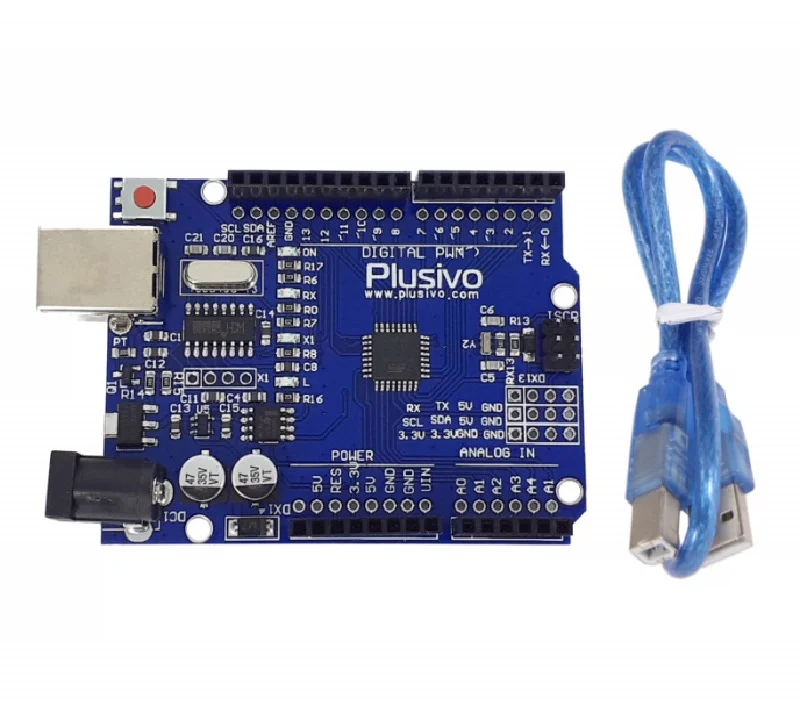
Plusivo UNO R3 Development Board (ATmega328p & CH340)

₹309.00 (Inclusive of all taxes)
Out of Stock

The Plusivo UNO R3 is an Arduino-compatible development board based on the ATmega328p microcontroller and CH340 USB-to-serial chip, providing a standard 5V platform with 14 digital I/O and 6 analog inputs for rapid prototyping and embedded systems development.

Features

  • ATmega328p microcontroller with 16 MHz clock speed and 32 KB Flash memory for robust Arduino IDE programming.
  • Integrated CH340 USB-to-serial converter for reliable PC connectivity and easy firmware uploads via included USB cable.
  • Standard UNO R3 pinout with 14 digital I/O (6 PWM-capable) and 6 analog inputs for extensive sensor and actuator interfacing.
  • Supports TWI (I2C), SPI, and UART serial communication protocols for modular expansion with shields and peripherals.
  • Wide 7-12V DC input range with onboard 5V regulation, suitable for both bench-top and portable power supply configurations.

Out of stock

Description

The Plusivo UNO R3 Development Board implements the classic Arduino UNO architecture, centered on the ATmega328p AVR microcontroller. This board serves as a foundational hardware platform for electronics prototyping, robotics, and IoT node development, offering a comprehensive set of digital and analog GPIOs alongside standard serial buses. The integrated CH340G USB-to-UART bridge ensures stable communication with development environments like the Arduino IDE, PlatformIO, or Atmel Studio.

Engineered for maker and educational use, the board operates from a 5V logic domain derived from an onboard linear regulator, accepting a wide 7-12V DC input. Its 16 MHz crystal oscillator provides the timing base for the MCU and synchronous communication interfaces. The pin-header layout is fully compatible with the vast ecosystem of Arduino shields and accessory modules, enabling rapid system integration for data acquisition, motor control, and wireless connectivity projects.

Key Features

  • Full Arduino UNO R3 hardware and pinout compatibility for seamless use with existing code libraries and shields.
  • CH340 USB-to-serial interface chip provides robust driver support across Windows, macOS, and Linux operating systems.
  • Comprehensive I/O suite includes 14 digital pins (with 6 capable of PWM output) and 6 analog input channels for versatile interfacing.
  • Onboard power LED, user-controllable LED on pin 13, and reset button for convenient debugging and board control.
  • Standard 2.54mm pin headers for reliable breadboarding and connection to peripheral modules and sensor breakout boards.
  • 32 KB of Flash memory (with 0.5 KB used for bootloader) and 2 KB SRAM for handling moderate complexity sketches and data buffers.

Applications

  • Educational electronics and introductory programming for STEM curricula using the Arduino IDE.
  • Rapid prototyping of sensor-based IoT nodes for environmental monitoring (temperature, humidity, light).
  • Central controller for small-scale robotics, motorized projects, and home automation systems.
  • Development platform for interfacing with wireless modules (Wi-Fi, Bluetooth, LoRa) via serial or SPI connections.
  • Bench tool for testing and debugging electronic circuits and component libraries.

Technical Specifications

MicrocontrollerATmega328p
USB InterfaceCH340 USB-to-Serial Converter
Operating Voltage5V
Input Voltage (Recommended)7-12V DC
Clock Speed16 MHz
Digital I/O Pins14 (6 provide PWM output)
Analog Input Pins6
Flash Memory32 KB (0.5 KB used by bootloader)
SRAM2 KB
EEPROM1 KB
Communication InterfacesUART, SPI, I2C (TWI)
Dimensions (approx.)75.0mm x 53.0mm (L x W)

Frequently Asked Questions

How do I install drivers for the CH340 chip on my computer?

For Windows, download the CH340 driver from the manufacturer's website or trusted repositories and run the installer, then reconnect the board. On macOS 10.9+, the driver often loads automatically; if not, install the signed CH34x package. For Linux, the 'ch341' kernel module is typically pre-installed. After driver installation, the board should appear as a serial COM or ttyUSB port in your Arduino IDE or serial terminal software for uploading sketches.

What is the correct power supply configuration for this UNO R3 board?

Power the board via the DC barrel jack (7-12V recommended) or the USB Type-B port (5V). The onboard linear regulator steps down higher voltages to 5V for the MCU and I/O pins. Avoid exceeding 12V on the DC jack to prevent regulator overheating. When using both USB and external power, the board automatically selects the higher voltage source. For stable operation with motors or high-current peripherals, use the external DC supply to avoid USB current limits.

Can I use standard Arduino libraries and shields with this Plusivo board?

Yes, the Plusivo UNO R3 maintains full hardware and pinout compatibility with the official Arduino UNO R3. All standard Arduino core libraries (for SPI, I2C, Servo, etc.) and thousands of community libraries will compile and run without modification. Any shield designed for the UNO R3 form factor will plug directly onto the board's headers. Select the 'Arduino Uno' board in the Arduino IDE Tools menu to ensure correct pin mappings and bootloader settings for programming.

What are the specifications of the ATmega328p microcontroller on this board?

The ATmega328p is an 8-bit AVR RISC microcontroller featuring 32 KB of Flash program memory (with 0.5 KB reserved for the Optiboot bootloader), 2 KB of SRAM, and 1 KB of EEPROM. It operates at 16 MHz via an external crystal, providing a 62.5 ns instruction cycle time. It includes 23 programmable I/O lines, three timer/counters, a 10-bit ADC with six channels, and hardware serial (UART), SPI, and I2C (TWI) interfaces, making it suitable for a wide range of embedded control applications.

Package Includes

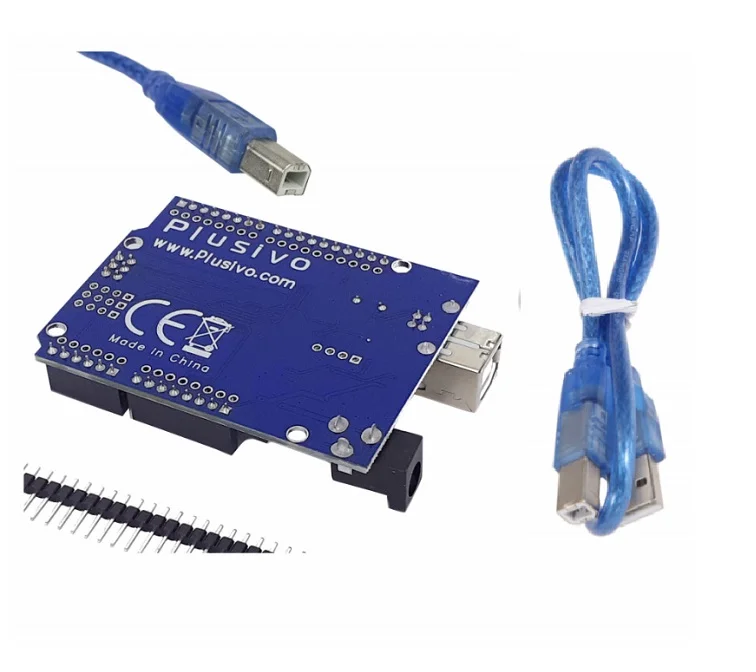
  • 1 x Plusivo UNO R3 Development Board (ATmega328p & CH340)
  • 1 x USB Cable (Type-A to Type-B)

Additional Information

Weight 0.022 kg
Dimensions 7.5 × 5.3 cm