SKU: SENS-0297
📋 GST Invoice Available

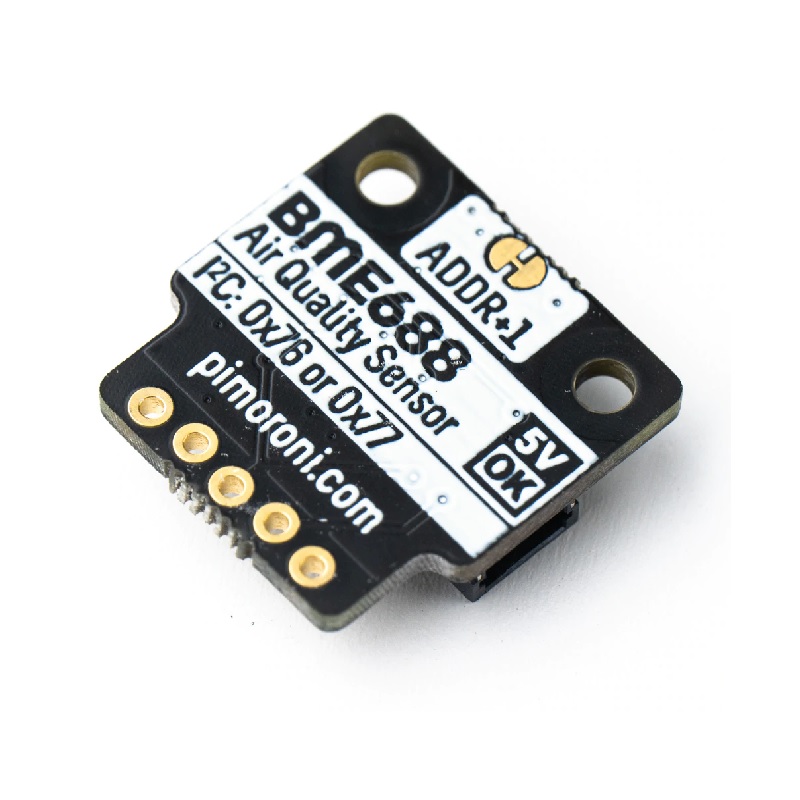
Pimoroni BME688 4-in-1 Air Quality Breakout (Gas, Temperature, Pressure, Humidity) - I2C/SPI

₹2,216.00 (Inclusive of all taxes)
Out of Stock

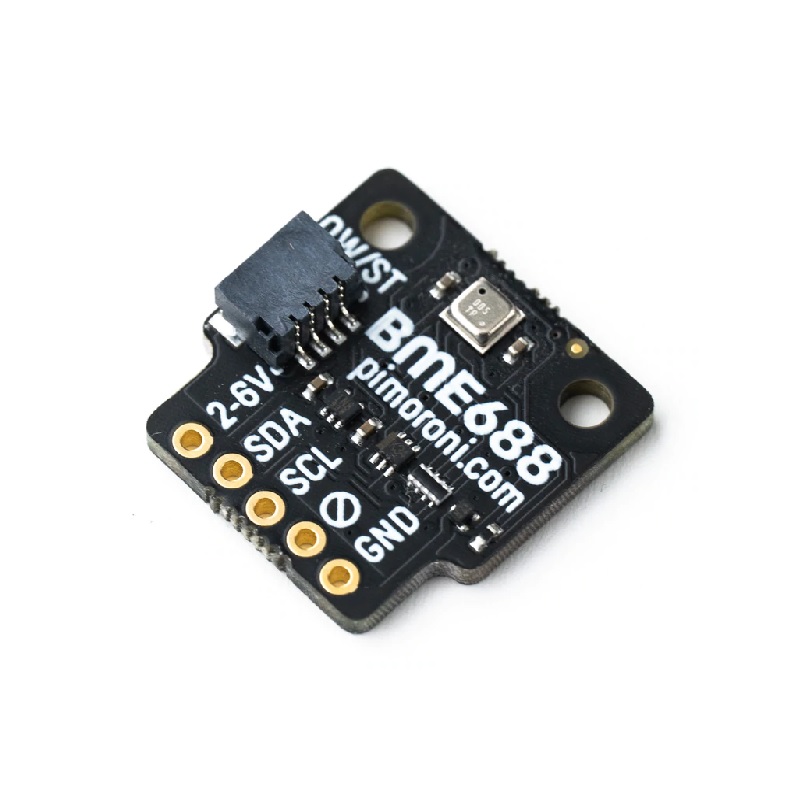
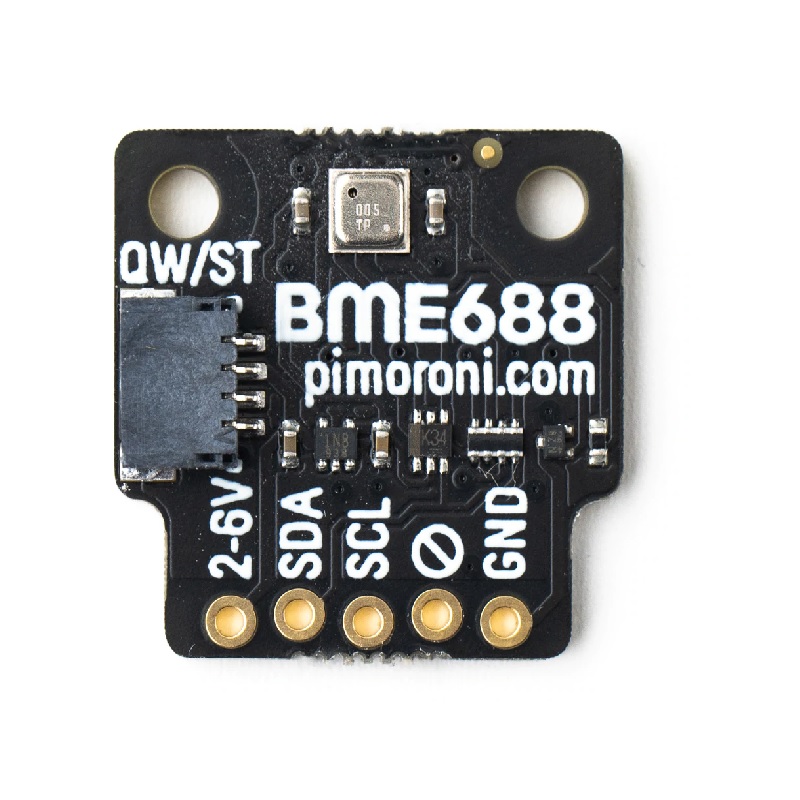
The Pimoroni BME688 breakout provides a compact, low-power 4-in-1 environmental sensing solution, integrating Bosch Sensortec’s AI-enabled gas scanner with high-accuracy pressure, humidity, and temperature sensors. It features a Raspberry Pi-compatible pinout and is easily interfaced via I2C or SPI for integration with Arduino, Raspberry Pi, ESP32, and other 3.3V microcontroller platforms.

Features

  • Bosch Sensortec BME688 with integrated AI for gas pattern recognition (VOCs, VSCs, CO, H2).
  • High-accuracy 4-in-1 sensing: gas (ppb), temperature, barometric pressure, and relative humidity.
  • Ultra-low power operation (3.1 µA typical) and wide voltage range (1.71V to 3.6V).
  • Dual digital interface: high-speed I2C (up to 3.4 MHz) and SPI (up to 10 MHz).
  • Compact 3.0 x 3.0 x 0.93 mm sensor package on a Raspberry Pi-compatible breakout board.

Out of stock

Description

The BME688 is Bosch Sensortec’s first gas sensor with integrated Artificial Intelligence (AI), packaged alongside high-linearity pressure, humidity, and temperature sensors. Its MEMS-based gas sensing element can detect a wide range of volatile organic compounds (VOCs), volatile sulfur compounds (VSCs), carbon monoxide, and hydrogen in the part-per-billion (ppb) range. The integrated AI-Studio tool allows for custom training of the gas scanner’s sensitivity and selectivity for specific application scenarios.

Housed in a robust 3.0 x 3.0 x 0.93 mm package, the sensor is designed for mobile and connected applications where minimal size and power consumption are critical. The Pimoroni breakout board provides easy access to the sensor’s pins, includes reverse polarity protection for the Breakout Garden connector, and supports a wide operating temperature range from -40°C to +85°C for demanding environments.

Key Features

  • AI-enabled gas scanner for detecting and learning complex gas patterns and odors.
  • High-accuracy environmental sensing: ±0.5°C temperature, ±3% RH humidity, ±0.6 hPa pressure.
  • Ultra-low power consumption, ideal for battery-powered IoT and portable devices.
  • Robust digital signal output via configurable I2C or SPI communication interfaces.
  • Compact breakout design with reverse polarity protection on the connector.
  • Direct compatibility with Raspberry Pi GPIO pinout and extensive software libraries.
  • Wide operating temperature range (-40°C to +85°C) for indoor and outdoor applications.

Applications

  • Smart home indoor air quality (IAQ) monitoring and VOC level tracking.
  • Portable environmental data loggers for health and wellness applications.
  • Early detection of food spoilage or bacterial growth via VSC monitoring.
  • IoT-based wildfire or combustion detection systems.
  • Baby care products for diaper state or ambient condition monitoring.

Technical Specifications

Sensor ModelBosch Sensortec BME688
Operating Voltage1.71V to 3.6V DC
Operating Current3.1 µA (typical)
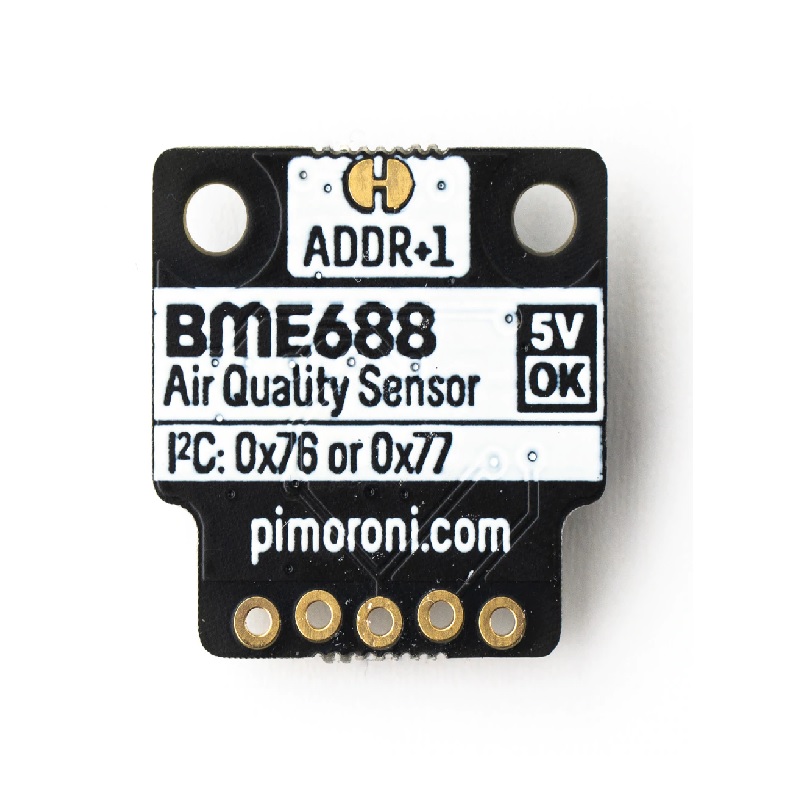
Digital InterfaceI2C (up to 3.4 MHz), SPI (3/4 wire, up to 10 MHz)
Operating Temperature-40°C to +85°C
Gas Detection RangeVOCs, VSCs, CO, H2 (ppb range)
Humidity Accuracy±3% RH
Response Time (τ63%)~8 s
Standard Scan Speed10.8 seconds per scan
Sensor Dimensions3.0 mm x 3.0 mm x 0.93 mm
Breakout Board CompatibilityRaspberry Pi, Arduino, Pico (I2C/SPI)

Frequently Asked Questions

What is the operating voltage range for the Pimoroni BME688 breakout?

The BME688 sensor itself operates from 1.71V to 3.6V DC. The Pimoroni breakout board is designed for use with 3.3V logic systems, such as Raspberry Pi and most 3.3V microcontrollers. Always ensure your host board provides a clean 3.3V supply to the VCC pin.

How do I communicate with the BME688 sensor - I2C or SPI?

The BME688 supports both I2C (up to 3.4 MHz) and SPI (3-wire or 4-wire, up to 10 MHz). The interface is selected via the CSB (Chip Select) pin. Pulling CSB high enables I2C mode; pulling it low enables SPI mode. The breakout board provides labeled pins for both protocols.

Can this sensor detect specific gases like carbon monoxide or methane?

The BME688's MEMS gas sensor is broadly sensitive to a wide range of volatile compounds, including VOCs, volatile sulfur compounds (VSCs), carbon monoxide (CO), and hydrogen (H2) in the ppb range. For specific gas identification and quantification, the integrated AI capabilities allow you to train the sensor using Bosch's BME AI-Studio tool to recognize patterns associated with target gas mixtures.

Is this breakout compatible with Arduino and Raspberry Pi Pico?

Yes. The breakout uses standard digital interfaces (I2C/SPI) and operates at 3.3V logic levels, making it compatible with 3.3V Arduino boards (e.g., Arduino Nano 33 BLE, ESP32) and the Raspberry Pi Pico. For 5V Arduino boards, you will need a logic level converter for the I2C/SPI lines. Libraries are available for both platforms.

What is the typical power consumption and scan rate?

In standard operation, the sensor consumes approximately 3.1 µA. A full measurement cycle (gas, temperature, pressure, humidity) takes about 10.8 seconds in the default configuration. Power consumption and scan speed can be traded off and customized via the sensor's configurable duty cycling and the AI-Studio tool to optimize for your application's battery life and data rate requirements.

Package Includes

  • 1 x Pimoroni BME688 4-in-1 Air Quality Breakout Board

Additional Information

Weight 0.004 kg
Dimensions 6 × 4 × 1 cm