
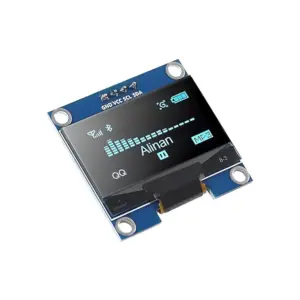
Generic 0.96-inch OLED Display Module | I2C/IIC 4-Pin Interface | Vivid Blue Pixels

₹149.00₹250.00 (price_including_tax) (-40%)
Unlock vibrant visual feedback for your embedded systems with this 0.96-inch OLED display. Perfectly suited for microcontrollers, it provides a crisp, high-contrast interface for data and status. Engineered for robust performance, it offers reliable operation in diverse project environments.
This compact 0.96-inch OLED display delivers crisp, high-contrast visuals via simple I2C, ideal for embedded projects.
Simple 4-pin I2C connectivity ensures quick setup with minimal microcontroller resource demands.
Self-emissive blue pixels provide sharp, high-contrast visuals, enhancing readability across various lighting.
Its small footprint and low power draw make it perfect for portable and battery-operated devices.
The Engineering Behind 0.96 Inch I2C OLED Display Module
The 0.96 Inch I2C/IIC OLED Display Module is a self-luminous display unit, eliminating the need for a backlight. Its compact design integrates a powerful SSD1306 controller, enabling direct interfacing with popular microcontrollers like Arduino, ESP32, and Raspberry Pi via a two-wire I2C communication protocol. Each pixel generates its own light, resulting in superior contrast ratios and true black levels, making it ideal for displaying concise textual and graphical information.
Built with robust components, this OLED module is designed for long-term stability in various DIY, educational, and professional prototyping applications. Its low power consumption and wide viewing angle make it a practical choice for battery-powered projects and user interfaces where clarity is paramount, fostering both innovation and reliable system integration.
I2C/IIC Communication Protocol
The integrated I2C (Inter-Integrated Circuit) interface, also known as IIC, simplifies wiring to just four pins (VCC, GND, SDA, SCL). This two-wire serial bus significantly reduces hardware complexity and pin usage on the host microcontroller, freeing up valuable GPIOs for other sensor or actuator connections. This efficient protocol enables rapid data transfer for dynamic display updates while maintaining a clean, organized project footprint.
Self-Luminous BLUE Pixels
Unlike traditional LCDs that require a backlight, the OLED technology features self-emissive pixels, which contribute to its ultra-thin profile and excellent visibility even in low-light conditions. The specific blue color output ensures high contrast and legibility for monochrome data, reducing eye strain and enhancing user experience, particularly in applications where aesthetic clarity and power efficiency are critical.
Optimized for Performance & Integration
- Display Type: OLED
- Screen Size: 0.96 Inch Diagonal
- Resolution: 128×64 Pixels
- Color: Blue Monochrome
- Controller IC: SSD1306
- Interface: I2C/IIC (4-pin)
- Operating Voltage: 3V-5V DC
- Viewing Angle: >160 Degrees
Features & Benefits
- Compact 0.96 Inch Size: Ideal for space-constrained projects requiring clear visual output.
- I2C/IIC Interface: Simplifies wiring with only two data lines, conserving microcontroller pins.
- 128×64 Resolution: Provides crisp, readable text and basic graphics for user interfaces.
- Self-Luminous OLED Technology: Delivers high contrast and true blacks without a backlight.
- Wide Operating Voltage (3V-5V): Compatible with both 3.3V and 5V logic microcontrollers.
- Blue Monochrome Display: Offers excellent readability and a distinctive aesthetic for embedded systems.
Pro-Grade Advantages
- High contrast ratio for superior readability in diverse conditions.
- Low power consumption extends battery life in portable applications.
- Minimal wiring complexity due to I2C interface, saving GPIOs.
- Fast refresh rates suitable for dynamic data display.
Technical Considerations
- Monochrome display limits complex graphical user interface designs.
- Limited screen size might not be suitable for extensive data presentation.
What is the primary controller chip used in this 0.96 inch OLED module?
This 0.96 inch OLED module commonly integrates the SSD1306 controller, which manages pixel addressing and display functions.
What is the difference between I2C and IIC in this context?
I2C and IIC (Inter-Integrated Circuit) are synonymous terms referring to the same two-wire serial communication protocol for connecting low-speed devices.
What is the typical operating voltage range for this OLED display?
The module is designed to operate reliably within a 3V to 5V DC supply voltage range, making it compatible with most microcontrollers.
Can I display images or custom fonts on this monochrome OLED?
Yes, while monochrome, you can display custom bitmapped images, icons, and various fonts by converting them to the 128×64 pixel format and sending them via I2C.
How does OLED technology differ from LCD technology for small displays?
OLED displays are self-emissive, meaning each pixel generates its own light, resulting in higher contrast, true blacks, and wider viewing angles compared to LCDs, which require a backlight.
| Specification | Value |
|---|---|
| Display Size | 0.96 inch |
| Resolution | 128×64 pixels |
| Color Depth | Monochrome (Blue) |
| Controller IC | SSD1306 |
| Interface Protocol | I2C/IIC |
| Number of Pins | 4 (VCC, GND, SCL, SDA) |
| Operating Voltage | 3.0V – 5.0V DC |
| Operating Current | ~20mA (Max) |
| Pixel Pitch | 0.15mm x 0.15mm |
| Active Area | 21.74mm x 10.86mm |
| Module Dimensions (L x W) | 27mm x 27mm (approx) |
| Viewing Angle | >160 Degrees |
Additional information
| Weight | 0.005 kg |
|---|---|
| Dimensions | 2.7 × 2.7 × 0.4 cm |
| Technology | OLED |
| Operating Voltage | 3V-5V DC |
| Control Interface | I2C/IIC |
| Sensor Type | Display |
| Package | Module |
Reviews
There are no reviews yet.