
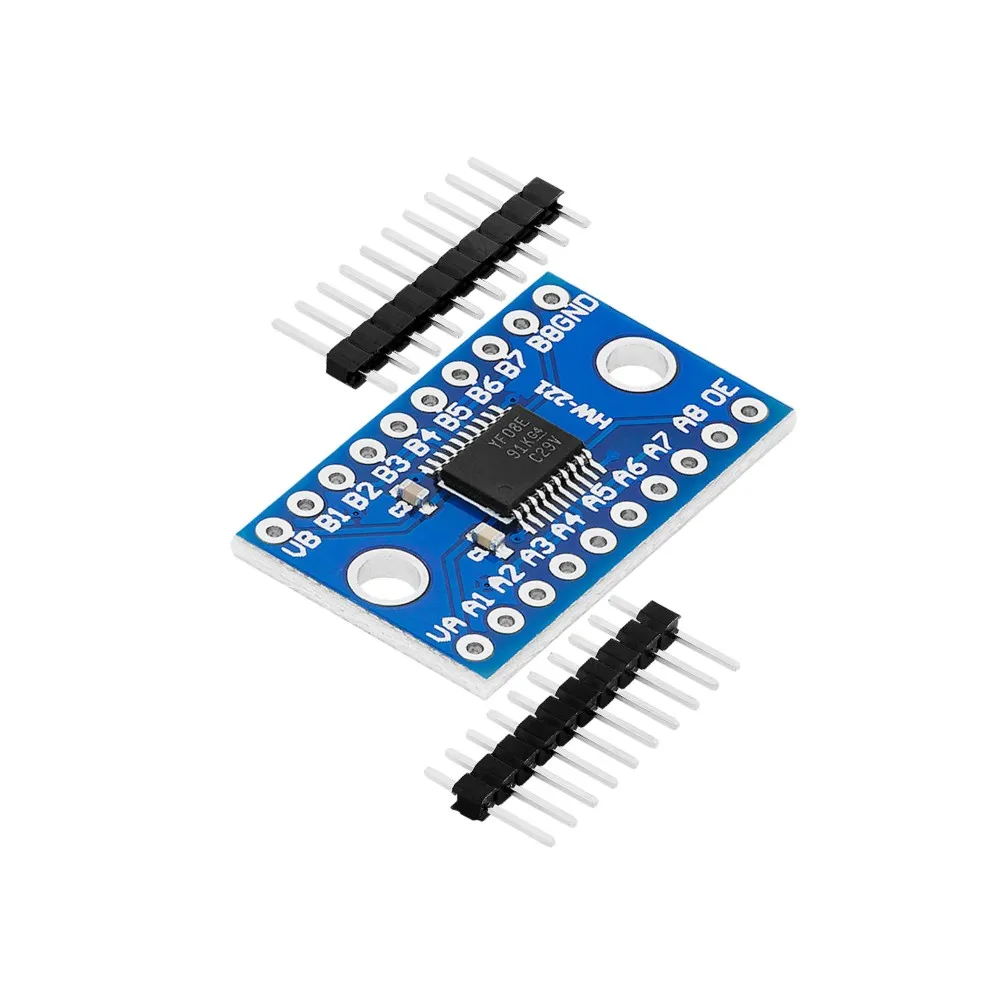
Generic 8-Channel Logic Level Converter Module | Bi-Directional | 3.3V-5V Interfacing
₹79.00₹120.00 (price_including_tax) (-34%)
Ensure perfect compatibility between your diverse digital components. This module effortlessly translates signals between 3.3V and 5V microcontrollers, sensors, and peripherals, preventing damage. Engineered for precision, it delivers stable, noise-free communication critical for complex embedded systems and IoT projects.
Essential 8-channel bi-directional logic level converter module for seamless 3.3V and 5V system integration.
Seamlessly translates signals in both directions, enabling robust communication between diverse voltage systems effortlessly.
Effortlessly interfaces 3.3V and 5V components, protecting sensitive electronics from damaging voltage mismatches.
Compact module with built-in pull-ups simplifies wiring, reducing complexity for rapid prototyping and deployment.
The Engineering Behind Generic 8-Channel Bi-Directional Logic Level Converter Module
The 8-channel bi-directional logic level converter module is a foundational component for interfacing digital systems operating at different voltage potentials, most commonly 3.3V and 5V. It typically employs a design centered around an array of low-threshold N-channel MOSFETs, such as the BSS138, combined with appropriate pull-up resistors on both the high-voltage (HV) and low-voltage (LV) sides. This architecture allows for seamless signal translation in either direction, crucial for microcontrollers communicating with peripherals or sensors that demand specific voltage logic.
Designed for robustness and ease of integration, this module features a compact form factor with clearly labeled pin headers, making it ideal for breadboard prototyping as well as permanent installations. The high-quality PCB and passively driven MOSFETs ensure reliable operation across various applications, from hobbyist projects to more demanding industrial embedded systems, safeguarding sensitive components from voltage mismatches.
Bi-Directional Signal Translation
The standout feature of this logic level converter is its inherent bi-directional capability. Unlike simpler uni-directional converters, this module allows a single data line to transmit information from the low-voltage side to the high-voltage side, and then seamlessly receive data back from the high-voltage side, all without needing to reconfigure or switch directions programmatically. This dynamic translation is essential for communication protocols like I2C, which utilize a single data line for both master and slave communication.
Wide Voltage Interoperability (3.3V to 5V)
Engineered to operate across a broad range of digital logic voltages, this module specifically caters to the pervasive 3.3V and 5V standards. It provides dedicated power input rails for both the high-voltage (HV) and low-voltage (LV) sides, allowing developers to connect 5V microcontrollers (like many Arduino boards) with 3.3V sensors (e.g., ESP32, Raspberry Pi, various accelerometers, and GPS modules) without fear of damaging components. This flexibility resolves common interoperability challenges in mixed-voltage electronic circuits.
Optimized for Performance & Integration
- Channels: 8 independent bi-directional conversion lines
- High Voltage (HV) Support: Up to 5.5V DC
- Low Voltage (LV) Support: Down to 1.8V DC (common for 3.3V logic)
- Architecture: MOSFET-based with integrated pull-up resistors
- Compatibility: I2C, SPI, UART, and general purpose I/O (GPIO)
- Form Factor: Compact breadboard-friendly design with male header pins
- Typical Usage: Interfacing 3.3V microcontrollers with 5V sensors/peripherals
Features & Benefits
- 8 Bi-Directional Channels: Simultaneously convert up to eight separate digital signals in both directions, perfect for complex projects like I2C or SPI communication.
- Wide Voltage Range (1.8V-5.5V): Safely connect components operating at different logic levels, from low-power 1.8V devices to standard 5V systems, enhancing project flexibility.
- Integrated Pull-Up Resistors: Simplifies circuit design by including necessary pull-up resistors, especially beneficial for open-drain protocols like I2C, reducing external component count.
- MOSFET-Based Architecture: Ensures efficient and reliable signal conversion with minimal signal degradation, suitable for high-speed data transfer and critical applications.
- Compact & Breadboard-Friendly: Its small footprint and standard pin headers allow for easy integration into prototypes and final products, saving valuable board space.
- Protection Against Voltage Mismatch: Prevents irreversible damage to sensitive microcontrollers and peripherals by providing a robust voltage translation layer.
Pro-Grade Advantages
- Supports simultaneous bi-directional conversion on 8 channels.
- Compatible with a wide range of logic voltages (1.8V to 5.5V).
- Integrated pull-up resistors simplify setup for I2C and similar protocols.
- Protects sensitive components from voltage overstress.
Technical Considerations
- Not suitable for very high-frequency signals (e.g., >20MHz without optimization).
- Requires external power connections for both HV and LV rails.
What is a logic level converter and why do I need one?
A logic level converter translates digital signals between components operating at different voltage levels (e.g., 3.3V and 5V). You need one to prevent damage to lower-voltage devices when connected to higher-voltage systems, ensuring safe and correct data communication.
Is this module truly bi-directional, and how does it work?
Yes, it is fully bi-directional. It uses MOSFETs that allow current to flow in both directions, making it ideal for protocols like I2C where a single line transmits and receives data.
What voltage ranges does this 8-channel converter support?
This module supports high voltage (HV) from 2V to 5.5V and low voltage (LV) from 1.8V to HV. It is commonly used for 3.3V to 5V conversions.
Can I use this with SPI or UART communication protocols?
Absolutely. Its 8 independent channels and bi-directional nature make it perfect for converting signals for SPI (MOSI, MISO, SCK, CS) and UART (TX, RX) communication between different voltage domains.
Are pull-up resistors required for I2C with this module?
This module typically includes integrated pull-up resistors on both the HV and LV sides, which are essential for I2C communication. This simplifies wiring and eliminates the need for external pull-up components.
What are the primary applications for this logic level converter?
It’s widely used in embedded systems, IoT projects, robotics, and STEM education for interfacing 3.3V microcontrollers (like ESP32, Raspberry Pi) with 5V sensors, displays, or other peripherals, and vice versa.
| Specification | Value |
|---|---|
| Module Type | Bi-Directional Logic Level Converter |
| Number of Channels | 8 |
| High Voltage (HV) Range | 2V to 5.5V DC |
| Low Voltage (LV) Range | 1.8V to HV DC |
| Typical LV Application | 3.3V Logic |
| Typical HV Application | 5V Logic |
| Conversion Method | MOSFET (e.g., BSS138) |
| Integrated Pull-ups | Yes (for I2C) |
| Board Dimensions | Approx. 25mm x 15mm |
| Pinout | HV, LV, GND, HV1-8, LV1-8 |
| Operating Temperature | -40°C to +85°C |
Additional information
| Brand | Generic |
|---|---|
| Technology | Logic Level Conversion (MOSFET) |
| Operating Voltage | 1.8V-5.5V |
| Channels | 8 |
| Difficulty Level | Intermediate |

Reviews
There are no reviews yet.