SKU: IOWC-0668
📋 GST Invoice Available

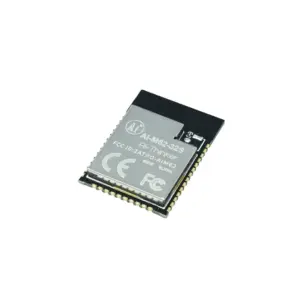
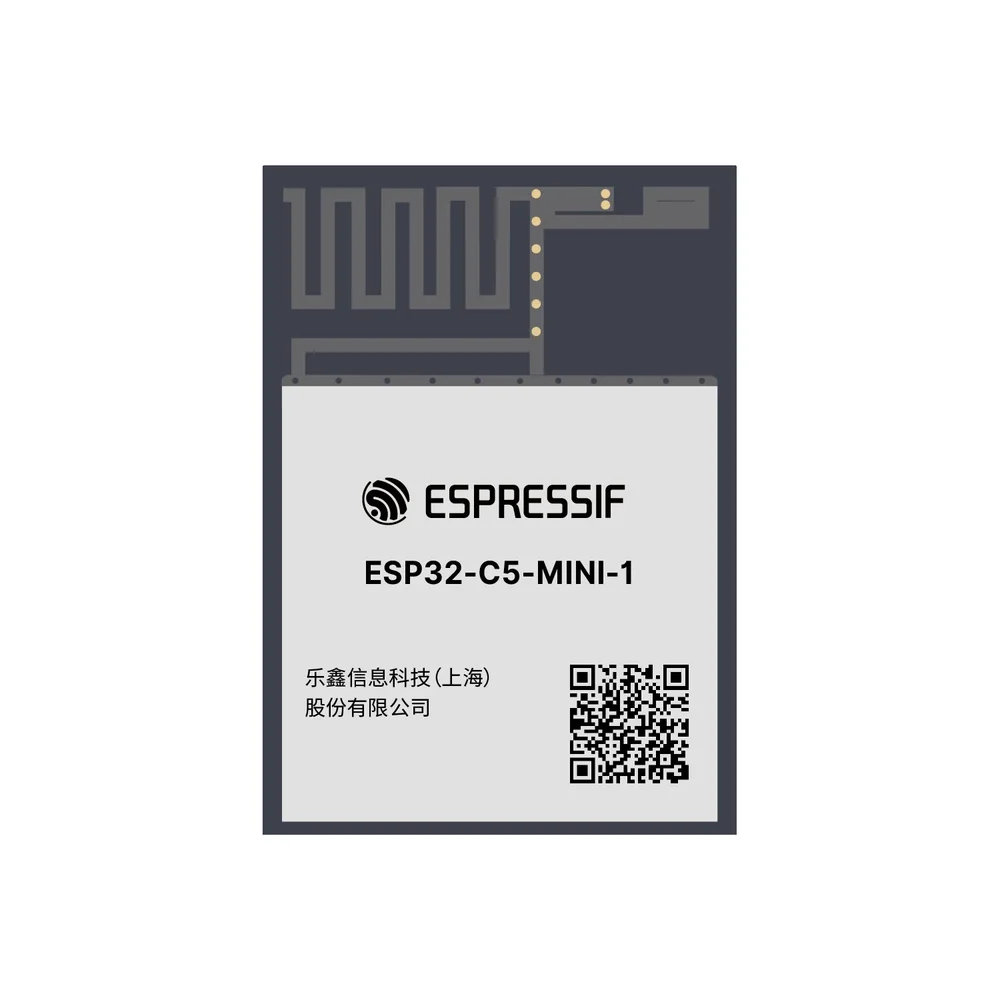
Espressif ESP32-C5-MINI-1-N4 Wi-Fi 6 & BLE Module

₹339.00 (Inclusive of all taxes)
Out of Stock

The Espressif ESP32-C5-MINI-1-N4 is a compact wireless module featuring a 240 MHz RISC-V core, dual-band Wi-Fi 6 (2.4/5 GHz), and Bluetooth LE 6.0 support, designed for modern IoT applications requiring multi-protocol connectivity.

Features

  • Dual-Band Wi-Fi 6 & Multi-Protocol Radio: Integrates 2.4/5 GHz Wi-Fi 6 (802.11ax) with concurrent Bluetooth LE 6.0, Zigbee 3.0, and Thread 1.4 support for flexible wireless IoT networks.
  • High-Performance RISC-V Core: Powered by a 32-bit single-core RISC-V processor clocked up to 240 MHz, delivering efficient processing for complex connectivity tasks.
  • Integrated 4 MB Flash & Rich I/O: Features 4 MB of onboard SPI flash and up to 22 GPIOs supporting SPI, I2C, UART, I2S, CAN FD, SDIO, ADC, and PWM interfaces.
  • Robust Industrial Design: Operates from 3.0V to 3.6V with a wide temperature range of -40°C to +85°C, ensuring reliability in demanding environments.
  • Compact, Antenna-Integrated Form Factor: Measures just 15.4 x 21.3 mm with an onboard PCB antenna, simplifying RF design for space-constrained applications.

Out of stock

Description

The Espressif ESP32-C5-MINI-1-N4 module represents a significant step forward in integrated wireless connectivity for embedded systems. Its architecture centers on a 240 MHz 32-bit RISC-V processor, providing a power-efficient yet capable compute platform for handling the protocol stacks of Wi-Fi 6, Bluetooth LE, Zigbee, and Thread simultaneously. This multi-protocol capability allows developers to design devices that can seamlessly interact across different wireless ecosystems, from IP-based networks to low-power mesh protocols.

Engineered for industrial-grade reliability, the module operates across a wide voltage range and is rated for extended temperature environments. Its compact footprint and integrated PCB antenna minimize external component count, accelerating time-to-market for products like smart home hubs, industrial sensor nodes, advanced wearables, and automation controllers. Full support within the ESP-IDF framework and Arduino core enables rapid firmware development, leveraging the module’s rich peripheral set including CAN FD for automotive networks and USB for direct programming and debugging.

Key Features

  • Multi-Protocol Wireless SoC: Combines dual-band Wi-Fi 6 (802.11ax), Bluetooth LE 6.0, Zigbee 3.0, and Thread 1.4 in a single chip, enabling versatile device connectivity.
  • RISC-V Processor Efficiency: Leverages an open-standard 240 MHz RISC-V core for optimal performance per watt, supported by 384KB HP SRAM and 16KB LP SRAM.
  • Onboard Memory Solution: Integrates 4 MB of SPI flash memory for application code and data storage, eliminating the need for external flash in many designs.
  • Comprehensive Peripheral Interface: Offers a full suite of interfaces including USB Serial/JTAG for programming, CAN FD for industrial buses, SDIO for storage, and multiple ADC/PWM channels.
  • Optimized RF Performance: Features an onboard PCB antenna tuned for dual-band operation, providing stable connectivity with a Wi-Fi data rate up to 150 Mbps.
  • Extended Operational Range: Certified for operation from -40°C to +85°C, making it suitable for outdoor, automotive, and harsh industrial applications.

Applications

  • Smart Home Hubs & Automation: Central controller for lights, locks, and sensors using Wi-Fi, BLE, and Thread/Zigbee mesh networks.
  • Industrial IoT & Telemetry: Rugged wireless node for machine monitoring, data logging, and CAN FD bus gateway functions.
  • Advanced Wearable Devices: Fitness and health trackers requiring multi-radio connectivity, local processing, and compact size.
  • Sensor Fusion Gateways: Aggregates data from multiple sensor types (via I2C/SPI/ADC) and transmits via Wi-Fi 6 or cellular backhaul.
  • Connected Consumer Electronics: Next-gen audio products, appliances, and tools with over-the-air (OTA) update capabilities via robust Wi-Fi 6.

Technical Specifications

Microcontroller/SoC32-bit RISC-V Single-Core, Up to 240 MHz
Wireless ProtocolsDual-Band Wi-Fi 6 (2.4/5 GHz), Bluetooth LE 6.0, Zigbee 3.0, Thread 1.4
Frequency RangeWi-Fi: 2412–2484 MHz, 5180–5885 MHz
RF Transmit Power / SensitivityWi-Fi Data Rate: Up to 150 Mbps
Memory4 MB SPI Flash, 384 KB HP SRAM, 16 KB LP SRAM, 320 KB ROM
Supply Voltage3.0 V to 3.6 V
GPIO & InterfacesUp to 22 GPIOs; SPI, UART, I2C, I2S, USB Serial/JTAG, CAN FD, SDIO, ADC, PWM
Antenna ConnectorOn-board PCB Antenna
Operating Temperature-40°C to +85°C
Dimensions (L x W x H)21.3 mm × 15.4 mm × 2.4 mm

Frequently Asked Questions

What development frameworks are supported for the ESP32-C5-MINI-1-N4?

The module is fully supported by Espressif's official ESP-IDF (IoT Development Framework) and the Arduino core for ESP32. You can develop applications in C/C++ using ESP-IDF for maximum control and low-level access to Wi-Fi 6, BLE, and Thread/Zigbee stacks. The Arduino core provides a simpler, library-based approach for rapid prototyping. Both frameworks support over-the-air (OTA) updates, deep sleep power management, and all integrated peripherals via PlatformIO or native toolchains.

How do I power the ESP32-C5 module and what are its current requirements?

Power the ESP32-C5-MINI-1-N4 with a regulated 3.3V supply (3.0V to 3.6V range) connected to the 3V3 and GND pins. Typical active current consumption depends on the wireless mode; Wi-Fi transmission can draw several hundred milliamps, while BLE or Zigbee operation is lower. The module supports various low-power sleep modes, with deep sleep current in the microamp range, which is critical for battery-powered sensor nodes. Always use a stable power source capable of supplying peak currents and include decoupling capacitors near the module's power pins.

Can I use an external antenna with this module, and how is the RF output configured?

The ESP32-C5-MINI-1-N4 variant comes with a fixed onboard PCB antenna. For designs requiring an external antenna, you would need to select a different module variant from Espressif (e.g., one with an IPEX connector). The RF path is factory-configured for the integrated antenna. If using an external antenna, you must ensure impedance matching (50 ohms) and use a certified antenna for the target frequency bands (2.4 GHz and 5 GHz for Wi-Fi, 2.4 GHz for BLE/Zigbee/Thread) to comply with regional regulatory standards.

What is the procedure for flashing firmware onto the ESP32-C5 module?

Firmware is flashed via the integrated USB Serial/JTAG interface, which appears as a COM port when connected to a host computer. Using ESP-IDF or Arduino IDE, you can compile your code and upload it directly. For production or headless programming, you can use the UART interface (GPIO pins for TX/RX) with an external USB-to-serial adapter. The module supports secure boot and flash encryption features available in ESP-IDF. Ensure the GPIO0 pin is pulled low during reset to enter the serial bootloader mode for initial flashing.

Package Includes

  • 1 x Espressif ESP32-C5-MINI-1-N4 Module

Additional Information

Weight 0.01 kg
Dimensions 2.13 × 1.54 × 0.24 cm