SKU: IOWC-1331
📋 GST Invoice Available

ESP8266 ESP-07 Serial Wi-Fi Module

₹146.00 (Inclusive of all taxes)
Out of Stock

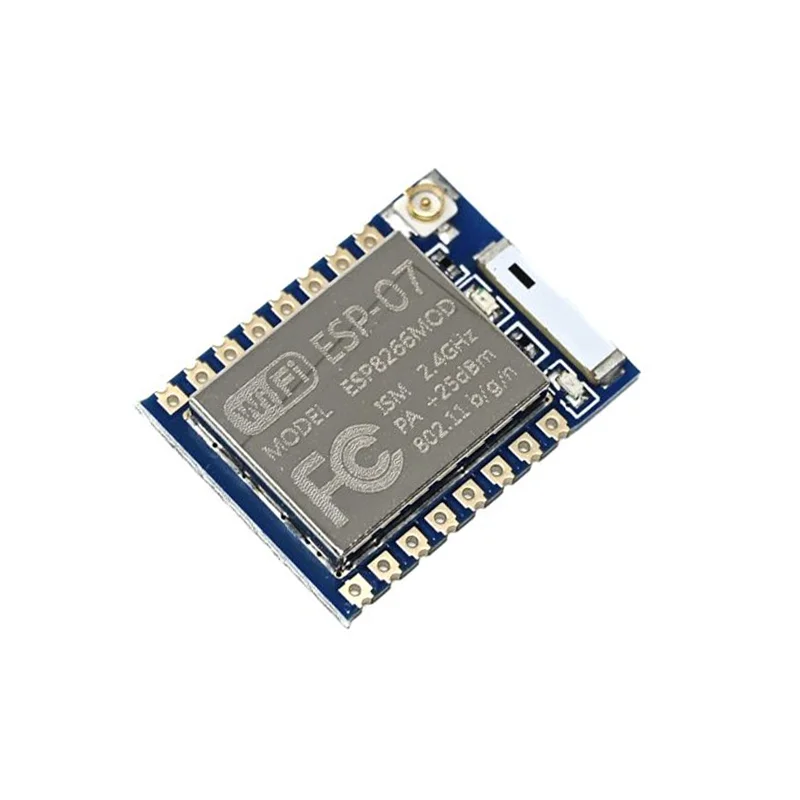
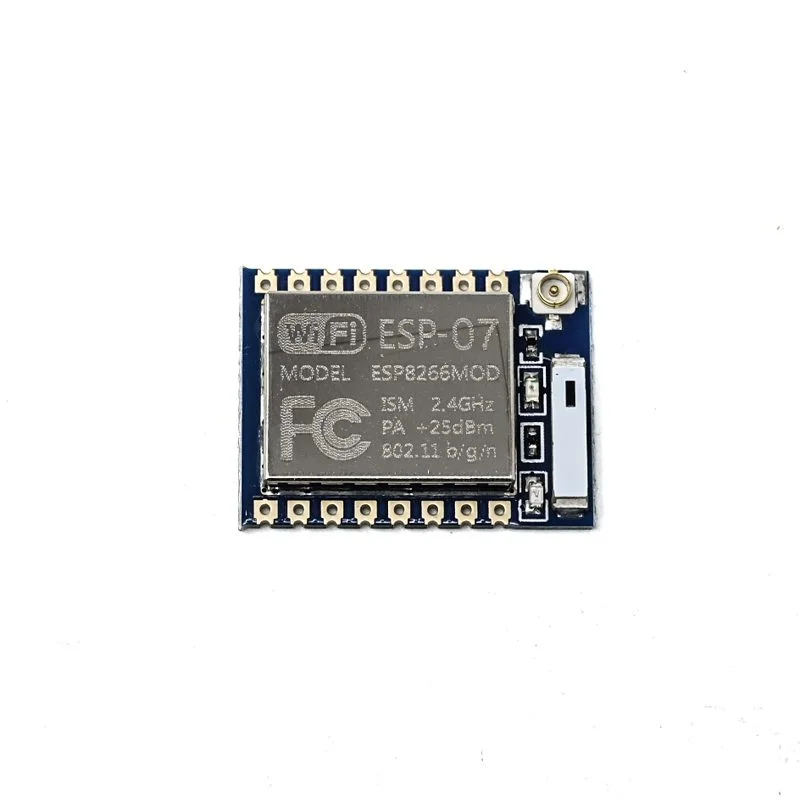
The ESP8266 ESP-07 is a compact serial-to-Wi-Fi module based on the ESP8266EX SoC, providing 2.4GHz 802.11 b/g/n connectivity for remote control and IoT projects. It operates at 3.3V and is programmable via Arduino IDE, PlatformIO, or ESP-IDF.

Features

  • Powered by the ESP8266EX SoC with integrated Wi-Fi and a 32-bit Tensilica L106 processor.
  • Supports 2.4GHz 802.11 b/g/n Wi-Fi in Station (STA), Soft Access Point (AP), and hybrid modes.
  • Features a UART serial interface for easy communication with microcontrollers like Arduino.
  • Includes onboard antenna and 1MB of flash memory for program and data storage.
  • Low-power design suitable for battery-powered wireless sensor nodes and remote controls.

Out of stock

Description

The ESP8266 ESP-07 module is a fundamental building block for adding Wi-Fi connectivity to embedded systems. It integrates the full TCP/IP protocol stack and microcontroller core, enabling direct wireless communication with minimal external components. The module’s serial interface allows it to act as a Wi-Fi adaptor for host MCUs or to run standalone applications.

With support for common security protocols (WEP, WPA/WPA2) and Over-The-Air (OTA) updates, it is designed for robust, maintainable deployments in smart home automation, industrial telemetry, and remote sensor networks. Its compact form factor and onboard antenna simplify integration into final product designs.

Key Features

  • Integrated Wi-Fi networking enables direct internet connectivity for any microcontroller project.
  • Serial UART interface provides a simple command-based control channel using AT commands or custom firmware.
  • Onboard PCB antenna offers a compact solution with typical indoor ranges of 50 meters.
  • Low power consumption with deep sleep modes extends battery life in intermittent sensing applications.
  • Programmability via Arduino IDE or ESP-IDF allows for rapid development of custom IoT applications.
  • Supports Over-The-Air (OTA) firmware updates for remote maintenance and feature deployment.
  • Robust Wi-Fi security with support for WPA/WPA2 enterprise and personal modes.

Applications

  • Smart home automation for wireless control of lights, relays, and sensors.
  • Industrial IoT (IIoT) for remote monitoring and telemetry data transmission.
  • DIY electronics projects requiring internet connectivity, such as weather stations or data loggers.
  • Wireless sensor networks for agriculture, environmental monitoring, and asset tracking.
  • Retrofitting legacy serial devices (RS232/RS485) with Wi-Fi capability.

Technical Specifications

Microcontroller/SoCESP8266EX (32-bit Tensilica L106)
Wireless Protocol802.11 b/g/n Wi-Fi
Frequency Range2.4 GHz
RF Transmit PowerTypical +20dBm
Supply Voltage3.3V DC
Flash Memory1 MB
InterfacesUART Serial
Antenna ConnectorOnboard PCB Antenna
Operating Temperature-40°C to +125°C (Chip spec)
DimensionsApprox. 18mm x 20mm (Module)

Frequently Asked Questions

How do I program the ESP-07 module using the Arduino IDE?

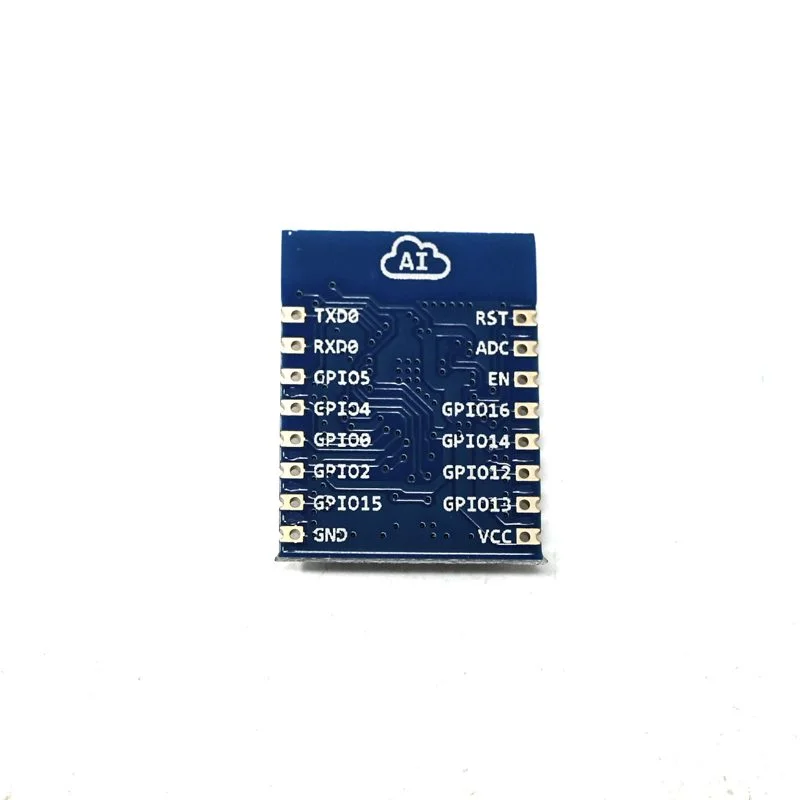
First, install the ESP8266 board package via the Arduino Boards Manager. Select 'Generic ESP8266 Module' as your board. Connect the module's TX/RX pins to a USB-to-Serial adapter, ensuring you connect the CH_PD (enable) pin to 3.3V. Set the correct baud rate (typically 115200) and flash size (1MB) in the Tools menu before uploading your sketch.

What is the default baud rate for AT commands on the ESP-07?

The factory firmware on many ESP-07 modules defaults to a baud rate of 115200 bps for the UART serial interface used for AT commands. You can verify this by sending 'AT' and expecting an 'OK' response. The rate can be reconfigured using the AT+UART command if your host microcontroller requires a different serial communication speed.

Can I use the ESP-07 as a standalone microcontroller without an external host?

Yes, the ESP8266EX integrates a 32-bit processor and can run your application code directly. You must program it using the Arduino IDE or ESP-IDF framework, utilizing its GPIO pins for I/O. This eliminates the need for a separate Arduino or MCU, making it ideal for compact, cost-sensitive Wi-Fi sensor node designs.

What power supply considerations are needed for the ESP-07 module?

The ESP-07 requires a stable 3.3V DC power supply. During Wi-Fi transmission peaks, it can draw over 200mA, so your regulator must provide adequate current. For battery operation, implement deep sleep modes to minimize average consumption. Bypass capacitors (e.g., 10uF and 0.1uF) placed close to the VCC pin are essential for stable operation.

Package Includes

  • 1 x ESP8266 ESP-07 Serial Wi-Fi Module

Additional Information

Weight 0.03 kg
Dimensions 6 × 8 × 3 cm