SKU: IOWC-1800
📋 GST Invoice Available

ESP32-DW3210 UWB Evaluation Board w/ Dual Antenna Switch

₹7,670.00 (Inclusive of all taxes)
Out of Stock

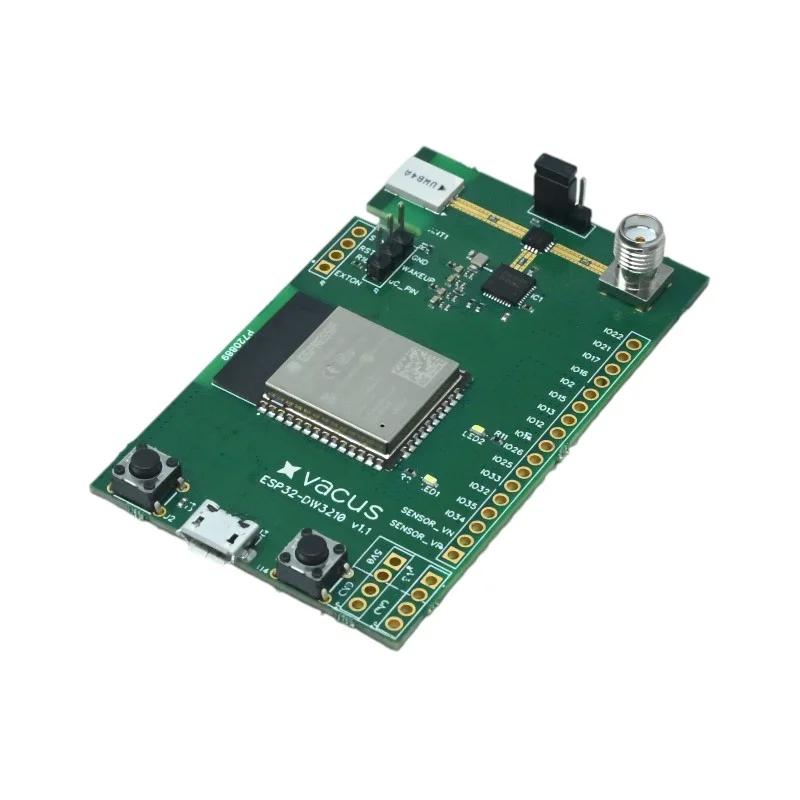
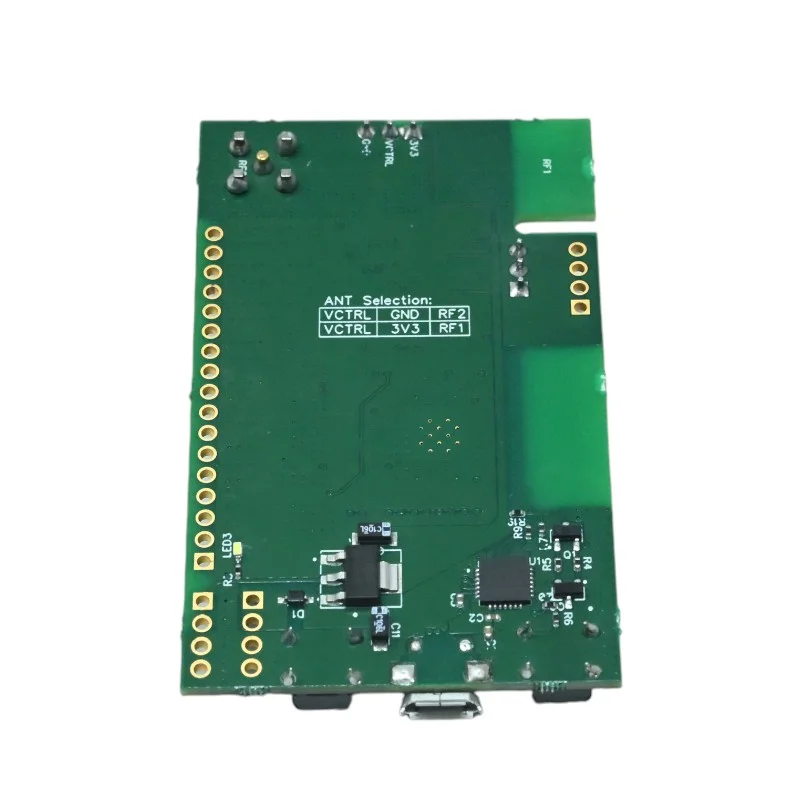
The ESP32-DW3210 UWB Evaluation Board integrates an ESP32 microcontroller with a DW3210 UWB transceiver for high-precision indoor positioning and ranging. Powered by 3.3V, it features an ADRF5019 RF switch for flexible selection between an onboard chip antenna and an external SMA antenna, enabling rapid prototyping for ESP-IDF or Arduino-based UWB applications.

Features

  • Dual-Core ESP32 + DW3210 UWB transceiver for precise ranging and wireless data processing.
  • ADRF5019 SPDT RF switch enables jumper-controlled selection between onboard chip antenna and external SMA antenna.
  • Compact onboard UWB chip antenna ideal for space-constrained indoor positioning system (IPS) prototypes.
  • SMA connector supports external high-gain antennas for extended-range UWB experiments and performance comparisons.
  • 4 MB flash memory and dual-core Xtensa LX6 processor support complex firmware development in ESP-IDF or Arduino IDE.

Out of stock

Description

The ESP32-DW3210 UWB Evaluation Board is a dedicated development platform for ultra-wideband (UWB) wireless ranging and indoor positioning. It pairs the computational power and Wi-Fi/Bluetooth connectivity of the ESP32 with the precise time-of-flight measurement capabilities of the DW3210 UWB transceiver. This combination allows developers to build systems capable of centimeter-accurate distance measurement and real-time location tracking.

Central to its design is the integrated ADRF5019 high-performance SPDT RF switch, which provides hardware-level flexibility for antenna configuration. Developers can use jumper settings to instantly switch the RF path between the compact, integrated chip antenna for minimal footprint designs or route the signal to an external SMA connector for attaching directional or high-gain antennas to maximize range and optimize link performance in challenging environments.

Key Features

  • Integrated ESP32 microcontroller provides dual-core processing, Wi-Fi, and Bluetooth for wireless communication and system control.
  • High-precision DW3210 UWB transceiver enables centimeter-accurate ranging and real-time indoor positioning.
  • ADRF5019 SPDT RF switch allows for seamless, low-loss switching between two antenna paths via a simple jumper setting.
  • Onboard UWB chip antenna offers a compact, integrated solution for development and testing in confined spaces.
  • SMA connector facilitates connection to external UWB antennas, enabling range extension and antenna performance benchmarking.
  • Jumper-controlled antenna selection enables rapid A/B testing between antenna configurations without hardware modification.
  • Robust 4 MB flash memory supports feature-rich firmware for complex UWB applications and data logging.
  • Wide operating temperature range (-40°C to +85°C) ensures reliability for industrial and outdoor deployment scenarios.

Applications

  • UWB-based Indoor Positioning System (IPS) prototyping for asset tracking and navigation.
  • Precision ranging experiments for robotics, drones, and autonomous systems.
  • Antenna performance comparison and evaluation for UWB link optimization.
  • Wireless sensor network development requiring accurate node localization.
  • Real-time location services (RTLS) and proximity sensing applications.

Technical Specifications

Microcontroller/SoCESP32 (Dual-core Xtensa 32-bit LX6)
UWB TransceiverDW3210
RF SwitchADRF5019 SPDT
Antenna OptionsOnboard Chip Antenna, External SMA Connector
Flash Memory4 MB
Supply Voltage3.3V
Max Operating Current240 mA
Operating Temperature-40°C to +85°C
Dimensions (LxW)72 mm x 45 mm
Weight20 g

Frequently Asked Questions

How do I switch between the onboard and external antenna on this board?

The board uses an ADRF5019 SPDT RF switch controlled by a physical jumper. To select the antenna path, simply move the jumper to connect the DW3210's RF output to either the onboard chip antenna trace or the path leading to the SMA connector. This allows for quick hardware switching without any firmware changes, ideal for comparing antenna performance in different UWB ranging scenarios.

What software frameworks are compatible with the ESP32-DW3210 board?

You can develop firmware for this board using Espressif's official ESP-IDF framework or the Arduino Core for ESP32 via the Arduino IDE or PlatformIO. You will need to integrate a UWB library or driver for the DW3210 transceiver to handle ranging and communication protocols. Example code often involves initializing the UWB radio, configuring ranging parameters, and processing time-of-flight data for positioning calculations.

What is the typical power consumption during UWB ranging operations?

While specific current draw for the DW3210 during active ranging depends on configuration, the board's ESP32 microcontroller and UWB transceiver combined can draw up to the specified maximum of 240 mA. For battery-powered applications, you should leverage the ESP32's deep sleep modes and only activate the UWB radio periodically to minimize average current consumption and extend operational life.

Can I use this board for bidirectional UWB communication, or just ranging?

The DW3210 UWB transceiver is capable of both precise ranging (measuring distance between nodes) and data communication. While often used for Time-of-Flight (ToF) based positioning, its UWB pulses can also be modulated to carry packet data. Your firmware can be designed to alternate between ranging sessions and sending small data packets, enabling networked sensor applications with integrated location awareness.

Package Includes

  • 1 x ESP32-DW3210 UWB Evaluation Board

Additional Information

Weight 0.02 kg
Dimensions 7.2 × 4.5 cm