SKU: IOWC-0902
📋 GST Invoice Available

Amotech Labs PIC18F/16F Mini Dev Board w/ PIC18F452 & LCD

₹1,328.00 (Inclusive of all taxes)
Out of Stock

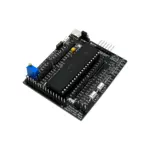
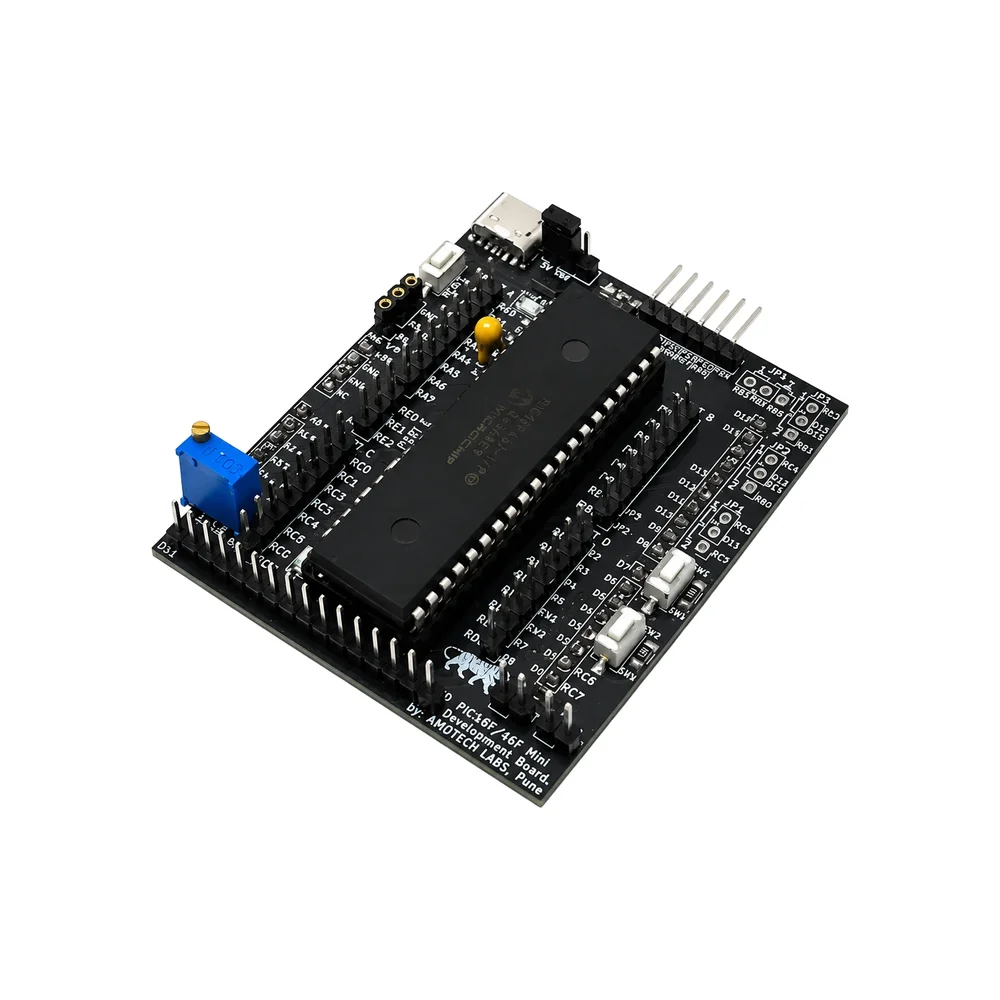
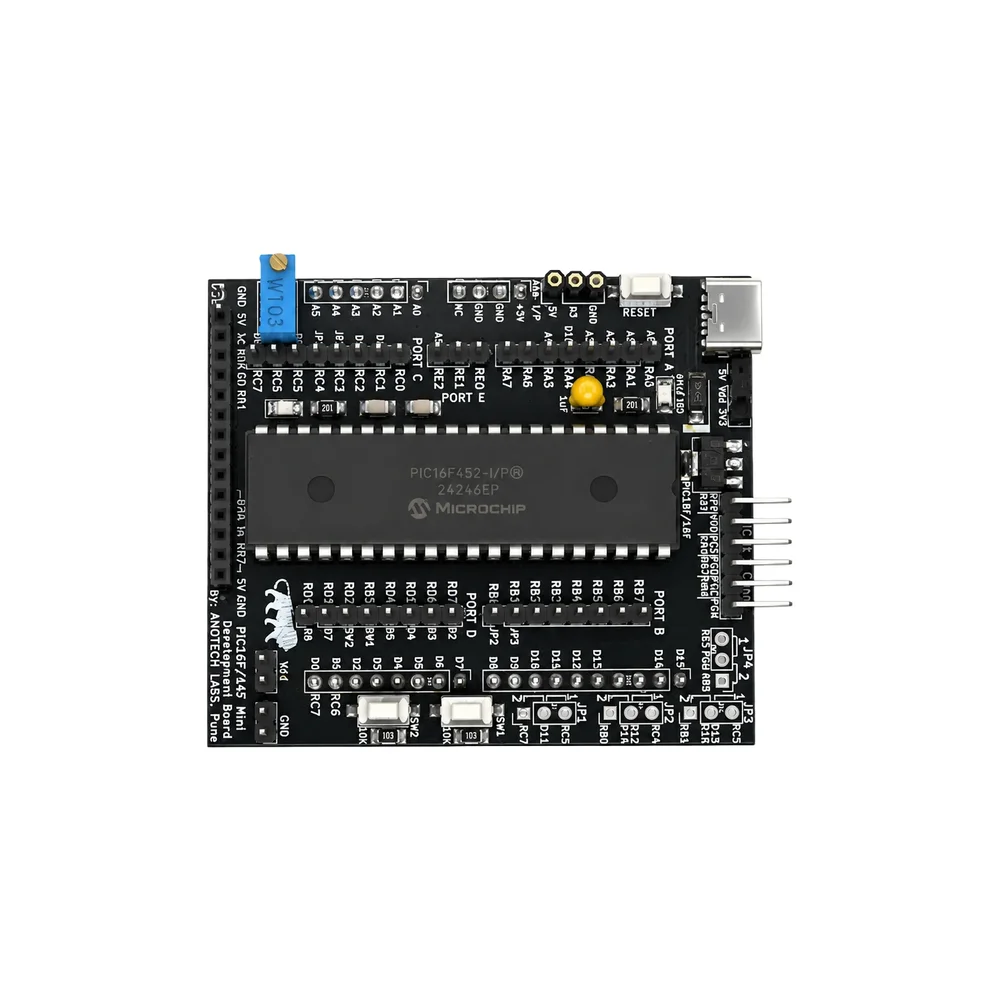
The Amotech Labs PIC18F/16F Mini Development Board is a dedicated platform for embedded development with Microchip Technology PIC microcontrollers. It features a 40-pin DIP socket, onboard PICkit programming connector, USB-C power, and an integrated LCD for rapid prototyping and educational projects.

Features

  • Supports a wide range of PIC16F and PIC18F series microcontrollers in a standard 40-pin DIP socket for flexible project development.
  • Integrated PICkit 3/3.5 programming connector enables direct firmware flashing without external adapters.
  • Onboard USB-C port provides a stable +5V power supply, simplifying the power setup for portable applications.
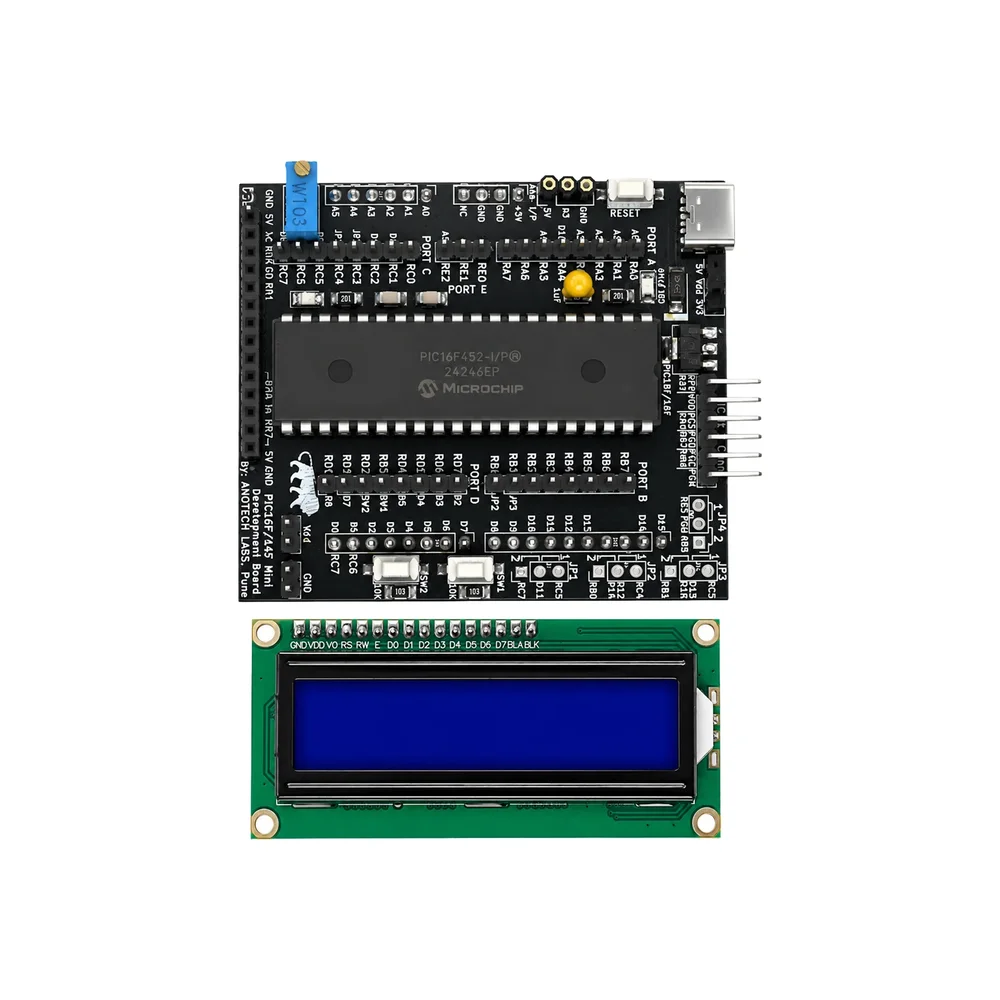
  • Includes a built-in LCD display and accessible GPIO ports (A-E) with an LED and push buttons for immediate I/O testing.
  • Features jumper-configurable SPI and I2C routing (JP1-JP4) and an analog input slot for easy sensor interfacing.

Out of stock

Description

The Amotech Labs PIC18F/16F Mini Development Board is a compact and efficient platform designed for embedded system engineers, students, and hobbyists working with Microchip Technology’s PIC microcontroller families. It provides a complete prototyping environment with a 40-pin DIP socket, accommodating various PIC16F and PIC18F chips, and includes essential peripherals like an LCD, user buttons, and a status LED for rapid functional validation.

Integration is streamlined with an onboard PICkit programming header, eliminating the need for external debuggers, and a USB-C port for reliable power delivery. The board offers full access to microcontroller Ports A through E via header pins, alongside configurable jumpers for SPI and I2C bus routing, making it suitable for developing sensor nodes, control systems, and educational demonstrations in embedded C or assembly.

Key Features

  • Universal 40-pin DIP socket compatible with numerous PIC16F and PIC18F microcontrollers for project flexibility.
  • Direct PICkit 3/3.5 programming interface onboard for seamless firmware uploads and debugging.
  • Stable USB-C +5V power input with robust power regulation circuitry.
  • Comprehensive I/O access via labeled header pins for Ports A, B, C, D, and E.
  • Integrated LCD display and user interface components (LED on RC2, push buttons on RD2/RD3) for immediate feedback and control.
  • Configurable signal routing jumpers (JP1-JP4) for setting up SPI and I2C communication protocols.
  • Dedicated analog input slot for connecting sensors like the LM35 or a potentiometer for analog signal sampling.
  • Compact and sturdy form factor designed for breadboard-friendly prototyping and educational lab use.

Applications

  • Embedded systems education and microcontroller programming labs for students and hobbyists.
  • Rapid prototyping of PIC-based control systems, sensor interfaces, and data loggers.
  • Development of standalone display-based projects using the integrated LCD for status or data output.
  • Building custom automation controllers for simple mechatronics or IoT node proof-of-concepts.

Technical Specifications

Microcontroller SupportPIC16F & PIC18F Series (40-pin DIP)
Programming InterfacePICkit 3 / PICkit 3.5 Connector
Power InputUSB-C +5V
Digital OutputLED on PWM-capable pin RC2
Digital Inputs2x Push Buttons (RD2, RD3)
Analog InputA3 Channel via dedicated slot
GPIO Port AccessPorts A, B, C, D, E
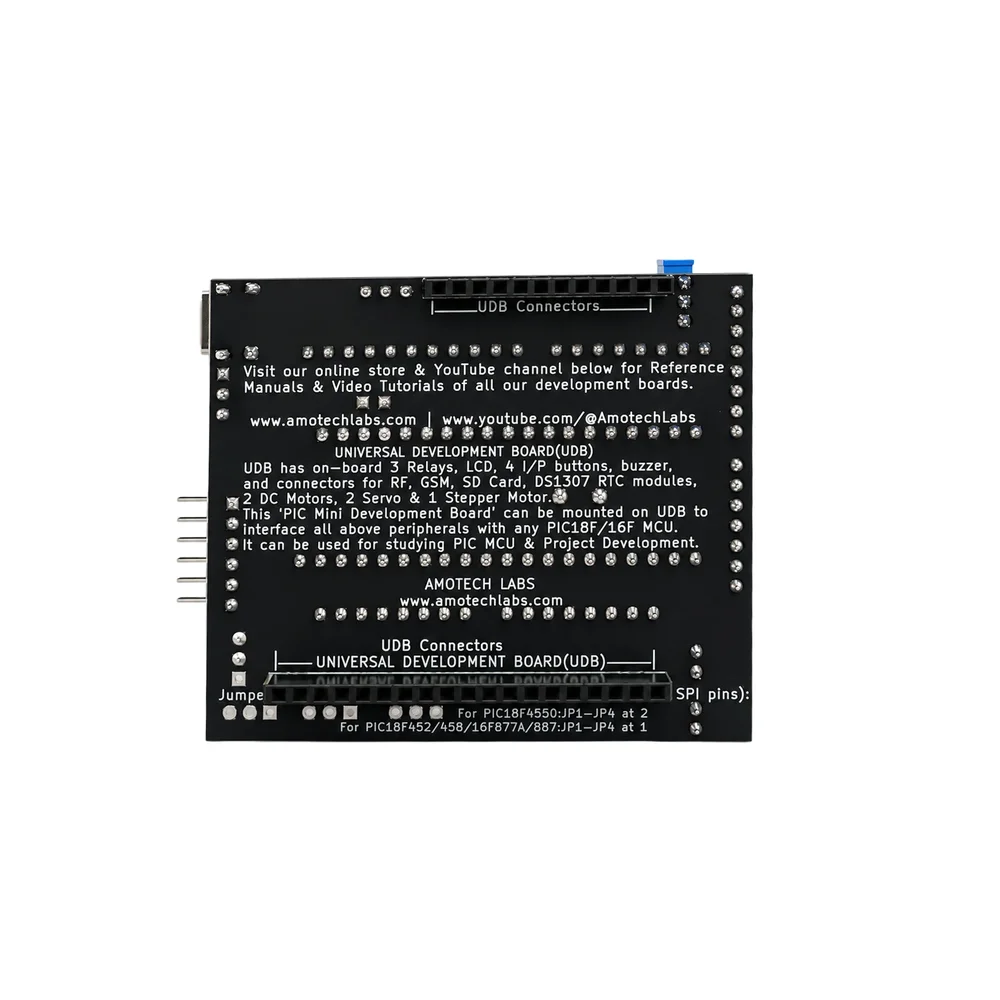
Expansion InterfaceUDB Connectors
Communication RoutingSPI & I²C via Jumpers JP1–JP4
MCU Socket Type40-pin DIP Socket
Dimensions68 x 56 x 20 mm
Weight33 g

Frequently Asked Questions

What PIC microcontrollers are compatible with this development board?

The board's 40-pin DIP socket supports a wide range of Microchip Technology PIC16F and PIC18F series microcontrollers that share the 40-pin dual-in-line package footprint. You must verify the specific pin compatibility of your chosen MCU model with the PIC18F452 reference design, as power, ground, and I/O pin mappings are standardized for the socket. Always consult the microcontroller's datasheet before insertion.

How do I program the microcontroller on this board?

Use a Microchip Technology PICkit 3 or PICkit 3.5 programmer. Connect it directly to the onboard 6-pin PICkit header. Then, use MPLAB X IDE or MPLAB IPE software to compile and flash your code. The board's design routes the programming signals (PGC/PGD) correctly, so no external wiring is needed. Ensure the board is powered via the USB-C port or an external +5V source during programming.

Can I power the board and program it simultaneously via USB-C?

Yes, the USB-C port provides the +5V operating voltage for the entire board. When using the PICkit programmer, it is recommended to also have the board powered through this USB-C port. This ensures stable voltage levels during the programming cycle. The PICkit itself does not need to supply power, as the board has its own regulated supply from the USB-C input.

How do I use the configurable SPI and I2C jumpers (JP1-JP4)?

The jumpers JP1 through JP4 route the SPI (SCK, SDI, SDO) and I2C (SDA, SCL) signals from the microcontroller to the expansion headers. Refer to the board's silkscreen or documentation to identify which jumper corresponds to each signal. To enable a specific protocol, place the shunt on the appropriate jumper pins to connect the MCU pins to the labeled header pins. This allows flexible peripheral connection without manual wiring.

What is the purpose of the analog input slot on the board?

The dedicated analog input slot provides a convenient way to interface analog sensors, such as an LM35 temperature sensor or a 10kΩ potentiometer, directly to the microcontroller's A3 analog channel. It includes connections for signal, power, and ground, simplifying wiring. You can use this slot for prototyping sensor inputs without needing a breadboard, enabling quick testing of analog-to-digital conversion functionality in your code.

Package Includes

  • 1 x Amotech Labs PIC18F/16F Mini Development Board (with PIC18F452 IC and LCD)

Additional Information

Weight 0.092 kg
Dimensions 14 × 10 × 3 cm