SKU: IOWC-0053
📋 GST Invoice Available

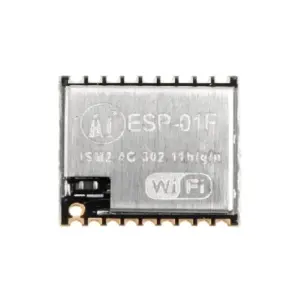
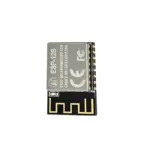
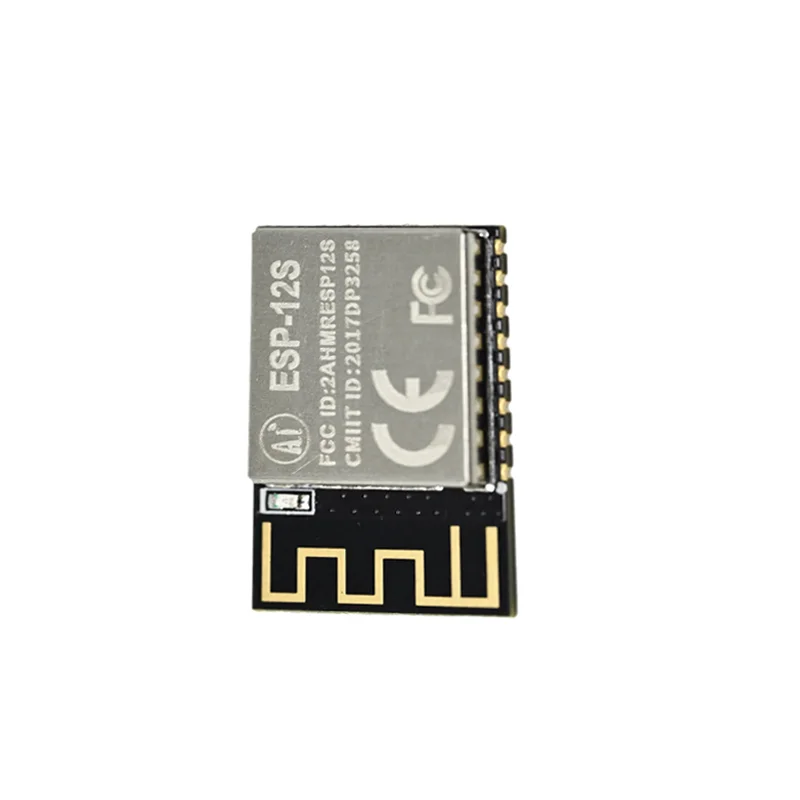
AI-Thinker ESP-12S ESP8266 Serial Wi-Fi Module

₹209.00 (Inclusive of all taxes)
Out of Stock

The AI-Thinker ESP-12S is a compact ESP8266-based serial Wi-Fi module, ideal for embedding wireless connectivity into IoT projects. It operates on a 3.3V supply and integrates a 32-bit MCU with full TCP/IP protocol stack for direct connection to Wi-Fi networks.

Features

  • Ultra-Compact Wi-Fi SOC: Features the ESP8266 chip with integrated MAC/BB/RF/PA/LNA in a tiny SMD-16 package (16x24mm), perfect for space-constrained designs.
  • High-Performance 32-bit MCU: Powered by a Tensilica L106 processor running up to 160MHz, capable of serving as the primary application processor, not just a network co-processor.
  • Low Power Operation: Supports multiple sleep modes with deep sleep current as low as 20µA, enabling battery-powered IoT sensor nodes and remote monitors.
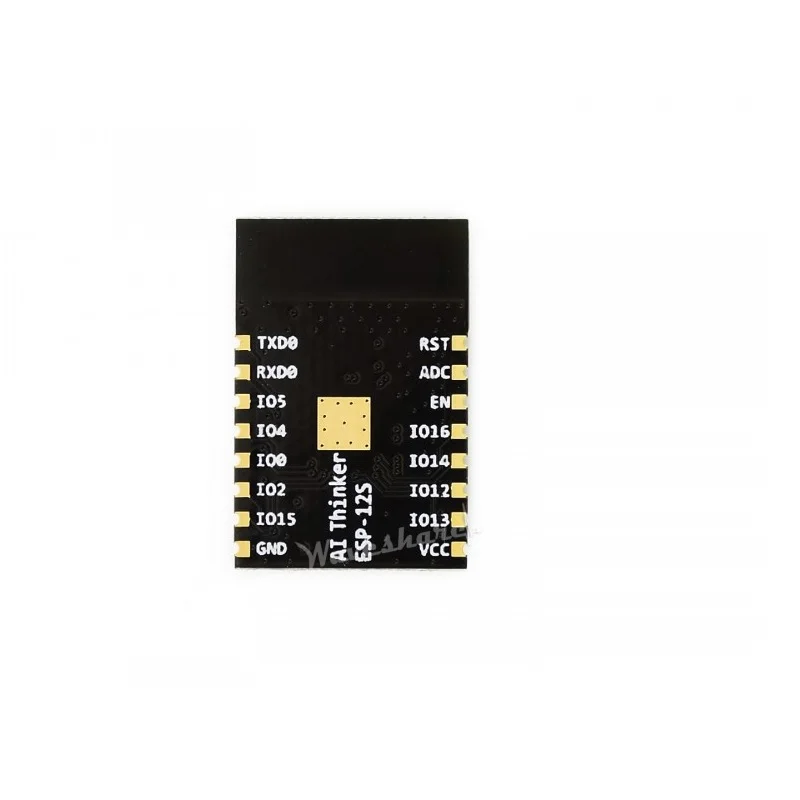
  • Rich Peripheral Set: Provides 9 GPIOs supporting UART, PWM, I2C, and a built-in 10-bit ADC for interfacing with sensors, actuators, and other external components.
  • Robust Connectivity & Development: Supports STA, AP, and STA+AP Wi-Fi modes, Smart Config, and FOTA. Compatible with Arduino IDE, ESP-IDF, and AT command set for rapid prototyping.

Out of stock

Description

The AI-Thinker ESP-12S is a surface-mount Wi-Fi module built around the industry-standard ESP8266 system-on-chip. It encapsulates a complete wireless networking solution, including the RF front-end, in a minimal footprint. The integrated Tensilica L106 32-bit RISC processor delivers both networking duties and application logic execution, eliminating the need for an external microcontroller in many designs.

Engineered for reliability in volume production, the module’s SMD-16 package is optimized for automated pick-and-place and reflow soldering. It features a PCB trace antenna and operates across the full 2.4GHz ISM band, supporting 802.11 b/g/n protocols with configurable output power up to +16dBm. The embedded LWIP TCP/IP stack and support for standard AT commands allow for quick integration, while the open SDK and RTOS support enable development of complex, connected applications for smart home automation, industrial wireless control, and wearable electronics.

Key Features

  • Complete Wi-Fi Network Processor: Integrates RF, power amplifier, low-noise amplifier, and TCP/IP stack, reducing external component count and design complexity.
  • Application Processor Capable: The onboard 32-bit CPU can run user application code directly, functioning as a standalone IoT controller.
  • Advanced Power Management: Features multiple configurable sleep modes (Modem-sleep, Light-sleep, Deep-sleep) to minimize energy consumption in periodic data transmission scenarios.
  • High-Speed Serial Interface: UART baud rate is configurable up to 4.6 Mbps, enabling fast data exchange between the module and a host MCU or for firmware debugging.
  • Secure & Scalable Firmware: Supports WEP, WPA, and WPA2 security protocols. Firmware can be updated Over-The-Air (FOTA) for deployed devices, simplifying maintenance and feature upgrades.
  • Developer-Friendly Ecosystem: Supported by a vast community and development frameworks including Arduino core, ESP-IDF, NodeMCU, and MicroPython, accelerating time-to-market.

Applications

  • Smart Home Automation: Core module for Wi-Fi smart plugs, light switches, sensors (motion, temperature), and appliance controllers.
  • Industrial Wireless Control & Monitoring: Enables wireless data acquisition from sensors, remote control of actuators, and machine telemetry for IIoT systems.
  • Consumer IoT Devices: Ideal for wearable electronics, baby monitors, pet trackers, and wireless positioning beacons.
  • Prototyping & Makerspace Projects: The go-to module for adding Wi-Fi to Arduino, Raspberry Pi Pico, or other microcontroller-based projects using serial AT commands or direct firmware.

Technical Specifications

Microcontroller / SoCESP8266 (Tensilica L106 32-bit RISC)
Wireless ProtocolIEEE 802.11 b/g/n Wi-Fi
Frequency Range2.4 - 2.5 GHz
RF Transmit Power802.11b: +16±2 dBm, 802.11g: +14±2 dBm, 802.11n: +13±2 dBm
Receiver SensitivityCCK 1 Mbps: -90 dBm, OFDM 54 Mbps: -70 dBm, MCS7: -67 dBm
Supply Voltage3.0V - 3.6V DC
Operating CurrentAverage ~80mA (Wi-Fi active); Deep Sleep: ~20µA
InterfacesUART, GPIO x9, I2C, PWM, ADC (10-bit)
AntennaIntegrated PCB Trace Antenna
Operating Temperature-20°C to +85°C
Dimensions (L x W)24 mm x 16 mm
Package / FlashSMD-16, Default 32 Mbit (4 MB) SPI Flash

Frequently Asked Questions

What is the default baud rate for UART communication, and can it be changed?

The default UART baud rate is 115200 bps. It is fully configurable via AT commands or custom firmware, supporting a range from 300 bps up to 4.6 Mbps (4608000 bps) to match host processor requirements and optimize data throughput for your specific application.

How do I program the ESP-12S module directly (without AT commands)?

To program it as a standalone MCU, you must connect GPIO0 to GND during reset to enter flash mode. Then, use a USB-to-serial adapter (3.3V logic) to connect TX, RX, EN, and GPIO0. You can develop code using the Arduino IDE with the ESP8266 board package, ESP-IDF, or PlatformIO, compiling and uploading firmware directly to its internal flash memory.

What is the power consumption in active and deep sleep modes?

During active Wi-Fi transmission, average current draw is approximately 80mA. In Deep Sleep mode, the CPU and RF are powered down, with only the RTC memory active, reducing current consumption to as low as 20 microamps (µA). This makes it suitable for battery-powered sensors that wake periodically to send data.

Does the ESP-12S have an onboard antenna, or does it require an external one?

The module features an integrated PCB trace antenna, which provides adequate range for most indoor applications. For extended range or specific directional needs, the design includes provisions to disconnect the PCB antenna and connect an external antenna via a matching network, though this requires modification of the board's RF circuit.

Package Includes

  • 1 x AI-Thinker ESP-12S ESP8266 Serial Wi-Fi Module

Additional Information

Weight 0.003 kg
Dimensions 2.4 × 1.6 cm