SKU: IOWC-0045
📋 GST Invoice Available

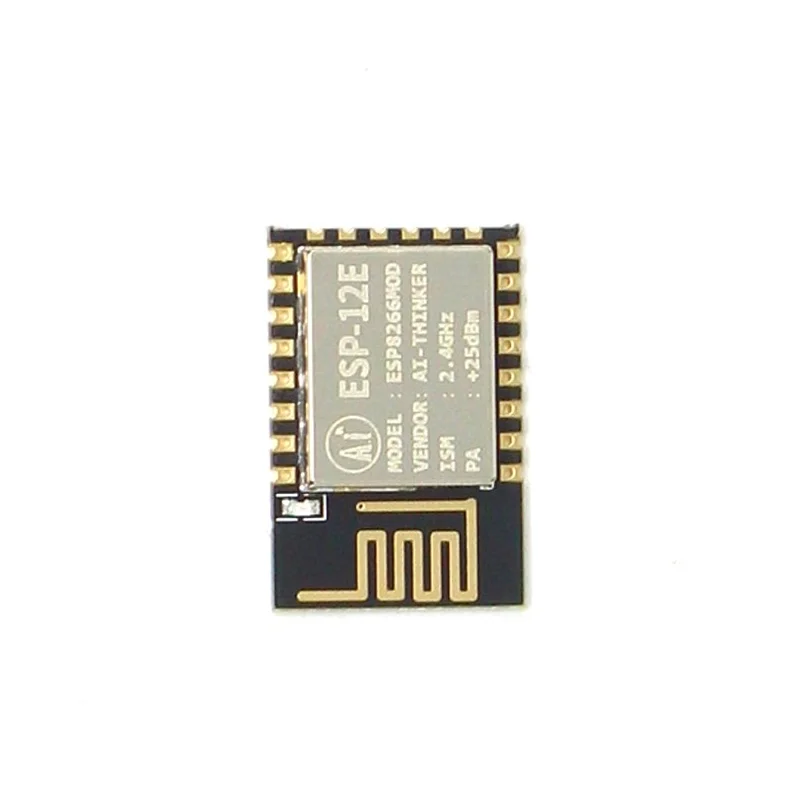
AI-Thinker ESP-12E ESP8266 Serial WiFi Module

₹339.00 (Inclusive of all taxes)
Out of Stock

The AI-Thinker ESP-12E is a compact ESP8266-based serial WiFi module designed for embedding wireless connectivity into IoT devices and mobile platforms, featuring an integrated 32-bit MCU, full TCP/IP stack, and 802.11 b/g/n support for Arduino IDE and AT command firmware.

Features

  • Ultra-low power 32-bit ESP8266 SoC with integrated WiFi MAC/BB/RF/PA/LNA and on-board PCB antenna.
  • Full 802.11 b/g/n (2.4GHz) compliance with support for STA, AP, and STA+AP operation modes for flexible networking.
  • Integrated 10-bit ADC and rich peripheral interfaces including UART, PWM, I2C, I2S, and GPIO for sensor integration.
  • Complete TCP/IP protocol stack enables direct HTTP/HTTPS, MQTT client connections without external processors.
  • Compact 24mm x 16mm form factor with deep sleep power management for battery-powered IoT deployments.

Out of stock

Description

The AI-Thinker ESP-12E module encapsulates the ESP8266 system-on-chip, providing a highly integrated wireless networking solution for space and power-constrained designs. Its Tensilica L106 32-bit RISC processor operates at 80/160 MHz and supports real-time operating systems, managing the integrated 2.4 GHz radio front-end with power amplifier, low-noise amplifier, and antenna matching network.

Engineered for IoT edge nodes, the module operates from a 3.0V to 3.6V supply with an active current of approximately 80mA, featuring deep sleep modes for extended battery life in remote sensors. The on-board PCB antenna and support for antenna diversity ensure reliable WiFi connectivity in diverse environments, while built-in hardware encryption supports WPA/WPA2 security protocols.

Key Features

  • High-integration ESP8266 SoC with embedded Tensilica L106 32-bit MCU core and full WiFi stack.
  • Supports IEEE 802.11 b/g/n standards with integrated TR switch, balun, LNA, power amplifier, and matching network.
  • Integrated 10-bit precision ADC for analog sensor signal acquisition directly on the module.
  • Complete TCP/IP protocol stack enables standalone HTTP, MQTT, and WebSocket client/server operation.
  • Multiple wireless modes: Station (STA), Access Point (AP), and combined STA+AP for flexible network topologies.
  • Rich peripheral interfaces: UART, SDIO, SPI, I2C, I2S, IR remote control, PWM, and GPIO.
  • Advanced RF features: antenna diversity, STBC, 1x1 MIMO, and A-MPDU/A-MSDU aggregation for improved throughput.
  • Ultra-low power architecture with deep sleep mode for battery-operated IoT sensor nodes and mobile devices.

Applications

  • Smart home automation nodes for lighting, switches, and appliance control via MQTT/HTTP.
  • Industrial sensor telemetry and remote monitoring with cloud data logging.
  • Battery-powered environmental sensors for temperature, humidity, and air quality monitoring.
  • WiFi-enabled consumer electronics, toys, and wearable device prototypes.
  • Network gateways and bridges converting serial UART data to wireless TCP/IP packets.

Technical Specifications

Wireless SoC / MCUESP8266 (Tensilica L106 32-bit RISC)
Wireless ProtocolsIEEE 802.11 b/g/n
Frequency Range2.4 GHz - 2.5 GHz
RF Transmit PowerIntegrated PA
RF SensitivityCCK 11 Mbps: -91 dBm, DSSS 1 Mbps: -98 dBm, OFDM 54 Mbps: -75 dBm
Supply Voltage3.0V - 3.6V DC
Operating Current~80 mA (average)
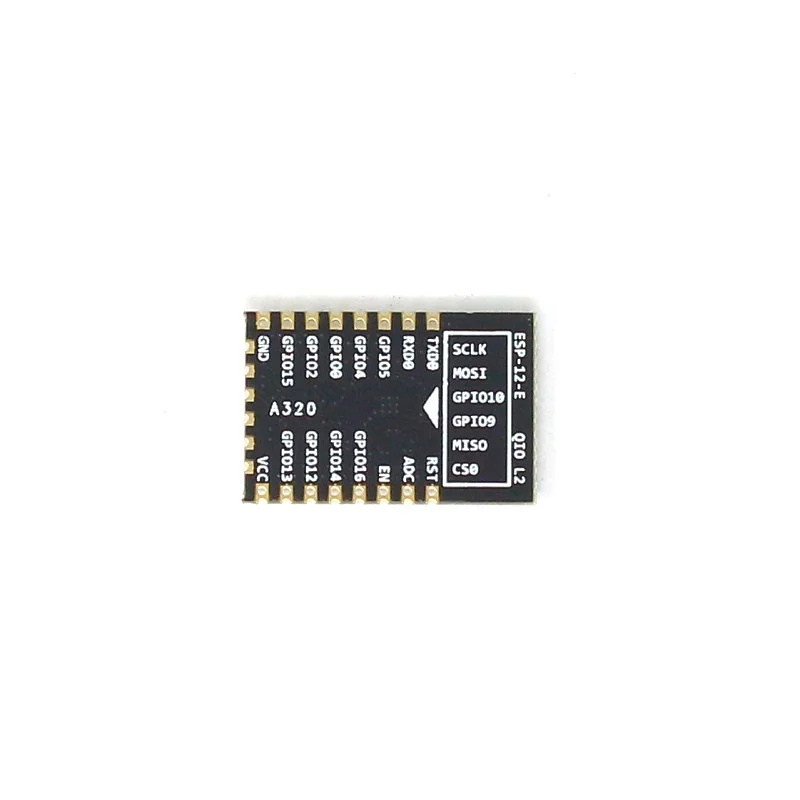
InterfacesUART, SDIO, SPI, I2C, I2S, IRDA, PWM, GPIO, ADC
Antenna ConnectorIntegrated PCB antenna
Operating Temperature-40°C to +125°C
Dimensions (L x W)24 mm x 16 mm

Frequently Asked Questions

How do I program the ESP-12E module using the Arduino IDE?

Install the ESP8266 board package via the Arduino Boards Manager. Select 'Generic ESP8266 Module' as your board. Connect the module's TX/RX pins to a USB-to-serial adapter, ensuring GPIO0 is pulled low during reset to enter flash mode. Use the correct COM port and upload your sketch. The typical baud rate for programming is 115200.

What is the power supply requirement and how do I minimize current consumption?

The module requires a stable 3.3V DC supply (3.0V-3.6V range) capable of delivering brief peaks up to 300mA. For battery operation, enable deep sleep mode via ESP.deepSleep() in code, which reduces current to microamps. Use a low-dropout regulator and ensure clean power to prevent brownout resets during RF transmission.

Can I use an external antenna with the ESP-12E module?

The ESP-12E has an integrated PCB antenna. For extended range, you can disable the onboard antenna in software and connect an external 2.4GHz antenna via a matching network to the RF pin. Ensure impedance matching to 50 ohms. Antenna diversity is supported if you configure a second GPIO for the alternate RF input.

What firmware options are available and how do I flash AT commands?

You can flash NodeMCU (Lua), MicroPython, or the official Espressif AT command firmware. Use a tool like esptool.py or Flash Download Tool. Connect GPIO0 to GND, reset the module, then flash the binary to address 0x00000. The AT firmware allows UART control via commands like AT+CWMODE to set WiFi mode and AT+CIPSTART to open TCP connections.

Package Includes

  • 1 x AI-Thinker ESP-12E ESP8266 Serial WiFi Module

Additional Information

Weight 0.03 kg
Dimensions 1.6 × 2.4 cm