SKU: SENS-3271
📋 GST Invoice Available

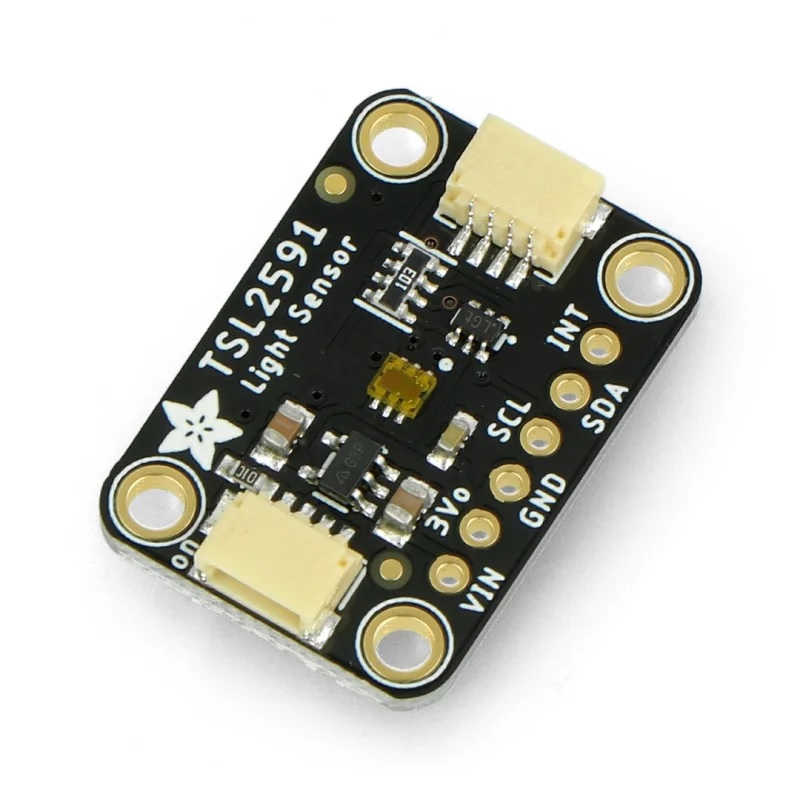
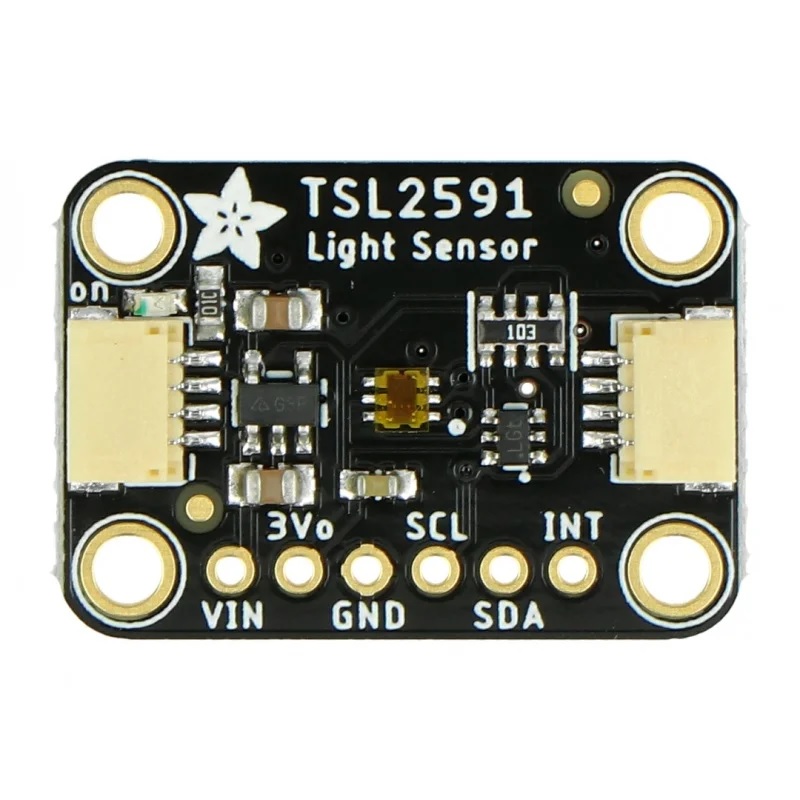
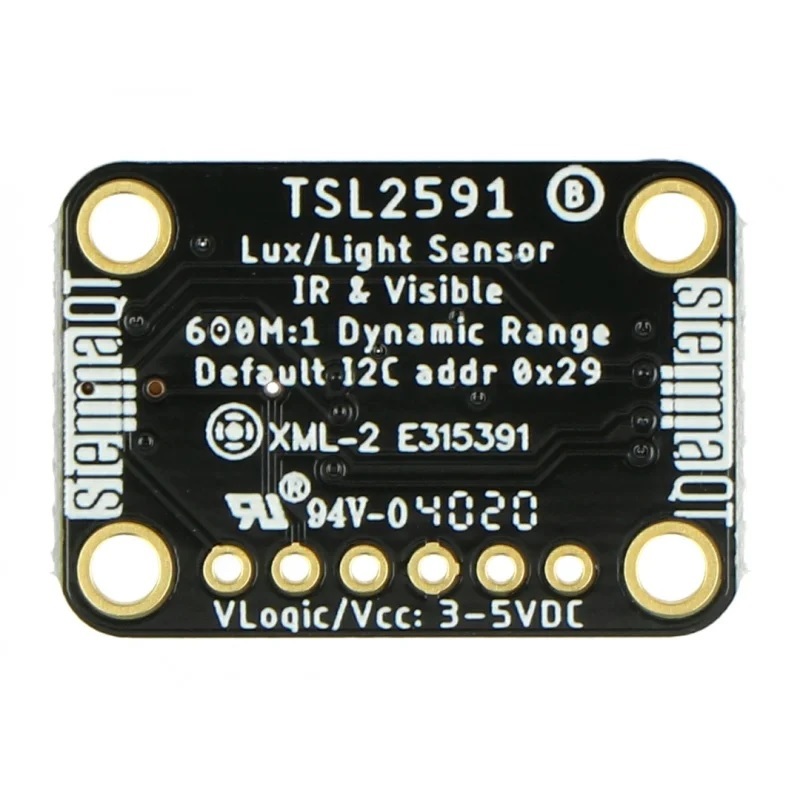
Adafruit TSL2591 High Dynamic Range Digital Light Sensor - STEMMA QT

₹1,159.00 (Inclusive of all taxes)
Out of Stock

The Adafruit TSL2591 is a high-precision digital light sensor with an ultra-wide dynamic range, ideal for Arduino, Raspberry Pi, and other 3.3V/5V microcontrollers. It provides separate infrared and full-spectrum light measurements for accurate human-eye response approximation.

Features

  • Ultra-wide dynamic range from 1 to 600,000,000 counts for extreme lighting conditions.
  • Separate infrared and full-spectrum photodiodes for precise human-visible lux calculations.
  • Onboard ADC and I2C interface (addresses 0x29 & 0x28) compatible with any microcontroller.
  • Plug-and-play connectivity via STEMMA QT / SparkFun Qwiic compatible 4-pin JST-SH connector.
  • Low power consumption: ~0.4mA active, <5 µA in power-down mode for data-logging applications.

Out of stock

Description

The TSL2591 luminosity sensor utilizes advanced dual-diode architecture, combining an infrared-sensitive photodiode and a full-spectrum (visible + IR) photodiode. This allows the integrated analog-to-digital converter (ADC) and digital signal processor to calculate precise illuminance in lux by subtracting the IR component, closely matching the photopic response of the human eye.

Its configurable gain and integration time settings enable on-the-fly adaptation to light levels from a dark 188 µLux up to a bright 88,000 Lux. The sensor’s all-digital I2C output ensures stable, noise-immune readings, making it suitable for integration into professional lighting control systems, environmental monitoring stations, and portable instrumentation.

Key Features

  • High-dynamic-range digital light sensor with 600,000,000:1 contrast ratio.
  • Dual photodiode design for separate IR and full-spectrum light measurement.
  • I2C digital interface with fixed 7-bit addresses (0x29, 0x28) for easy daisy-chaining.
  • Onboard 3.3V regulator for flexible 3.3V to 5V DC power supply compatibility.
  • Ultra-low power consumption ideal for battery-powered and data-logging projects.
  • Pre-soldered STEMMA QT 4-pin JST-SH connector for plug-and-play cabling.
  • Compact PCB footprint (19mm x 16mm) for space-constrained designs.
  • Fully assembled and tested, ready for immediate integration.

Applications

  • Professional-grade ambient light sensing for smart lighting and building automation.
  • High-dynamic-range photography light metering and camera control systems.
  • Environmental data logging and weather station solar radiation monitoring.
  • Display backlight dimming control in consumer electronics and industrial HMIs.
  • Agricultural and horticultural light intensity monitoring for Grow operations.

Technical Specifications

Manufacturer Part NumberTSL2591
Sensor TypeDigital Light / Luminosity
Dynamic Range1 to 600,000,000 counts
Illuminance Range188 µLux to 88,000 Lux
PhotodiodesInfrared + Full-Spectrum
InterfaceI2C (2-wire)
I2C Addresses0x29, 0x28
Supply Voltage3.3V to 5V DC
Active Current~0.4 mA
Power-Down Current< 5 µA
ConnectorSTEMMA QT (JST-SH 4-pin)
Board Dimensions (L x W)19 mm x 16 mm
Board Weight1.1 g

Frequently Asked Questions

What is the supply voltage range for the TSL2591 sensor module?

The module includes an onboard voltage regulator and accepts a supply voltage from 3.3V to 5V DC. You can power it directly from the 3.3V or 5V pins of most development boards like Arduino, Raspberry Pi, or ESP32.

How do I connect this sensor to my microcontroller?

Connection is simplified via the pre-soldered STEMMA QT (JST-SH) 4-pin connector. Use a compatible cable to plug directly into the I2C port of your board. Alternatively, you can solder to the breakout pads for SDA, SCL, VIN, and GND. The I2C interface uses standard pull-up resistors.

Can I change the I2C address of the TSL2591?

No, the TSL2591 has two fixed I2C 7-bit addresses: 0x29 and 0x28. The sensor responds to both, which can be useful for certain library implementations, but the address cannot be hardware-configured like some other sensors (e.g., TSL2561).

How does the dual-diode design improve lux measurement accuracy?

The sensor houses separate infrared and full-spectrum photodiodes. By measuring the IR component separately and subtracting it from the full-spectrum reading, the sensor calculates illuminance (lux) that closely approximates human eye response, which is insensitive to infrared light.

Is this sensor suitable for low-power or battery-operated projects?

Yes, the TSL2591 features very low power consumption, drawing approximately 0.4mA during active sensing and less than 5 microamps when placed in its software-controlled power-down mode. This makes it excellent for solar-powered data loggers or long-term battery-operated monitoring systems.

Package Includes

  • 1 x Adafruit TSL2591 High Dynamic Range Digital Light Sensor Board

Additional Information

Weight 0.0011 kg
Dimensions 1.9 × 1.6 cm