SKU: SENS-0672
📋 GST Invoice Available

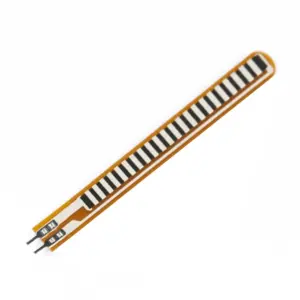
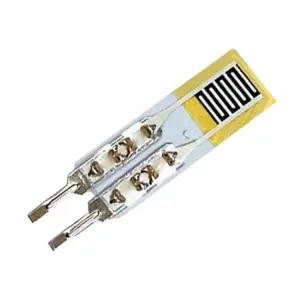
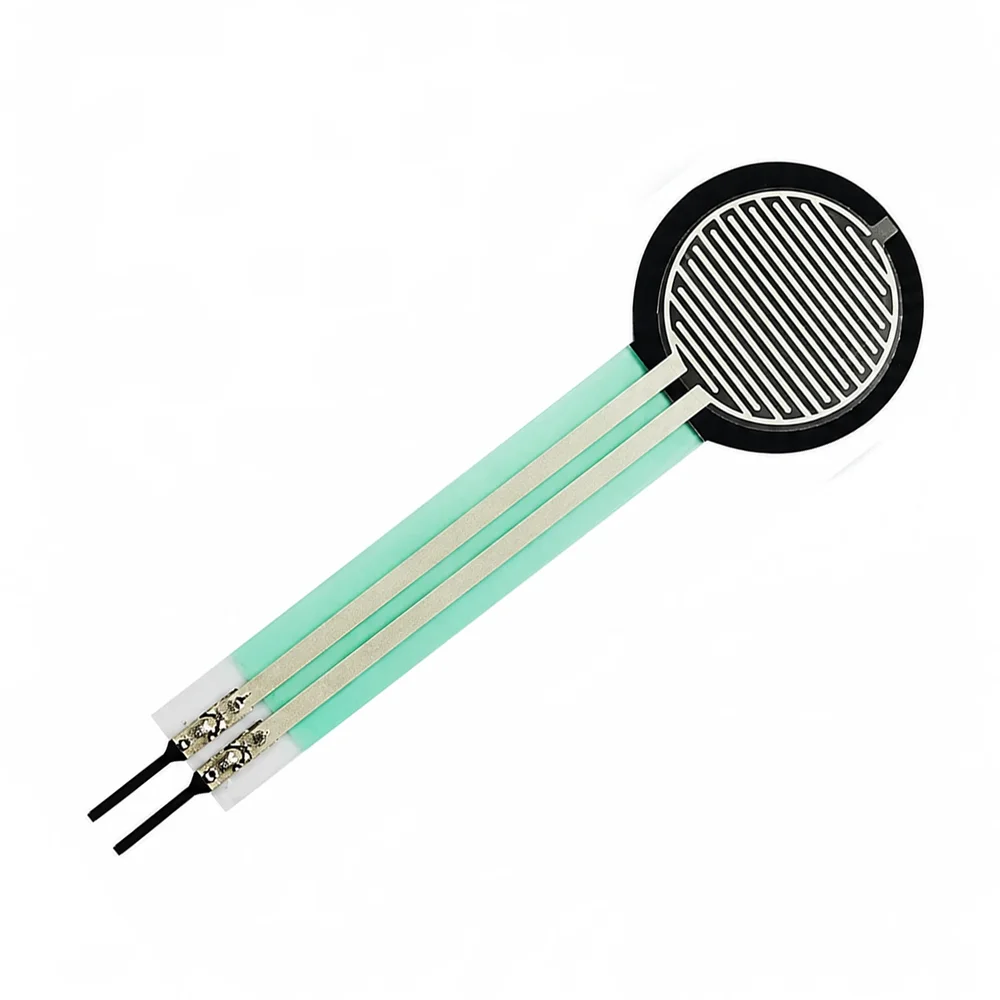
SOUSHINE FSR410 25.42mm Force Sensing Resistor (30g-10kg) - Flexible Film Sensor

₹399.00 (Inclusive of all taxes)
Out of Stock

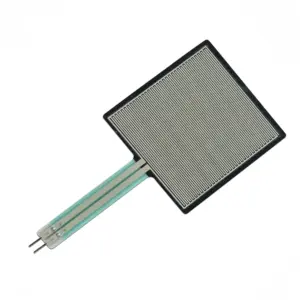
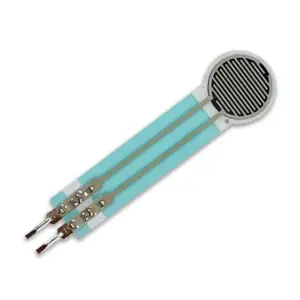
The SOUSHINE FSR410 is a flexible film force-sensing resistor (FSR) with a 25.42mm diameter, designed for detecting applied forces from 30g to 10kg. This ultra-thin 0.3mm sensor is ideal for integration into compact, curved-surface applications and interfaces directly with microcontroller ADCs for touch sensing and pressure measurement in Arduino, Raspberry Pi, and embedded systems.

Features

  • Wide Force Detection Range from 30 grams to 10 kilograms.
  • Ultra-Thin & Flexible 0.3mm film construction adapts to curved or irregular mounting surfaces.
  • Fast Dynamic Response with 10ms response time and 0.01s activation for real-time force feedback.
  • High Mechanical Durability rated for over 1 million actuation cycles.
  • Extended Operating Temperature Range from -40°C to +85°C for harsh environments.

Out of stock

Description

The FSR410 operates on the principle of piezoresistivity, where applied force reduces the internal resistance of its conductive polymer film. This change in resistance is typically measured via a simple voltage divider circuit connected to a microcontroller’s analog-to-digital converter (ADC), providing a proportional voltage output corresponding to the applied force.

Its robust construction ensures reliable performance across a wide industrial temperature spectrum, making it suitable for applications subject to thermal variation. The sensor’s flexibility and minimal profile allow for seamless integration into space-constrained designs without compromising on sensing area or mechanical longevity.
Key Features

  • Flexible Film Design: 0.3mm thick sheet conforms to non-planar surfaces for versatile mounting.
  • Precise Force Sensing: Provides analog resistance output proportional to applied force within the 30g-10kg range.
  • Rapid Signal Response: Delivers real-time force detection with a 10ms response time for dynamic applications.
  • Exceptional Endurance: Engineered for long-term reliability with a lifespan exceeding 1 million actuations.
  • Broad Thermal Tolerance: Maintains stable operation across an extended -40°C to +85°C range.
  • Simple Interface: Easily integrated into measurement circuits using basic voltage divider topology.
  • Compact Sensing Area: 25.42mm (1-inch) diameter active region optimizes spatial efficiency.
  • High-Value Build: Durable construction offers optimized performance-to-cost ratio for prototyping and production.

Applications

  • Touch-sensitive control panels and human-machine interface (HMI) buttons.
  • Robotic gripper end-effector force feedback and object weight detection.
  • Wearable device pressure monitoring for gait analysis or sports equipment.
  • Industrial process control for lightweight part presence or assembly verification.
  • Medical device instrumentation for compression or patient interface sensing.

Technical Specifications

Manufacturer Part NumberFSR410
Force Detection Range30 g to 10 kg
Sensing Area Diameter25.42 mm
Sensor Thickness0.3 mm
Shape / FlexibilitySheet, Flexible Film
Activation Time0.01 s
Response Time10 ms
Mechanical Life>1,000,000 actuations
Operating Temperature Range-40°C to +85°C

Frequently Asked Questions

What is the operating principle of the FSR410 sensor?

The FSR410 is a piezoresistive force-sensing resistor. Its internal conductive polymer exhibits a decrease in electrical resistance when mechanical force is applied to its active surface. This resistance change is typically measured using a simple voltage divider circuit to produce an analog voltage signal proportional to the force.

How do I interface the FSR410 with an Arduino or Raspberry Pi?

Connect the FSR410 in a voltage divider configuration with a fixed-value resistor (e.g., 10kΩ) between the sensor and ground. The junction between the resistor and sensor connects to an analog input pin on an Arduino or to an ADC pin on a Raspberry Pi (using an external ADC module for the Pi). The microcontroller reads the varying voltage to calculate the applied force.

What is the difference between the activation time and response time?

Activation time (0.01s) refers to the delay before the sensor begins to respond after force is initially applied. Response time (10ms) is the time it takes for the sensor's output to stabilize and reflect a steady-state reading after a force change. The fast 10ms response enables real-time force monitoring.

Can the FSR410 be used for measuring dynamic or impact forces?

While it has a fast 10ms response, the FSR410 is best suited for measuring sustained or slowly varying applied pressure rather than high-speed impacts. Its design optimizes sensitivity for controlled force application, making it ideal for touch interfaces, weight sensing, and pressure mapping rather than impulse detection.

What is the recommended circuit for reading the FSR410 output?

A standard voltage divider is recommended. Connect one FSR lead to your logic voltage (e.g., 3.3V or 5V). Connect the other FSR lead to one end of a fixed pull-down resistor (typical values range from 1kΩ to 100kΩ, depending on desired sensitivity), and connect the other end of that resistor to ground. Measure the voltage at the junction between the FSR and the fixed resistor.

Package Includes

  • 1 x SOUSHINE FSR410 Force Sensing Resistor