SKU: IOWC-1903
📋 GST Invoice Available

Olimex ESP8266-EVB Evaluation Board w/ Relay & UEXT

₹1,459.00 (Inclusive of all taxes)
Out of Stock

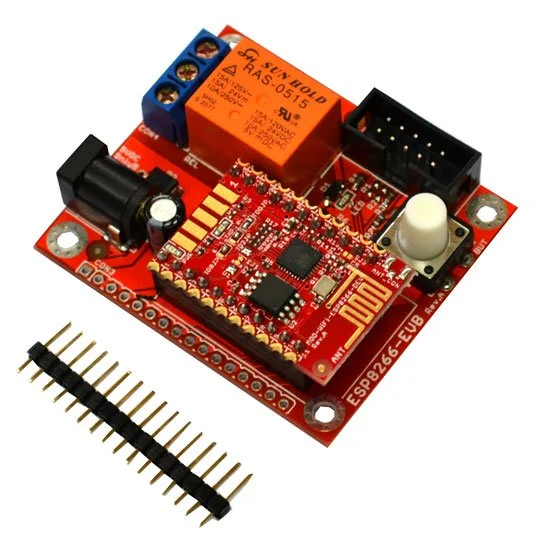
The Olimex ESP8266-EVB is an ESP8266EX-based Wi-Fi evaluation board featuring a built-in 220VAC/10A relay, UEXT connector, and comprehensive GPIO breakout, designed for prototyping IoT and home automation applications with Arduino IDE or AT command firmware.

Features

  • Integrated 220VAC/10A relay with status LED for direct mains switching control.
  • Full-featured ESP8266EX SoC with Wi-Fi TCP/IP stack, I2C, SPI, and GPIO interfaces.
  • UEXT connector for easy expansion with Olimex sensor and display modules.
  • Includes 16-pin male-male header for direct access to all ESP8266 signals.
  • Convenient power jack for +5V external supply and big button for UART boot mode selection.

Out of stock

Description

The Olimex ESP8266-EVB serves as a robust development platform for the ESP8266EX Wi-Fi SoC, integrating essential peripherals for rapid IoT prototyping. Its core is the highly integrated ESP8266EX, which hosts a full Wi-Fi TCP/IP stack and provides multiple serial interfaces including I2C, SPI, and a set of free GPIOs, enabling complex wireless applications with minimal external components.

The board’s design emphasizes practical development, featuring a UEXT connector for seamless module expansion, a dedicated relay output for high-voltage control, and a full row of accessible pin headers. It is pre-configured for standard boot-from-FLASH operation and is compatible with common development frameworks like the Arduino IDE for ESP8266 and the official AT command set, facilitating both beginner and advanced embedded Wi-Fi projects.

Key Features

  • Evaluation board centered on the ESP8266EX Wi-Fi SoC for IoT development.
  • Onboard electromechanical relay capable of switching 220VAC at 10A loads.
  • UEXT (Universal EXTension) connector for plug-and-play expansion with Olimex ecosystem modules.
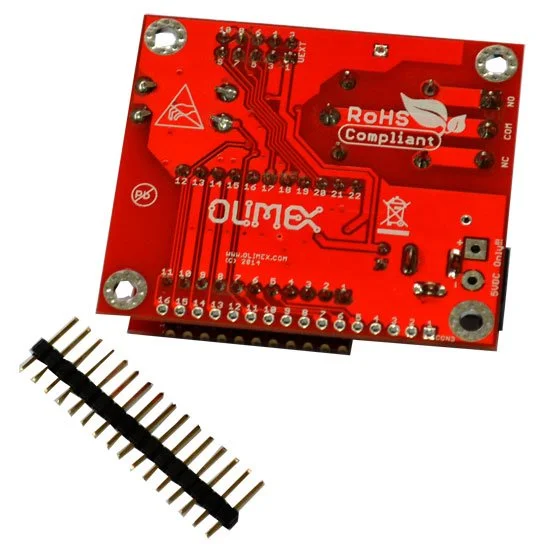
  • Comprehensive 16-pin breakout header providing direct access to all ESP8266 signals including GPIO, I2C, SPI, and UART.
  • Convenient tactile button for easy entry into UART programming/flashing mode.
  • 5V DC power jack for stable external power supply, independent of USB.
  • Four mounting holes for secure installation in enclosures or prototypes.
  • Pre-loaded with AT command firmware, ready for serial configuration and network testing.

Applications

  • Smart home automation and appliance control via Wi-Fi.
  • Prototyping IoT relay controllers for lighting, HVAC, or industrial equipment.
  • Wireless sensor nodes with UEXT-connected environmental sensors.
  • Educational platform for learning ESP8266 programming and Wi-Fi networking.
  • Remote monitoring and control systems using MQTT or HTTP protocols.

Technical Specifications

Microcontroller/SoCESP8266EX
Wireless ProtocolWi-Fi 802.11 b/g/n
Flash Memory2 MB (16 Mb)
Key InterfacesUART, I2C, SPI, GPIO
Relay Output1x 220VAC / 10A
Expansion ConnectorUEXT
Antenna TypePCB Trace Antenna
Power Supply+5V via DC Jack or via UEXT
Leakage Current (Sleep)< 5 µA
Dimensions (L x W)33 mm x 23 mm (Board)

Frequently Asked Questions

How do I connect and send AT commands to the ESP8266-EVB board?

Establish a 3.3V TTL UART connection using the RX, TX, and GND pins on the UEXT connector, typically via a USB-to-serial adapter. Power the board in standard 'boot from FLASH' mode (no buttons pressed). Use a terminal program like PuTTY or Arduino Serial Monitor, ensuring it is configured to send both Carriage Return and Line Feed (\\r\\n) at the end of each command. Commands are case-sensitive, so enter 'AT' followed by CR+LF to receive an 'OK' response.

What is the purpose of the large button on the ESP8266-EVB board?

The large button is used to force the ESP8266EX into UART download mode for firmware flashing. Hold this button down while applying power or resetting the board to enter the bootloader. This mode is required when uploading new firmware via serial using tools like esptool.py or the Arduino IDE. For normal operation, ensure the button is not pressed during power-up so the chip boots from its internal flash memory.

Can I power the ESP8266-EVB solely through the UEXT connector?

Yes, the board can be powered via the +5V and GND pins on the UEXT connector, which is convenient when using an Olimex UEXT-USB adapter or other UEXT-capable power source. Alternatively, you can use the dedicated 5V DC power jack. Ensure your power supply can provide sufficient current for the ESP8266 chip and any connected peripherals, especially when the onboard relay is actively switching a load.

How do I connect external sensors or displays to this development board?

The UEXT connector provides a standardized interface for Olimex and compatible modules, offering I2C, SPI, UART, and power lines. Simply plug in a UEXT module. For direct wiring, use the 16-pin header row which breaks out all ESP8266 GPIOs. Refer to the board's pinout diagram to identify pins for I2C (GPIO4/GPIO5), SPI (GPIO12-15), or other functions, taking care to use 3.3V logic levels for all connected devices.

Package Includes

  • Olimex ESP8266-EVB Evaluation Board
  • Male-Male 16-pin Header Connector

Additional Information

Weight 0.03 kg
Dimensions 3.3 × 2.3 cm