SKU: IOWC-1659
📋 GST Invoice Available

Waveshare Core2021-HF Dual-Band LoRa Module LR2021 Transceiver

₹1,399.00 (Inclusive of all taxes)
Out of Stock

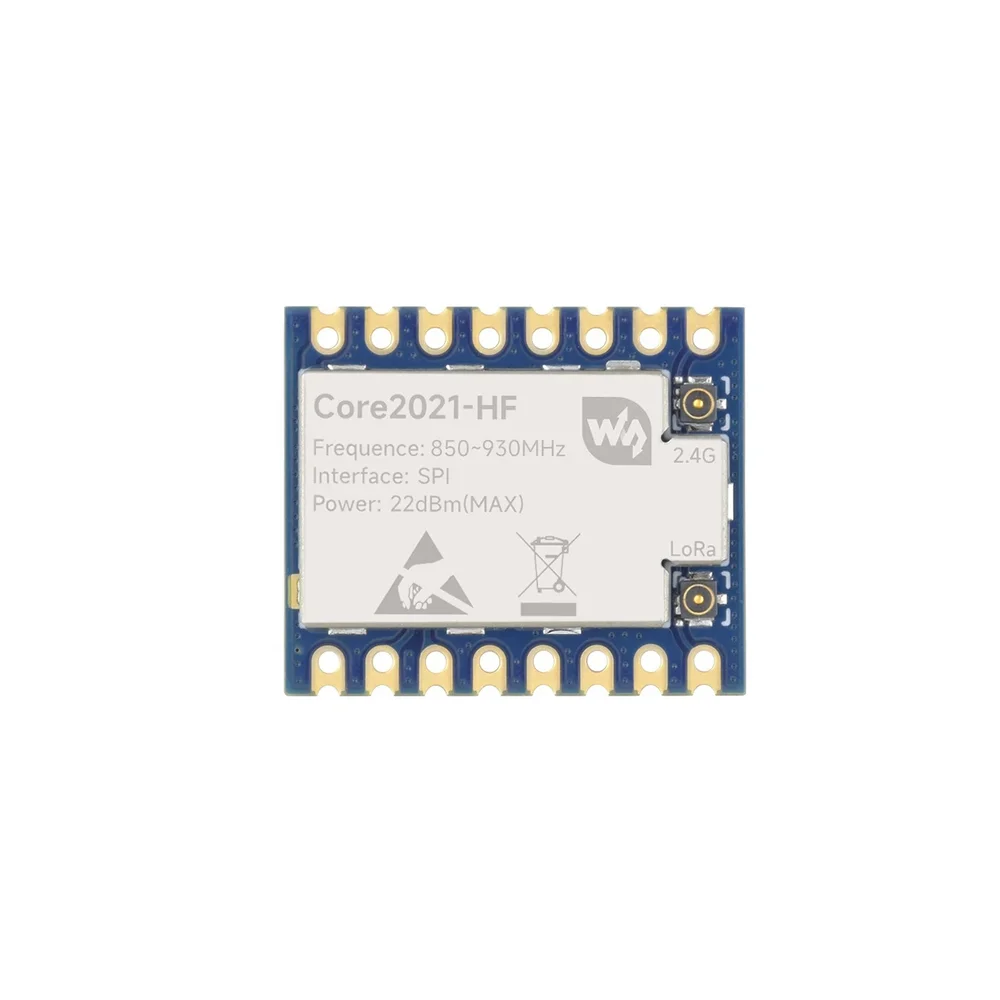
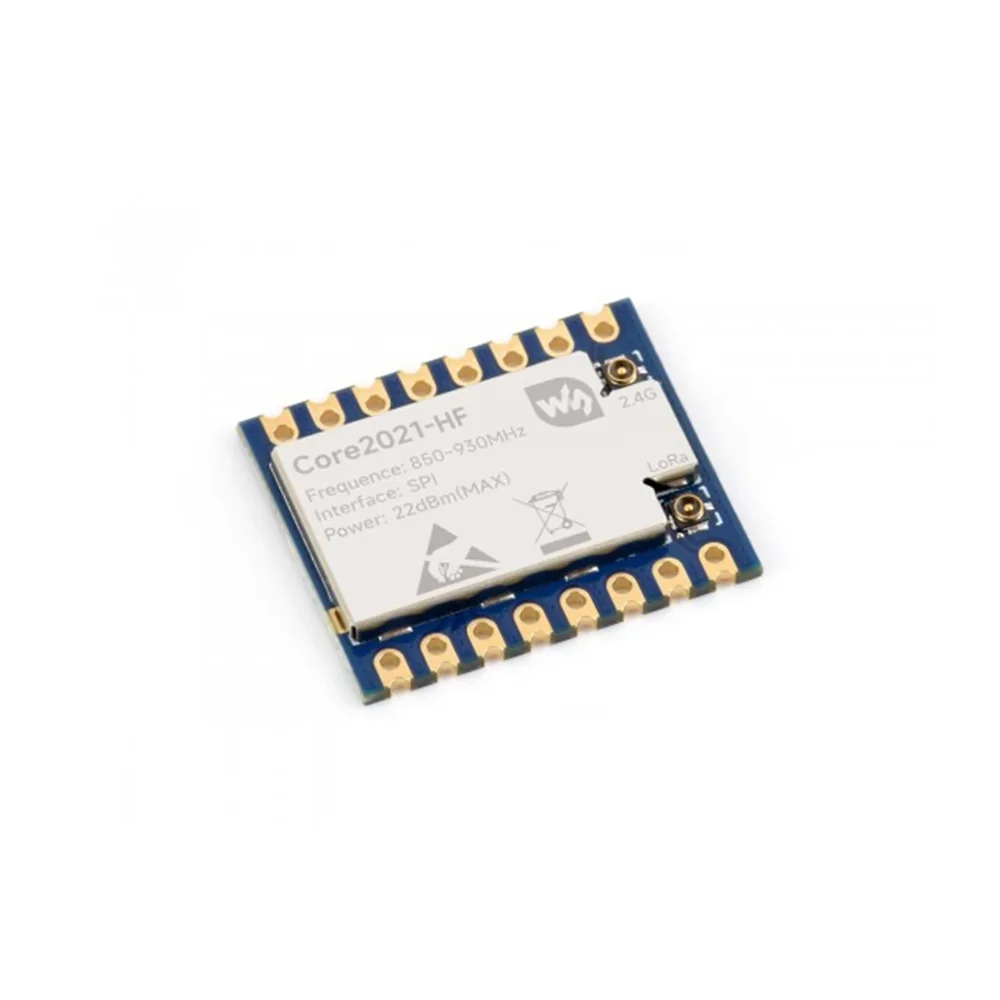
The Waveshare Core2021-HF is a dual-band LoRa module based on the LR2021 multi-protocol transceiver, supporting Sub-GHz (850-930MHz) and 2.4GHz ISM bands for flexible LPWAN deployments. It interfaces via SPI and is compatible with ESP32, STM32, Arduino, and Raspberry Pi platforms for IoT telemetry and automation.

Features

  • Multi-protocol LR2021 transceiver supports LoRa, FLRC, FSK, BLE, and ZigBee for versatile wireless connectivity.
  • Dual-band operation across Sub-GHz (850-930 MHz) and 2.4GHz ISM bands enables flexible global IoT network deployment.
  • High RF output power up to +22dBm extends typical communication range to 5km in Sub-GHz and 2km in ISM bands.
  • SPI interface ensures seamless integration with mainstream MCUs like ESP32, STM32, Arduino, and Raspberry Pi.
  • Includes IPEX-4 to SMA cable, 2dBi SMA antenna, and 2.4G antenna for immediate prototyping and deployment.

Out of stock

Description

The Waveshare Core2021-HF Dual-Band LoRa Module integrates the advanced fourth-generation LR2021 transceiver chip, engineered for low-power wide-area networking (LPWAN) and multi-protocol IoT applications. Its architecture supports a broad spectrum from Sub-GHz (850-930 MHz) to 2.4GHz ISM and licensed 1.5-2.5GHz bands, providing system integrators with flexible frequency planning for industrial telemetry, smart agriculture, and remote environmental monitoring across different regulatory regions.

Operating from a 3.3V supply with a maximum rating of 3.7V, the module features precise power management for battery-operated edge nodes, with transmit power configurable from -10 dBm to +22 dBm. The castellated hole footprint and IPEX-4 antenna connector offer both direct PCB soldering and external antenna options, backed by TVS protection for enhanced RF front-end resilience. Developers can leverage extensive online resources for ESP-IDF, Arduino IDE, and MicroPython to implement LoRaWAN, BLE mesh, or proprietary FLRC links with data rates up to 2.6 Mbps.

Key Features

  • Multi-band LR2021 transceiver supports Sub-GHz, 2.4GHz ISM, and licensed 1.5-2.5GHz frequency ranges for global compliance.
  • Protocol versatility includes LoRa, FLRC, FSK, BLE, and ZigBee modulation for adaptive network topology design.
  • High-efficiency RF power amplifier delivers up to +22dBm output for extended range in LPWAN and industrial sensor networks.
  • SPI communication interface ensures low-latency data exchange and straightforward migration across 3.3V MCU platforms.
  • Integrated TVS protection on the antenna line safeguards the transceiver against electrostatic discharge and voltage surges.
  • Castellated hole and IPEX-4 connector provide flexible antenna integration options for embedded or external mounting.
  • Comprehensive development support for ESP32, STM32, Arduino, Raspberry Pi, and Raspberry Pi Pico accelerates firmware deployment.

Applications

  • Industrial telemetry and IIoT for remote monitoring of equipment status and sensor data over LPWAN.
  • Smart home automation networks utilizing BLE or ZigBee for device control and environmental sensing.
  • Agricultural and environmental monitoring systems deploying long-range LoRa sensor nodes for soil moisture and weather data.
  • Asset tracking and fleet management solutions using dual-band communication for hybrid network coverage.
  • Remote data acquisition in licensed spectrum applications such as private LTE or industrial wireless links.

Technical Specifications

Transceiver ChipLR2021
Wireless ProtocolsLoRa, FLRC, FSK, BLE, ZigBee
Frequency RangeSub-GHz: 850-930 MHz; ISM: 2.4 GHz; Licensed: 1.5-2.5 GHz
RF Transmit Power-10 dBm to +22 dBm (Sub-GHz)
Supply Voltage3.3V (Maximum 3.7V)
Communication InterfaceSPI
Logic Voltage Level3.3V
Antenna ConnectorIPEX-4 & Castellated Hole
Typical RangeSub-GHz: 5 km; ISM: 2 km
Maximum Data RateUp to 2.6 Mbps
Dimensions19.00 x 22.00 mm

Frequently Asked Questions

What is the default communication interface for the Core2021-HF module and how do I connect it to an MCU?

The Core2021-HF module utilizes an SPI interface for all communication with the host microcontroller. Connect the module's SPI pins (MOSI, MISO, SCK, CS) directly to your MCU's corresponding SPI peripheral pins. Ensure your MCU operates at 3.3V logic levels; if using a 5V Arduino, you must implement a bidirectional logic level shifter on the SPI lines to prevent damage to the module's LR2021 transceiver IC.

How do I configure the module for LoRaWAN operation and what is the typical range?

To configure the Core2021-HF for LoRaWAN, you must initialize the LR2021 transceiver via SPI commands, setting the frequency band (e.g., 868MHz for EU), spreading factor (SF7-SF12), bandwidth (125 kHz typical), and coding rate. Use a LoRaWAN stack library like Mbed TLS or Semtech's LoRaMAC-node. With the included antenna and +22dBm transmit power, typical line-of-sight range in the Sub-GHz band is approximately 5 kilometers, though urban environments with obstructions will reduce this distance significantly.

Can I use this module with a 5V Arduino Uno board, and what precautions are necessary?

Yes, you can interface the Core2021-HF module with a 5V Arduino Uno, but you must use a logic level converter (e.g., a bi-directional shifter like the TXB0104) on all SPI signal lines (SCK, MOSI, MISO, CS) and any GPIO used for reset or interrupt. The module's absolute maximum voltage on any pin is 3.7V; applying 5V directly will permanently damage the LR2021 chip. Power the module from the Arduino's 3.3V pin, ensuring it can supply the required current during transmission peaks.

What antennas are included and how do I connect an external antenna?

The package includes a 2dBi SMA antenna for Sub-GHz operation and a separate 2.4GHz antenna for ISM band use. The module features an IPEX-4 connector; use the provided IPEX4-to-SMA cable to connect the SMA antenna. For permanent embedded designs, you can solder a wire antenna or ceramic chip antenna directly to the castellated pad designated for the RF output, ensuring proper impedance matching (50 ohms) and keeping the trace length minimal to preserve signal integrity.

What development platforms and software libraries are supported for this module?

Waveshare provides example code and libraries for ESP32 (using ESP-IDF or Arduino core), STM32 (via HAL libraries), Arduino frameworks, Raspberry Pi (using Python or C), and Raspberry Pi Pico (MicroPython/C SDK). The LR2021 is controlled through its SPI register set; you can use the manufacturer's driver or open-source libraries to handle protocol initialization, packet transmission, and reception. Start by downloading the official wiki resources which include wiring diagrams and basic AT command or raw SPI configuration examples.

Package Includes

  • 1 x Waveshare Core2021-HF Dual-Band LoRa Module
  • 1 x IPEX4 to SMA Cable
  • 1 x 2dBi SMA Antenna
  • 1 x 2.4G Antenna

Additional Information

Weight 0.012 kg
Dimensions 2.1 × 2.5 × 0.7 cm