SKU: IOWC-1081
📋 GST Invoice Available

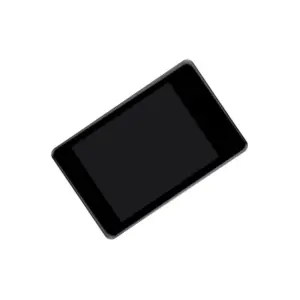
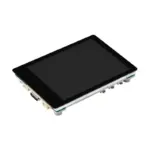
Waveshare RP2350 2.8-Inch Capacitive Touch Display Development Board

₹2,809.00 (Inclusive of all taxes)
Out of Stock

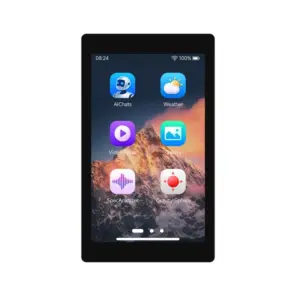
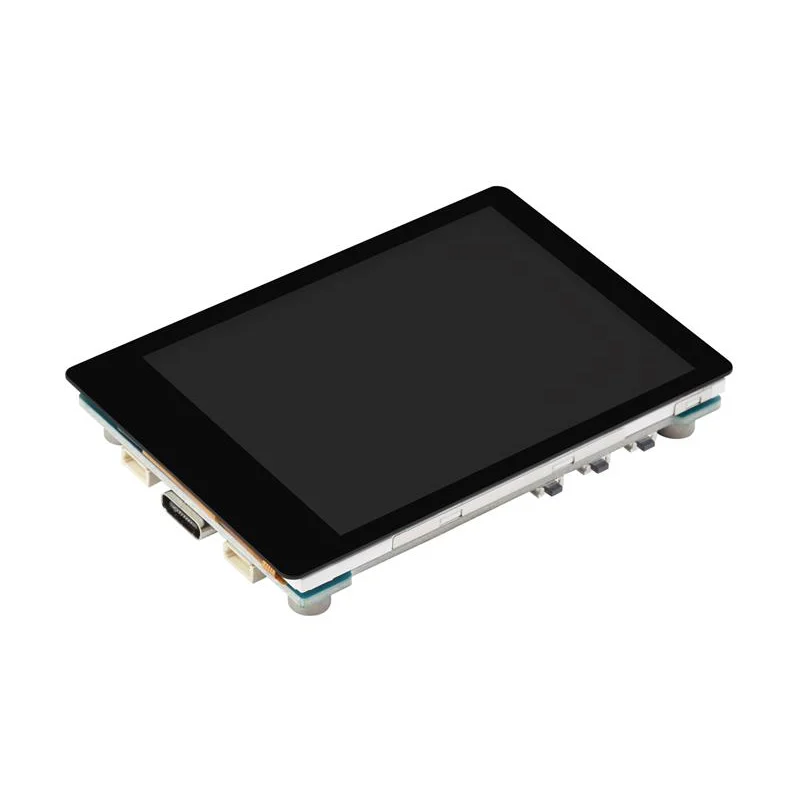
The Waveshare RP2350 Development Board is a feature-rich AIoT platform built around the Raspberry Pi RP2350 dual-core MCU, featuring a 2.8-inch IPS capacitive touch display, 6-axis IMU, and battery management, ideal for embedded GUI and sensor applications.

Features

  • Raspberry Pi RP2350 dual-core ARM Cortex-M33 + RISC-V MCU running up to 150 MHz for robust embedded processing.
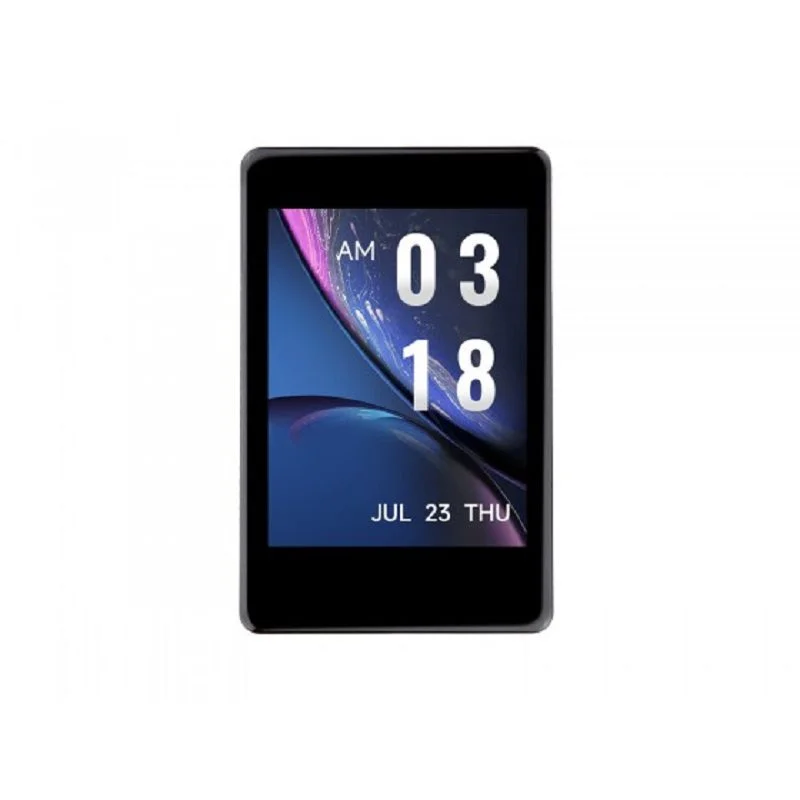
  • Integrated 2.8-inch IPS LCD with 240×320 resolution, 262K colors, and 5-point capacitive touch via I2C.
  • Onboard QMI8658 6-axis IMU (accelerometer & gyroscope), RTC, and Li-ion battery charge management module.
  • Generous 520KB SRAM and 16MB Flash memory for storing complex GUI assets and application code.
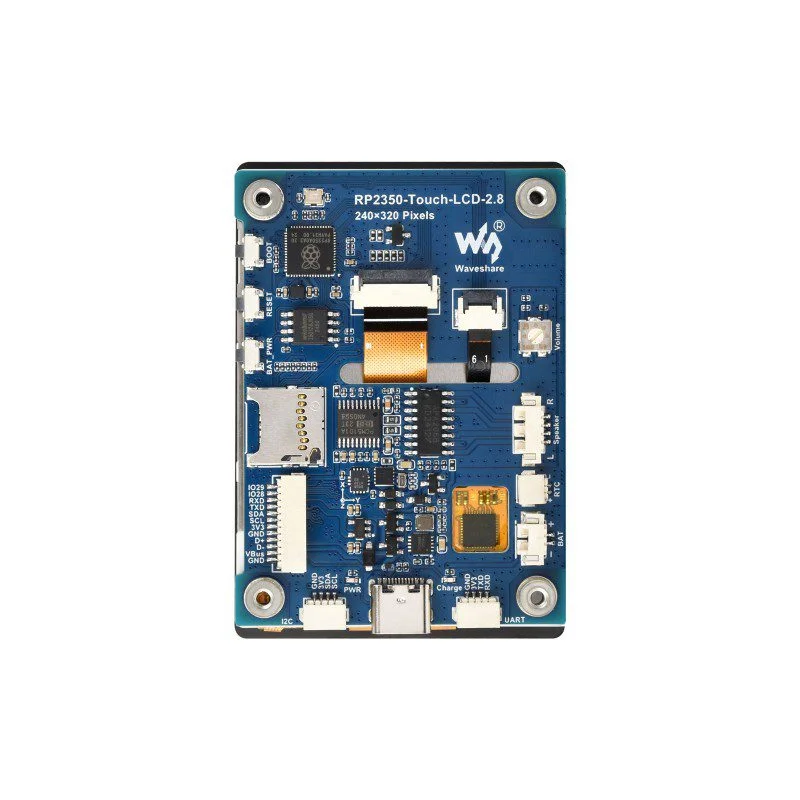
  • Comprehensive I/O including SPI display interface, UART, I2C, full-speed USB, and a microSD (TF) card slot.

Out of stock

Description

The Waveshare RP2350 Development Board combines a powerful Raspberry Pi RP2350 microcontroller with a vibrant 2.8-inch capacitive touch display, creating an all-in-one platform for building interactive embedded devices and IoT dashboards. Its unique dual-core, dual-architecture design (ARM Cortex-M33 and RISC-V) delivers flexible compute performance up to 150MHz, efficiently handling GUI rendering with frameworks like LVGL while managing sensor data acquisition.

Beyond the display, the board integrates a full suite of peripherals essential for portable and sensing applications, including a 6-axis inertial measurement unit (IMU) for motion detection, a real-time clock (RTC) for timekeeping, and a lithium battery management circuit. The inclusion of a microSD slot, speaker driver, and USB mass storage programming simplifies development and deployment, enabling rapid prototyping of handheld instruments, smart controllers, and industrial HMIs.

Key Features

  • High-performance RP2350 MCU with dual-core ARM Cortex-M33 and dual-core RISC-V processor architecture.
  • Vivid 2.8-inch IPS LCD with capacitive multi-touch support for responsive user interfaces.
  • Integrated motion sensing via the QMI8658 6-axis accelerometer and gyroscope sensor.
  • Onboard power management with Li-ion battery charging and monitoring capabilities.
  • Drag-and-drop USB programming via Mass Storage Device (MSD) class for easy firmware updates.
  • Multiple low-power modes and flexible clock control for energy-efficient portable designs.
  • Expandable storage via microSD (TF) card slot for data logging or media files.
  • Comprehensive connectivity with SPI, I2C, UART, and GPIOs broken out via SH1.0 connectors.

Applications

  • Portable handheld devices and IoT dashboards with interactive touchscreen interfaces.
  • Industrial HMIs (Human-Machine Interfaces) and control panels for monitoring systems.
  • Motion-activated gadgets and wearable tech utilizing the onboard 6-axis IMU sensor.
  • Prototyping platforms for embedded GUI development with LVGL or similar libraries.
  • Battery-powered data loggers and field measurement instruments.

Technical Specifications

Microcontroller / SoCRaspberry Pi RP2350 (Dual-core ARM Cortex-M33 + Dual-core RISC-V)
Display2.8-inch IPS LCD, 240x320 resolution, 262K colors
Touch InterfaceCapacitive, 5-point, I2C controlled with interrupt
Onboard SensorsQMI8658 6-axis IMU (Accelerometer & Gyroscope), RTC
Memory520KB SRAM, 16MB Flash
Key InterfacesSPI (Display), I2C, UART, Full-speed USB, microSD (TF) Slot, GPIO
Power ManagementIntegrated Li-ion battery charger
Clock SpeedUp to 150 MHz
Dimensions (Shipping)11 x 8 x 3 cm
Weight (Shipping)0.065 kg

Frequently Asked Questions

What development frameworks are supported for programming the Waveshare RP2350 board?

The board is primarily programmed using C/C++ within the official Raspberry Pi Pico SDK, which supports both bare-metal and FreeRTOS environments. It is also compatible with MicroPython for rapid scripting. The integrated display is well-suited for GUI libraries like LVGL (Light and Versatile Graphics Library), which can be ported using the SDK. Programming is simplified via USB Mass Storage Device (MSD) drag-and-drop flashing, eliminating the need for a separate programmer.

How do I connect and use the onboard capacitive touch screen?

The 2.8-inch capacitive touch panel is connected to the RP2350 MCU via an I2C interface and includes an interrupt line for efficient touch event handling. You must initialize the I2C peripheral in your firmware and communicate with the touch controller's specific register set to read touch coordinates. Driver examples are typically provided in the Waveshare wiki or GitHub repository. The touch controller supports 5-point multi-touch, and the interrupt pin can be configured to wake the MCU from sleep on touch.

Can this board run on battery power, and how is charging managed?

Yes, the board includes a dedicated lithium battery management IC that handles charging, power-path management, and battery monitoring. You can connect a standard 3.7V Li-ion or Li-Po cell via the provided terminals. The charging current is typically set by a resistor on the board. In your firmware, you can monitor battery voltage via an ADC pin connected to the management IC's output. The RP2350's multiple low-power modes allow you to minimize current draw, extending battery life for portable applications.

What is the purpose of the QMI8658 sensor and how do I read data from it?

The QMI8658 is a 6-axis inertial measurement unit (IMU) combining a 3-axis accelerometer and a 3-axis gyroscope. It is used for motion sensing, orientation detection, and gesture recognition. The sensor communicates over I2C. To use it, you must initialize the I2C bus, write configuration registers to set the sensor's range and output data rate (ODR), and then periodically read the acceleration and gyroscope data registers. Libraries and example code for the QMI8658 are often available from the sensor manufacturer or community repositories.

Package Includes

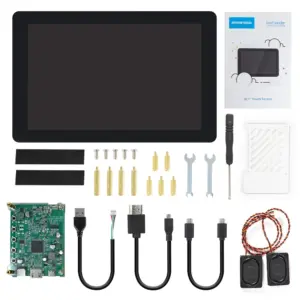
  • 1 x RP2350-Touch-LCD-2.8 Development Board
  • 1 x 8Ω 2W Speaker
  • 2 x SH1.0 4PIN Cable
  • 1 x SH1.0 12PIN Cable

Additional Information

Weight 0.065 kg
Dimensions 8 × 11 × 3 cm