SKU: IOWC-0670
📋 GST Invoice Available

Espressif ESP32-C3-DevKit-RUST-2 Development Board

₹2,679.00 (Inclusive of all taxes)
Out of Stock

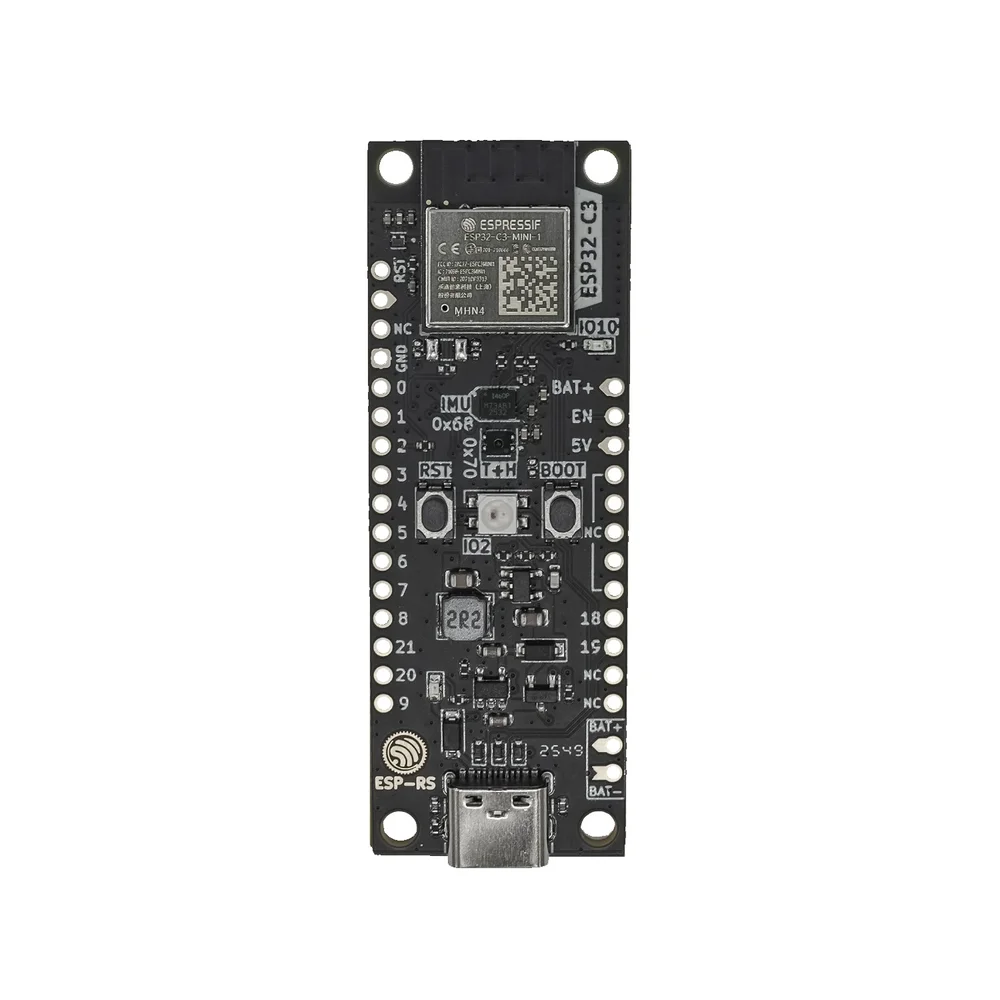
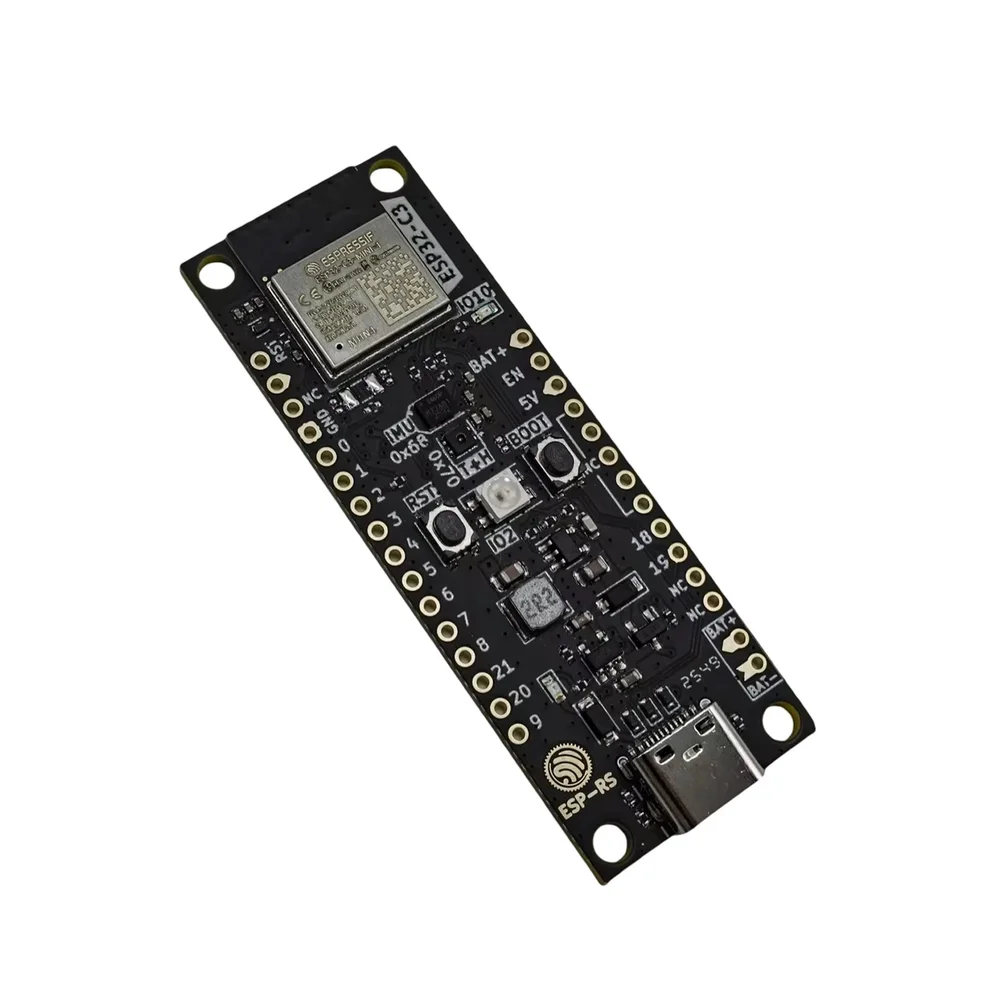
The Espressif ESP32-C3-DevKit-RUST-2 is a compact development board featuring the ESP32-C3-MINI-1 module with 4MB flash, a 160MHz RISC-V core, and integrated 2.4GHz Wi-Fi & BLE 5.0. It includes onboard sensors, a USB-C port, and a Li-Ion charger, making it ideal for Rust-based IoT prototyping and portable wireless applications.

Features

  • ESP32-C3-MINI-1 module with 160MHz RISC-V core, 4MB flash, and 400KB SRAM for efficient IoT processing.
  • Dual wireless connectivity with 2.4GHz 802.11 b/g/n Wi-Fi and Bluetooth Low Energy 5.0 (BLE 5) for versatile IoT networking.
  • Integrated environmental and motion sensing via onboard temperature/humidity sensor and IMU, eliminating external sensor needs.
  • Built-in Li-Ion battery charging circuit and USB Type-C port for simplified power management and portable device development.
  • Rich I/O with 22 GPIOs supporting SPI, I2C, UART, I2S, ADC, and USB Serial/JTAG for extensive peripheral expansion.

Out of stock

Description

The Espressif ESP32-C3-DevKit-RUST-2 is a feature-rich development platform built around the certified ESP32-C3-MINI-1 system-in-package module. It leverages a 32-bit RISC-V single-core processor clocked at 160MHz, providing a balance of computational power and energy efficiency for embedded wireless applications. The board integrates a complete RF front-end for robust 2.4GHz Wi-Fi and BLE 5.0 connectivity, enabling rapid development of connected devices for smart home, wearables, and sensor networks.

Beyond core wireless functionality, the board incorporates practical features for real-world IoT deployments. An onboard temperature and humidity sensor and an inertial measurement unit (IMU) provide immediate environmental and motion data. The integrated Li-Ion battery charging circuit, coupled with a 5V to 3.3V buck converter, simplifies the design of battery-powered, portable prototypes. The breadboard-friendly form factor with accessible pin headers, user and RGB LEDs, and a USB Type-C interface for programming and power streamlines the development workflow for engineers and makers.

Key Features

  • ESP32-C3-MINI-1 module provides certified 2.4GHz Wi-Fi and BLE 5.0 connectivity in a compact, pre-flashed package.
  • 160MHz RISC-V processor core offers a modern, open instruction set architecture optimized for low-power embedded tasks.
  • Onboard environmental sensing suite includes a digital temperature and humidity sensor and an IMU for motion tracking.
  • Integrated power management features a Li-Ion/Polymer battery charger and a high-efficiency 5V to 3.3V DC-DC buck converter.
  • USB Type-C port delivers robust connectivity for firmware flashing via USB Serial/JTAG, serial communication, and 5V power input.
  • Comprehensive I/O breakout exposes 22 programmable GPIOs supporting SPI, I2C, UART, I2S, ADC, PWM, and the RMT peripheral.
  • Developer-friendly indicators include a user LED, an addressable RGB LED, and a battery charging status LED for system feedback.
  • Optimized for Rust and embedded development workflows, supported by Espressif's ESP-IDF framework and Arduino core.

Applications

  • Smart home automation nodes for lighting, climate control, and security sensors.
  • Wearable technology prototypes and fitness trackers leveraging BLE and motion sensing.
  • Battery-powered environmental monitoring stations for temperature, humidity, and air quality.
  • Educational platforms for learning embedded systems, IoT connectivity, and Rust programming.
  • Industrial sensor gateways collecting data via wired interfaces and transmitting via Wi-Fi.

Technical Specifications

Module/SoCESP32-C3-MINI-1
Processor32-bit RISC-V Single-Core, 160MHz
Wireless ProtocolsWi-Fi 802.11 b/g/n (2.4GHz), Bluetooth Low Energy 5.0 (BLE 5)
Flash Memory4MB SPI Flash
SRAM400KB
ROM384KB
Supply Voltage5V via USB-C or external source
Operating Voltage3.3V (regulated onboard)
GPIO22
Interfaces3x SPI, 2x UART, I2C, I2S, USB Serial/JTAG, 12-bit ADC, RMT, TWAI, GDMA
Onboard SensorsTemperature & Humidity Sensor, IMU (Inertial Measurement Unit)
Power FeaturesIntegrated Li-Ion Battery Charging Circuit, 5V to 3.3V Buck Converter
USB PortUSB Type-C
IndicatorsUser LED, RGB LED, Battery Charging LED
ButtonsReset, Boot
Dimensions60 x 30 x 10 mm
Weight20 g

Frequently Asked Questions

How do I program the ESP32-C3-DevKit-RUST-2 development board?

You can program the board using Espressif's official ESP-IDF framework, the Arduino core for ESP32, or PlatformIO. Connect the USB Type-C port to your computer. The board includes a USB Serial/JTAG interface, so most modern IDEs will detect it automatically. For Rust development, you can use the esp-rs toolchain and frameworks like esp-idf-hal. Ensure you have the correct USB drivers installed if required by your operating system.

What is the purpose of the onboard Li-Ion battery charging circuit?

The integrated charging circuit allows you to connect a single-cell Li-Ion or Li-Polymer battery directly to the board's designated pins. It manages the charging process (typically up to 500mA), enabling the development of portable, battery-powered IoT devices without requiring an external charger IC. The battery voltage is also regulated to provide the 3.3V system power, and a status LED indicates the charging state. Always refer to the board's schematic for the correct battery connection polarity and maximum voltage specifications.

Can I use the onboard temperature/humidity sensor and IMU with Arduino IDE?

Yes, you can use these sensors with the Arduino IDE by installing the ESP32 board package and relevant sensor libraries. The sensors are connected via I2C or other digital interfaces. You will need to find and install community libraries specific to the sensor models used on the board (check the official Espressif documentation for part numbers). Initialize the sensors in your setup() function and read data in the loop(). Example code is often provided in the library repositories to help you get started quickly.

What is the power consumption and how can I implement deep sleep?

Active power consumption depends on Wi-Fi/BLE radio state, but the ESP32-C3 is designed for low-power operation. For minimal consumption, you can use the deep sleep mode, which drastically reduces current to microamps, preserving battery life. In your firmware, use the `esp_deep_sleep_start()` function (ESP-IDF) or equivalent Arduino commands. Configure a wake-up source like a timer or GPIO pin before entering sleep. Ensure all unnecessary peripherals are powered down. The onboard buck converter remains active, so measure total board current for accurate battery runtime calculations.

How do I access all 22 GPIO pins and what are their limitations?

All 22 GPIOs are broken out to the pin headers on the board's edges. Consult the official pinout diagram to identify each pin's number and alternate functions (SPI, I2C, ADC, etc.). Note that some pins are used internally for flash memory, USB, or the onboard LEDs/buttons, restricting their use. For example, GPIOs 8-11 are often used for the embedded flash. Always check the board's schematic or pin definition header file to avoid conflicts. Most pins support digital I/O, PWM, and interrupt handling, with a subset providing analog-to-digital conversion (ADC) capability.

Package Includes

  • 1 x Espressif ESP32-C3-DevKit-RUST-2 Development Board

Additional Information

Weight 0.04 kg
Dimensions 10 × 5 × 2 cm