SKU: IOWC-0054
📋 GST Invoice Available

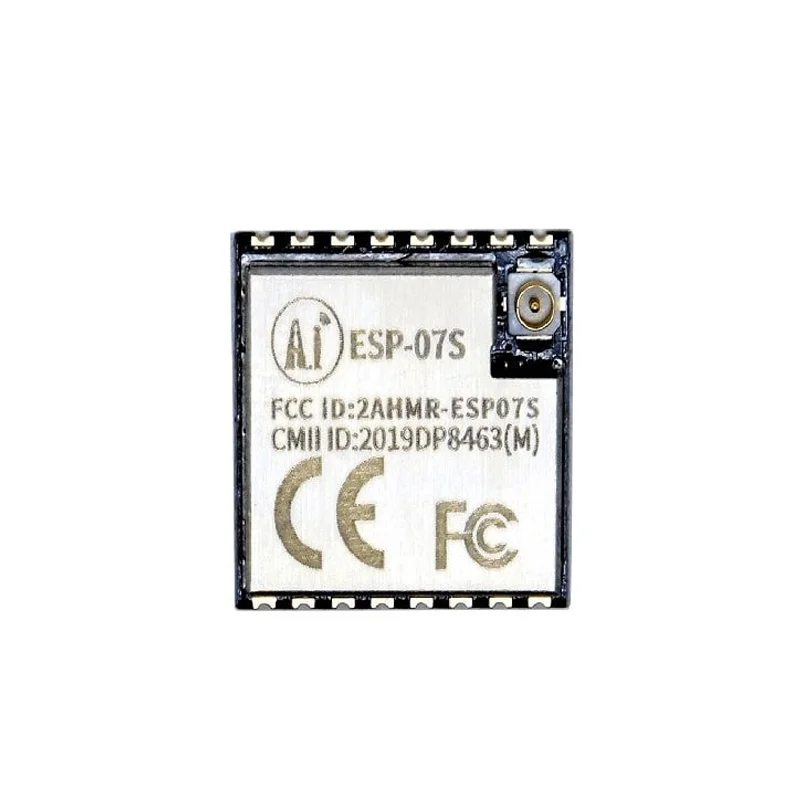
AI-Thinker ESP-07S ESP8266 WiFi Module w/ U.FL Connector

₹219.00 (Inclusive of all taxes)
Out of Stock

The AI-Thinker ESP-07S is a compact ESP8266 serial WiFi module featuring a U.FL antenna connector for external antenna support, ideal for space-constrained IoT projects requiring robust 2.4GHz Wi-Fi connectivity and programmable via Arduino IDE or AT commands.

Features

  • Compact ESP8266 module with U.FL antenna connector for improved range and signal diversity.
  • Full 802.11 b/g/n Wi-Fi support with integrated TCP/IP stack and STA/AP/STA+AP operation modes.
  • Integrated low-power 32-bit Tensilica L106 MCU with 4MB flash, programmable via Arduino or AT commands.
  • Wide peripheral support including UART, SPI, I2C, I2S, PWM, GPIO, and a 10-bit ADC.
  • Optimized for low-power applications with deep sleep modes and an operating voltage of 3.0-3.6V.

Out of stock

Description

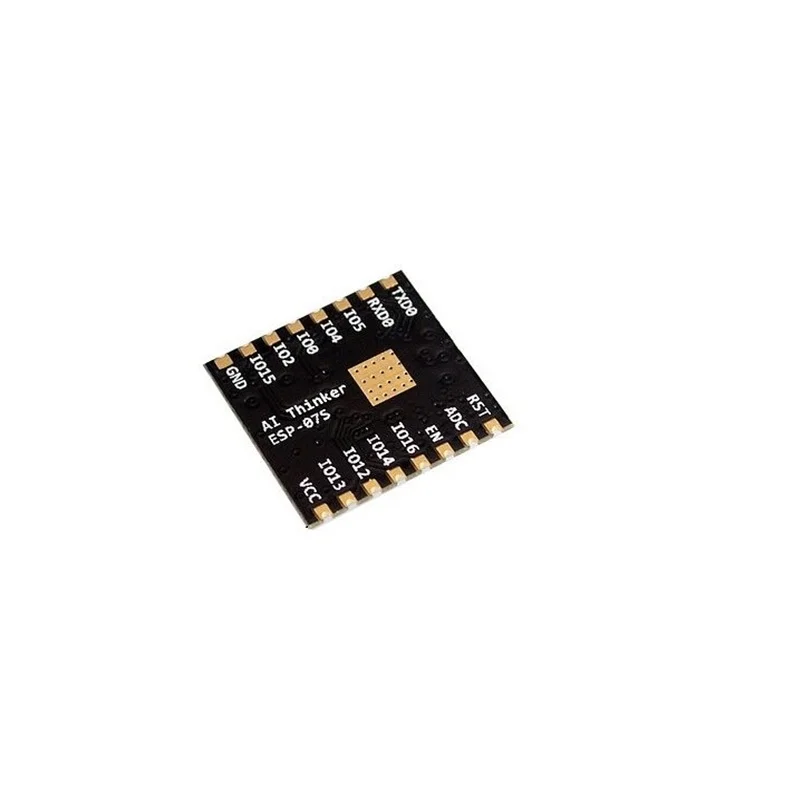
The AI-Thinker ESP-07S is a streamlined variant of the popular ESP-12 series, designed for compact PCB layouts while maintaining full firmware compatibility. It removes the redundant bottom row of pads found on ESP-12E/F modules, resulting in a smaller footprint without sacrificing accessible GPIOs. The inclusion of a U.FL antenna connector allows for the attachment of an external antenna, significantly enhancing signal range and reliability in challenging RF environments compared to modules with only a PCB trace antenna.

Built around the ESP8266 SoC, it integrates a 32-bit microcontroller, RF front-end, power amplifier, and matching network. This module is ideal for developers needing a certified, low-power Wi-Fi solution for sensor nodes, smart home devices, or wireless gateways. It operates on a 3.3V supply and supports advanced Wi-Fi features like WPA/WPA2 security, Smart Link configuration, and antenna diversity.

Key Features

  • Compact form factor with U.FL antenna port for external high-gain antenna connection.
  • Pin-compatible with ESP-12E/F development boards for easy migration and prototyping.
  • Integrated TCP/IP protocol stack simplifies network connectivity for IoT applications.
  • Supports multiple development environments including Arduino IDE, ESP8266 RTOS SDK, and NodeMCU.
  • Low operating current enables battery-powered, long-term Wi-Fi sensing deployments.
  • Robust peripheral set with SPI, I2C, I2S, PWM, and ADC interfaces for sensor integration.
  • Certified module ensures reliable RF performance and regulatory compliance.
  • Wide operating temperature range (-40°C to 125°C) suitable for industrial environments.

Applications

  • Compact IoT sensor nodes for home automation and environmental monitoring.
  • Wi-Fi-enabled smart plugs, lighting controllers, and wireless switches.
  • Industrial telemetry devices requiring reliable 2.4GHz connectivity.
  • Retrofit modules for adding Wi-Fi control to existing serial devices.
  • Prototyping and product development with external antenna flexibility.

Technical Specifications

Wireless SoCESP8266
Wireless Protocol802.11 b/g/n Wi-Fi
Frequency Range2.4GHz - 2.5GHz
RF Output PowerIntegrated PA +20dBm typical
Supply Voltage3.0V - 3.6V DC
Operating Current~80mA (average during RF transmission)
Flash Memory4 MB
InterfacesUART, SPI, I2C, I2S, PWM, GPIO, ADC
Antenna ConnectorU.FL (IPEX)
Operating Temperature-40°C to +125°C
Dimensions17mm x 16mm

Frequently Asked Questions

How do I connect an external antenna to the ESP-07S module?

The ESP-07S features a U.FL (IPEX) connector. You must solder a U.FL pigtail cable to your main PCB or use a U.FL to SMA adapter. Ensure the antenna is impedance-matched for 2.4GHz (50 ohms) and has an appropriate gain for your application. The module automatically switches to the external antenna when connected, disabling the internal PCB trace antenna option.

What is the pinout compatibility between the ESP-07S and ESP-12E/F modules?

The ESP-07S is 100% pin-compatible with the ESP-12E and ESP-12F modules on the remaining top and side pads. The removed bottom row contained mostly non-user-accessible test points. You can directly solder the ESP-07S onto a PCB designed for an ESP-12E/F. Ensure your design accounts for the 2.0mm pitch of the castellated holes for hand soldering.

What firmware and development platforms are supported for programming the ESP-07S?

You can program the ESP-07S using the Arduino IDE with the ESP8266 board package, the official ESP8266 RTOS SDK (ESP-IDF style), or the NodeMCU Lua firmware. Flashing typically requires a USB-to-Serial adapter connected to the TX, RX, GPIO0, and EN pins. Use a 3.3V logic level adapter and pull GPIO0 low during boot to enter flash mode.

What are the power supply requirements and sleep current for battery operation?

The module requires a stable 3.3V power supply (3.0V to 3.6V range) capable of delivering at least 300mA peak current. For deep sleep, current consumption drops to approximately 20µA, making it suitable for battery-powered sensors. Ensure your voltage regulator has low quiescent current and use a pull-up resistor on the EN pin if implementing deep sleep cycles.

Package Includes

  • 1 x AI-Thinker ESP-07S ESP8266 Serial WiFi Module

Additional Information

Weight 0.003 kg
Dimensions 1.6 × 1.7 cm