SKU: SBCD-0080
📋 GST Invoice Available

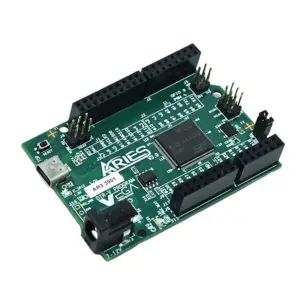
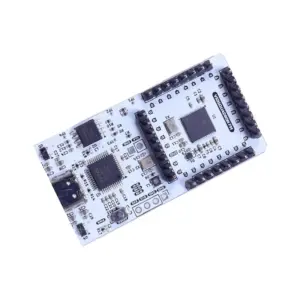
ARIES v2.0 Development Board | THEJAS32 RISC-V SoC

₹2,269.00 (Inclusive of all taxes)
Out of Stock

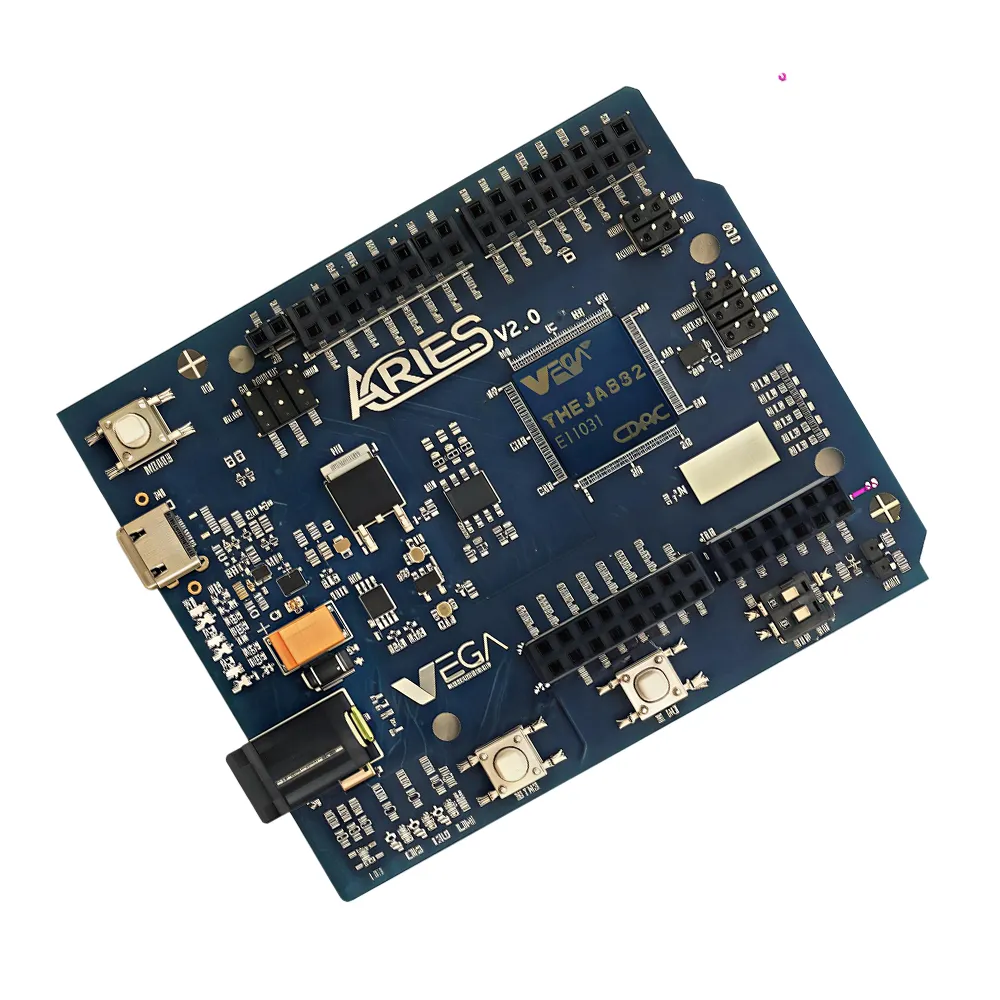
The ARIES v2.0 Development Board, powered by the THEJAS32 ASIC with a VEGA ET1031 microprocessor, offers a versatile platform operating at 100MHz. Designed by C-DAC, it is ideal for low-power IoT, sensor fusion, and smart meter applications, providing 256KB SRAM, 2MB Flash, and extensive I/O for standalone operation.

Features

  • Powered by THEJAS32 ASIC integrating VEGA ET1031 RISC-V microprocessor.
  • Features 256KB SRAM, 2MB Flash memory, and a 100MHz clock speed.
  • Equipped with multiple UART, SPI, I2C, and PWM interfaces for diverse applications.
  • Designed by C-DAC as part of the Digital India RISC-V (DIR-V) Program.
  • Supports standalone operation, easily powered via USB or external supply.

Out of stock

Description

The ARIES v2.0 is a robust development platform built around the THEJAS32 ASIC, operating at a reliable 100MHz. At its core lies the VEGA ET1031 Microprocessor, complemented by 256KB of internal SRAM and 2MB of Flash memory, providing ample resources for complex embedded applications. This board integrates a comprehensive suite of peripherals, including three UARTs, four SPIs, three timers, eight PWMs, and three I2C interfaces, along with 32 versatile GPIOs, ensuring extensive connectivity and control options for various projects.

Designed for seamless standalone operation, the ARIES v2.0 board simplifies the development process. Users can quickly initiate projects by connecting the board to a computer via a standard USB cable, or by powering it with an AC/DC adapter or battery for portable applications. This platform was meticulously engineered and developed by the Centre for Development of Advanced Computing (C-DAC) under the Digital India RISC-V (DIR-V) Program, an initiative funded by the Ministry of Electronics and Information Technology, Government of India, highlighting its significance in advancing indigenous hardware capabilities.

The ARIES v2.0 targets a broad spectrum of embedded applications, from resource-constrained low-power IoT devices and intricate sensor fusion systems to smart meters, system supervisors, and remote sensing solutions. Its capabilities also extend to wearable devices, educational equipment, industrial networking, and modernizing legacy 8/16-bit applications, offering a powerful yet flexible foundation for innovation across diverse sectors.

Key Features

  • Integrated THEJAS32 ASIC with VEGA ET1031 Microprocessor.
  • Operates at a clock frequency of 100 MHz.
  • Onboard 256KB SRAM and 2MB Flash memory.
  • Comprehensive I/O: 3 UARTs, 4 SPIs, 3 TIMERS, 8 PWMs, 3 I2C interfaces, 32 GPIOs.
  • Supports 3.3V I/O voltage with 12 mA DC current per pin.
  • Designed for standalone operation, easily powered via USB, AC/DC adapter, or battery.
  • Developed by C-DAC as part of the Digital India RISC-V (DIR-V) Program.

Applications

  • Low-power IoT devices
  • Sensor fusion systems
  • Smart Meter applications
  • System supervisors
  • Remote sensors
  • Wearable devices
  • Toy and electronic education equipment
  • Legacy 8/16-bit application modernization
  • Industrial networking

Technical Specifications

ControllerTHEJAS32 ASIC
MicroprocessorVEGA ET1031
SRAM256 KB
Flash Memory2 MB
Clock Speed100 MHz
Input Voltage7-12 V
PWM Pins8
SPI Interfaces4
UART Interfaces3
I2C Interfaces3
GPIOs32
I/O Voltage3.3 V
DC Current per I/O Pin12 mA
Length7.8 cm
Width6.6 cm

Frequently Asked Questions

What is the core processor of the ARIES v2.0 Development Board?

The ARIES v2.0 is powered by the THEJAS32 ASIC, which integrates the VEGA ET1031 Microprocessor. This RISC-V architecture operates at 100MHz and is complemented by 256KB SRAM and 2MB Flash, making it suitable for a range of embedded applications requiring efficient processing.

What are the primary communication interfaces available on the ARIES v2.0?

The board provides extensive communication capabilities, including three UARTs, four SPIs, and three I2C interfaces. These enable flexible peripheral connections and data exchange with other devices in embedded systems, supporting complex multi-sensor or networked applications effectively.

What development environment and power supply options does the ARIES v2.0 support?

The ARIES v2.0 is designed for standalone operation and can be powered via a USB cable, an AC/DC adapter, or a battery, accommodating various project setups. While specific IDEs aren't listed, being a RISC-V platform, it typically supports open-source GCC toolchains and potentially specific SDKs provided by C-DAC.

What is the input voltage range and I/O voltage of the ARIES v2.0 board?

The ARIES v2.0 Development Board accepts an input voltage between 7V and 12V. Its general-purpose input/output (GPIO) pins operate at a 3.3V logic level, providing compatibility with a wide array of common sensors and modules while maintaining a DC current capacity of 12 mA per pin.

What specific program or organization developed the ARIES v2.0?

The ARIES v2.0 Development Board was designed and developed by the Centre for Development of Advanced Computing (C-DAC). This initiative is part of the Digital India RISC-V (DIR-V) Program, which is funded by the Ministry of Electronics and Information Technology, Government of India, emphasizing indigenous technological advancement.

Package Includes

  • 1 x ARIES v2.0 Development Board

Additional Information

Weight 0.044 kg
Dimensions 7.8 × 6.6 cm