SKU: IOWC-1094
📋 GST Invoice Available

WeAct Studio RP2350B RISC-V Development Board w/ 16MB Flash

₹729.00 (Inclusive of all taxes)
Out of Stock

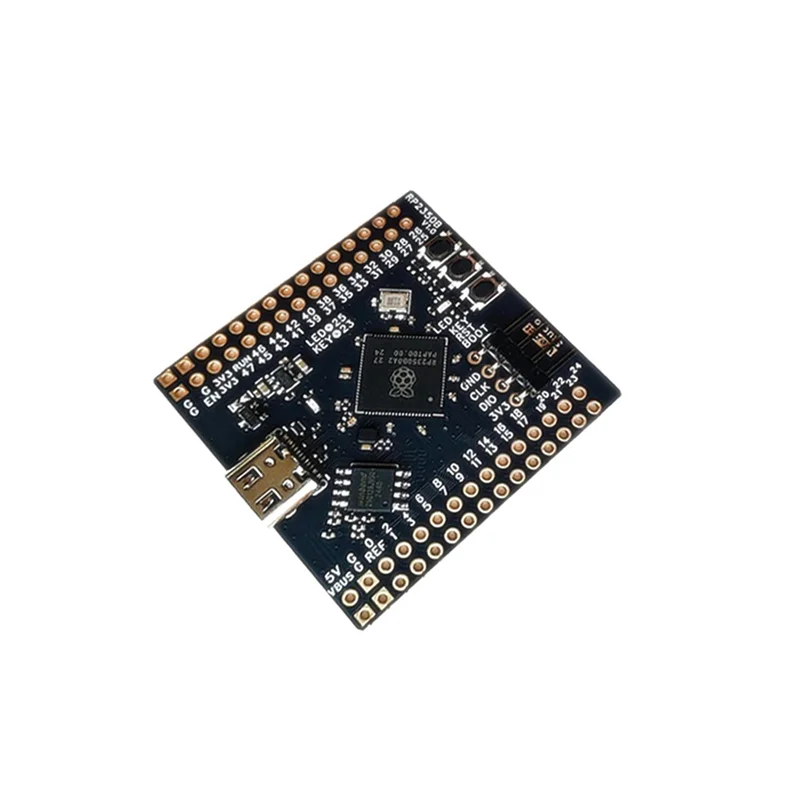
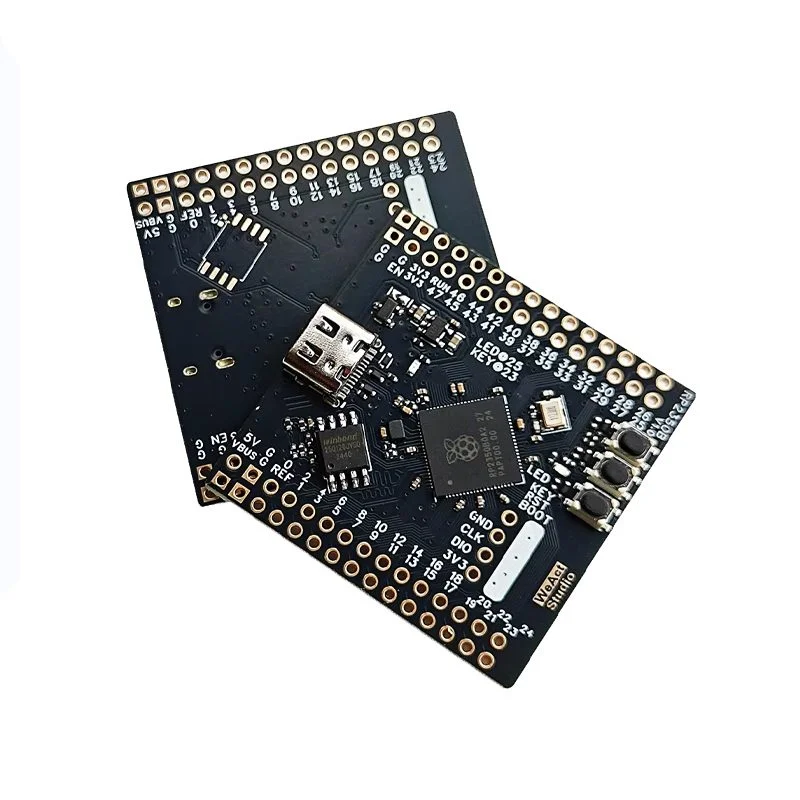
The WeAct Studio RP2350B is a compact RISC-V development board featuring Raspberry Pi’s dual-core RP2350B microcontroller with 520KB SRAM and 16MB QSPI flash, ideal for embedded systems, real-time processing, and IoT prototyping with extensive 48-pin GPIO.

Features

  • Powered by Raspberry Pi’s RP2350B dual-core RISC-V (Hazard3) microcontroller for efficient, real-time embedded processing.
  • Features 520KB of on-chip SRAM and 16MB of QSPI flash memory for ample program and data storage.
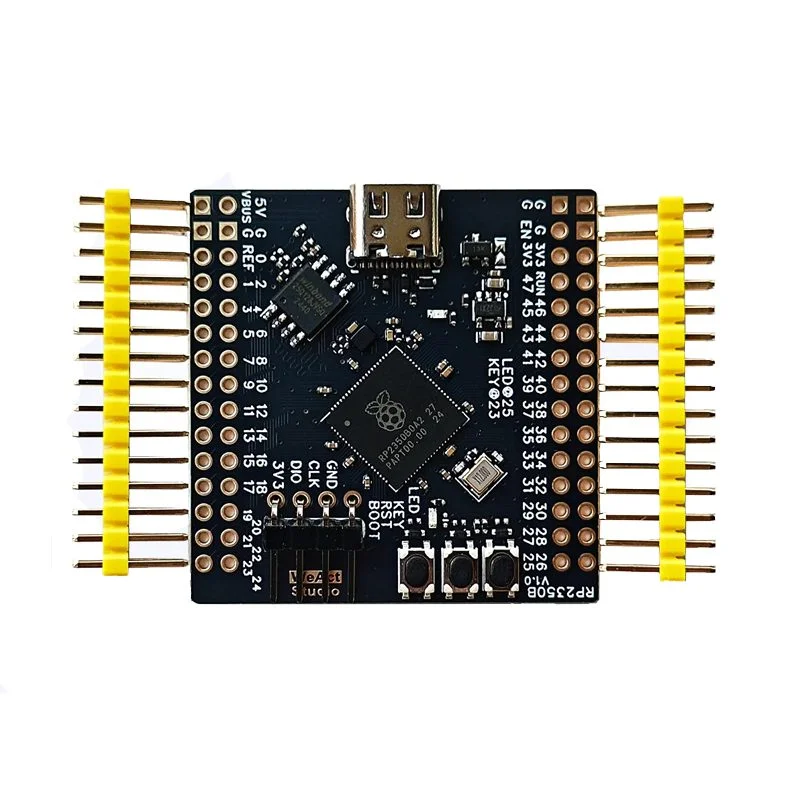
  • Exposes 48 versatile GPIO pins for connecting sensors, displays, actuators, and communication modules.
  • Compact 41.1 x 41.4 mm form factor with pre-soldered headers for immediate prototyping and integration.
  • Supports USB Type-C for programming, debugging, and power, compatible with open-source RISC-V toolchains.

Out of stock

Description

The WeAct Studio RP2350B development board delivers a robust platform for embedded developers and makers exploring the RISC-V architecture. Centered on Raspberry Pi’s RP2350B microcontroller, it combines a dual-core Hazard3 CPU with substantial integrated memory—520KB of SRAM and 16MB of QSPI flash—enabling complex application development without external memory. The board’s 48-pin GPIO header provides extensive I/O for peripherals like SPI, I2C, UART, and PWM, facilitating sensor integration and hardware control.

Designed for low-power operation with a 3.3V supply and typical currents between 50-100mA, it’s suitable for portable and battery-powered IoT nodes. The inclusion of a USB Type-C connector streamlines firmware uploads and serial debugging. With its industrial temperature range and compact footprint, this board is engineered for reliable performance in educational, DIY, and professional embedded system prototyping.

Key Features

  • High-performance dual-core RISC-V RP2350B microcontroller from Raspberry Pi.
  • Generous 520KB on-chip SRAM for data-intensive applications and multitasking.
  • Integrated 16MB QSPI flash provides ample non-volatile storage for firmware and file systems.
  • Comprehensive 48-pin GPIO breakout supports a wide range of digital, analog, and serial interfaces.
  • USB Type-C interface offers convenient power delivery, programming, and serial communication.
  • Compact PCB design with pre-installed headers enables rapid prototyping and system integration.
  • Wide operating temperature range (-20°C to +85°C) ensures reliability in varied environments.
  • Fully compatible with open-source RISC-V development toolchains and debugging software.

Applications

  • Embedded system prototyping and education for RISC-V architecture.
  • Real-time control systems for robotics, motor drives, and automation.
  • Low-power IoT sensor nodes and data loggers for environmental monitoring.
  • DIY electronics projects requiring extensive GPIO for displays, keypads, and sensors.
  • Development platform for custom peripherals and communication gateways.

Technical Specifications

Microcontroller / SoCRaspberry Pi RP2350B Dual-Core RISC-V (Hazard3)
SRAM520 KB
Flash Memory16 MB QSPI Flash
GPIO Pins48
Core Clock Frequency133 MHz
Supply Voltage3.3V
Operating Current50–100 mA (typical)
Max Operating CurrentUp to 120 mA
Programming/Debug InterfaceUSB Type-C
Operating Temperature-20°C to +85°C
Dimensions (L x W)41.1 mm x 41.4 mm
Board WeightApprox. 10 g

Frequently Asked Questions

What toolchain and IDE are recommended for programming the RP2350B board?

You can use the official Raspberry Pi Pico SDK or the open-source RISC-V GNU toolchain. Development is supported in Visual Studio Code with the Raspberry Pi Pico extension, or via command line using CMake. The board appears as a mass storage device for dragging UF2 firmware files, and the USB Type-C port also provides a serial console for debugging output.

How do I power the board and what are the power requirements?

The board is powered via the onboard USB Type-C port at 5V, which is regulated down to the core 3.3V. You can also supply 3.3V directly to the appropriate GPIO pin if designing a custom carrier. Typical operating current is 50-100mA, but can peak up to 120mA when all peripherals are active, so ensure your power supply can deliver at least 500mA for reliable operation.

Are all 48 GPIO pins broken out and what are their capabilities?

Yes, all 48 GPIO pins are accessible via the dual rows of male headers. These pins support digital I/O, multiple hardware UART, SPI, and I2C peripherals, PWM outputs, and some can function as analog inputs. Consult the RP2350B datasheet for the specific multiplexing options. It is recommended to add pull-up/pull-down resistors externally as needed for your circuit.

Package Includes

  • 1 x WeAct Studio RP2350B RISC-V Development Board
  • 1 x Set of Header Pins
  • 1 x Set of Connectors

Additional Information

Weight 0.01 kg
Dimensions 4.11 × 4.14 cm