SKU: IOWC-1111
📋 GST Invoice Available

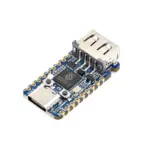
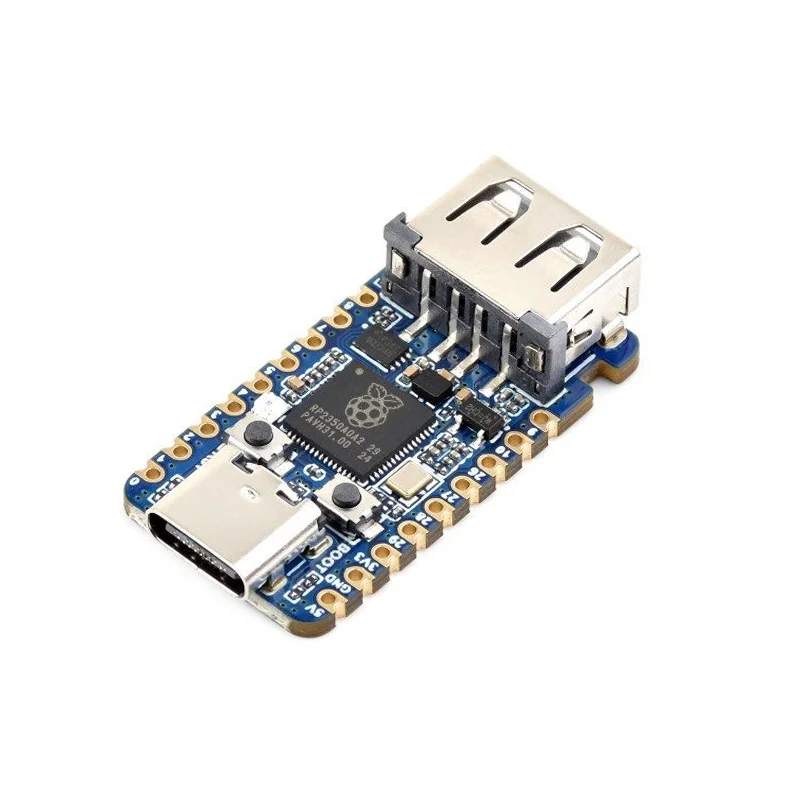
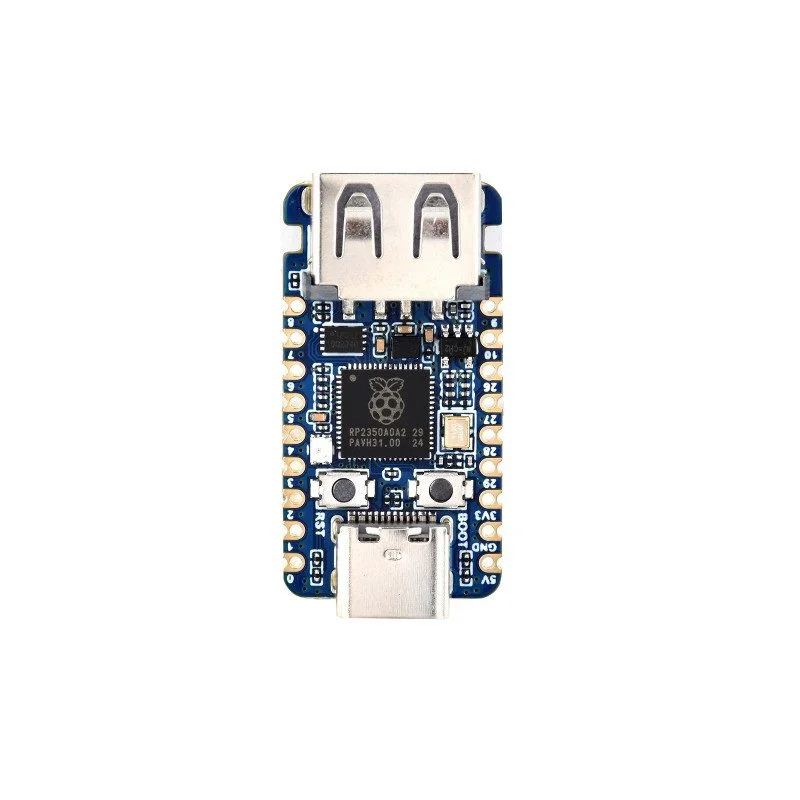
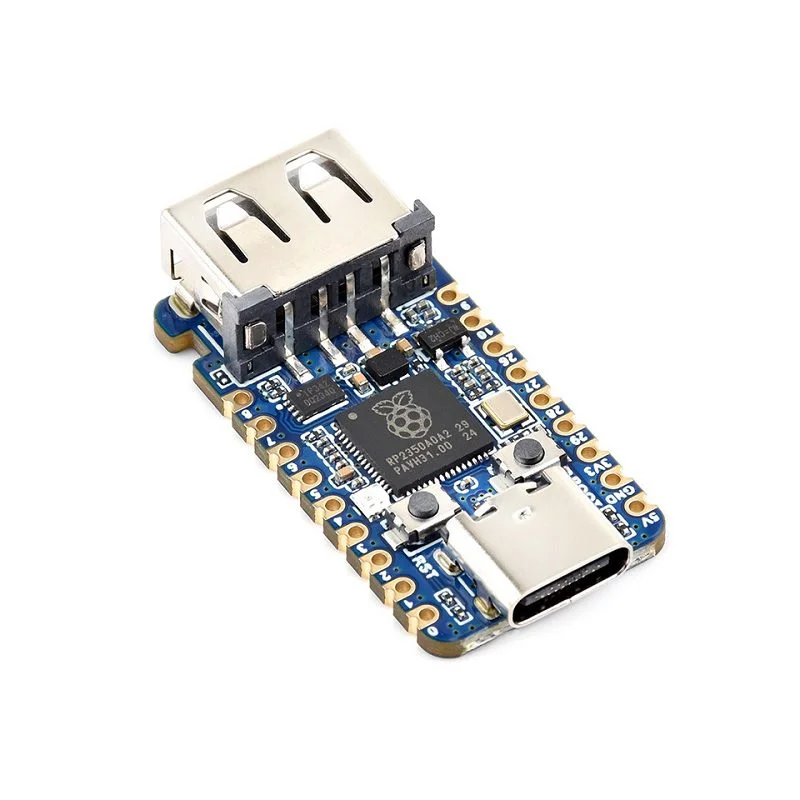
Waveshare RP2350A USB Mini Dev Board, Raspberry Pi Dual-Core MCU

₹649.00 (Inclusive of all taxes)
Out of Stock

The Waveshare RP2350A USB Mini Development Board is a compact, dual-core MCU platform based on the Raspberry Pi RP2350A, featuring a unique Arm Cortex-M33 and RISC-V core architecture. It supports drag-and-drop USB programming and is ideal for embedded projects requiring flexible I/O and low-power operation.

Features

  • Dual-Core, Dual-Architecture MCU: Features a Raspberry Pi RP2350A with dual Arm Cortex-M33 and dual RISC-V cores for flexible, parallel task execution.
  • High-Performance & Memory: Operates at 150MHz with 520KB SRAM and 2MB onboard Flash for demanding embedded applications.
  • Versatile Connectivity & I/O: Includes USB-C for power/programming, a USB host port, 15 multi-function GPIOs, SPI, I2C, UART, ADC, PWM, and 12 programmable PIO state machines.
  • Developer-Friendly Workflow: Supports drag-and-drop programming via USB mass storage, eliminating the need for dedicated programmers or debuggers.
  • Compact & Integrable Form Factor: Castellated module edges allow direct soldering onto carrier boards for space-constrained, custom PCB designs.

Out of stock

Description

The Waveshare RP2350A USB Mini Development Board provides a powerful and accessible entry point into embedded systems development using Raspberry Pi’s innovative microcontroller silicon. At its heart is the RP2350A, which combines a dual-core Arm Cortex-M33 processor cluster with a dual-core Hazard3 RISC-V processor, enabling developers to partition tasks across different instruction set architectures for optimized performance and power efficiency.

With a flexible clock speed up to 150MHz, substantial 520KB of SRAM, and 2MB of integrated Flash memory, this board handles complex logic, data buffering, and firmware storage with ease. Its comprehensive peripheral set includes multiple serial interfaces, high-resolution ADCs, precise PWM channels, and the unique Programmable I/O (PIO) blocks that allow for the creation of custom, bit-banged communication protocols without CPU overhead. The integrated USB 1.1 interface with device and host support, coupled with a modern USB-C connector, simplifies both connectivity to peripherals and the firmware update process.

Designed for low-power applications, the board supports sleep and dormant modes, making it suitable for battery-powered IoT nodes. The castellated module design facilitates direct integration into final products, bridging the gap between prototyping and production. This board is engineered for developers, makers, and professionals seeking a capable, small-form-factor platform for sensor interfacing, motor control, custom USB devices, and other embedded computing tasks.

Key Features

  • Unique Dual-Core, Dual-Architecture Design: Leverage both Arm Cortex-M33 and RISC-V cores for task-specific optimization and parallel processing.
  • High-Speed Processing & Ample Memory: 150MHz operating frequency, 520KB SRAM, and 2MB Flash support complex algorithms and data logging.
  • Comprehensive Digital & Analog Interfaces: Features 2x SPI, 2x I2C, 2x UART, 4x 12-bit ADC channels, and 14x PWM outputs for extensive peripheral connectivity.
  • Programmable I/O (PIO) State Machines: 12 dedicated PIO blocks enable custom, timing-critical peripheral emulation (e.g., NeoPixel, DPI video) without CPU load.
  • Integrated USB Host & Device Capability: Built-in USB 1.1 controller with a Type-C port for programming and a PIO-driven Type-A host port for peripheral attachment.
  • Developer-Centric Programming Model: Supports simple drag-and-drop firmware updates via USB mass storage class, streamlining the development cycle.
  • Low-Power Operational Modes: Includes configurable sleep and dormant states to minimize energy consumption in battery-operated deployments.
  • Direct PCB Integration: Castellated holes allow the module to be surface-mounted directly onto custom carrier boards for final product designs.

Applications

  • Embedded System Prototyping: Rapid development and testing of custom firmware for dual-core microcontroller applications.
  • USB Device Development: Creation of custom HID devices, data loggers, or communication adapters using the integrated USB host/device functionality.
  • IoT Sensor Nodes: Low-power data acquisition from analog/digital sensors with local processing and serial communication.
  • Motor & Actuator Control: Precise PWM-based control of motors, servos, and LEDs for robotics and automation projects.
  • Custom Peripheral Emulation: Utilizing PIO blocks to implement non-standard communication protocols like WS2812 (NeoPixel), DPI video, or custom serial interfaces.
  • Educational Tool for Computer Architecture: Teaching concepts of dual-ISA (Arm/RISC-V) programming, concurrent processing, and low-level hardware interaction.

Technical Specifications

Microcontroller / SoCRaspberry Pi RP2350A (Dual-core Arm Cortex-M33 + Dual-core RISC-V Hazard3)
Operating FrequencyUp to 150 MHz
SRAM520 KB
Flash Memory2 MB
USB InterfaceUSB 1.1 (Device/Host), USB Type-C Connector, PIO-driven USB Type-A Host Port
GPIO Pins15 Multi-function
Serial Interfaces2x SPI, 2x I2C, 2x UART
Analog Inputs4x 12-bit ADC Channels
PWM Channels14 Controllable Channels
Programmable I/O (PIO)12 State Machines
On-Chip FeaturesAccelerated Floating-Point Libraries, Temperature Sensor, Accurate Clock/Timer
Programming MethodDrag-and-drop via USB Mass Storage
Form FactorCastellated Module

Frequently Asked Questions

How do I program the Waveshare RP2350A board?

The board supports drag-and-drop programming via USB Mass Storage. Connect it to your computer with a USB-C cable; it will appear as a removable drive. Simply copy your compiled UF2 firmware file onto this drive, and the board will automatically reboot and run the new code. No external programmer or complex IDE setup is required for basic flashing.

What development frameworks or SDKs are compatible with this board?

You can develop for the RP2350A using the official Raspberry Pi Pico C/C++ SDK or the Arduino Core for RP2350. The dual-core Arm/RISC-V architecture is fully supported in the Pico SDK, allowing you to write code for specific cores. MicroPython is also available. Setup involves installing the SDK, configuring your toolchain, and targeting the RP2350A as your board in the build system.

Can I use the USB Type-A host port to connect peripherals like keyboards?

Yes, the PIO-driven USB Type-A host port supports USB 1.1/2.0 communication. You can connect HID devices like keyboards or mice. Implementation requires writing firmware using the Pico SDK's USB host library to handle enumeration and data exchange. Note that the USB host functionality is implemented via Programmable I/O (PIO), showcasing the chip's flexibility for custom peripheral support.

What is the purpose of the castellated module edges?

The castellated (half-hole) edges allow you to solder the entire development board directly onto a custom PCB as a surface-mount module. This is ideal for moving from a prototype to a final product, as it saves space and simplifies assembly. Ensure your carrier board footprint matches the pinout and that you apply appropriate soldering techniques for reliable electrical and mechanical connections.

How do I utilize the Programmable I/O (PIO) state machines?

The 12 PIO state machines are used to create custom, timing-precise hardware interfaces without CPU intervention. You write small assembly programs for the PIO blocks to handle protocols like SPI, I2C, UART, or custom ones like DPI video or LED strip control. The Raspberry Pi Pico SDK provides a PIO assembler and C API to integrate these programs into your main application, offloading timing-critical tasks.

Package Includes

  • 1 x Waveshare RP2350A USB Mini Development Board

Additional Information

Weight 0.007 kg
Dimensions 3 × 5 × 2 cm