SKU: IOWC-1090
📋 GST Invoice Available

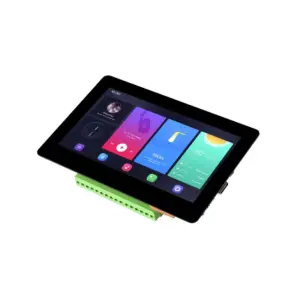
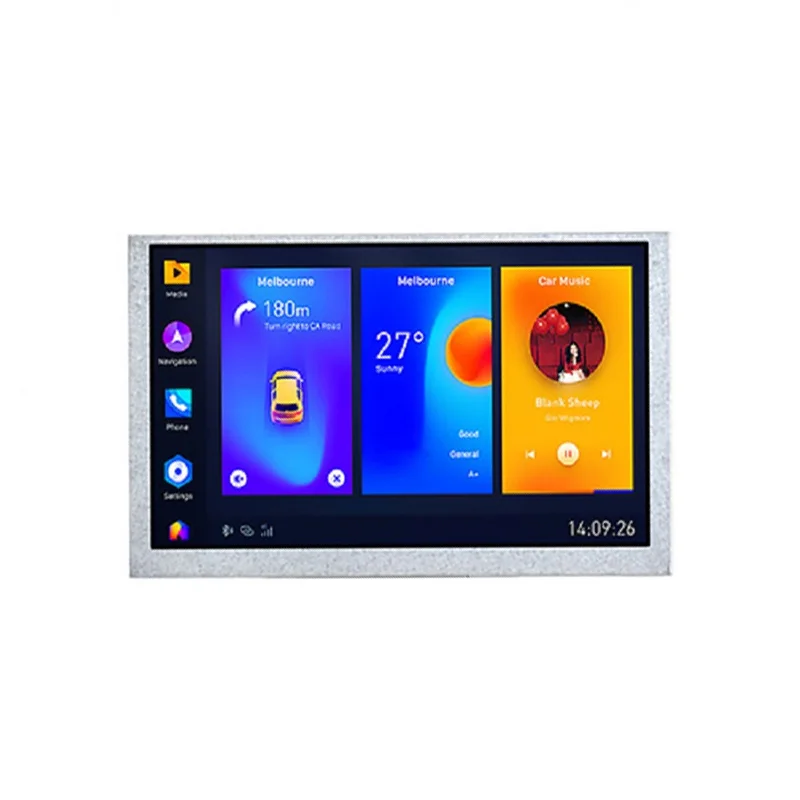
Waveshare ESP32-S3 5inch Display Development Board w/ 800x480 LCD

₹4,409.00 (Inclusive of all taxes)
Out of Stock

This Waveshare ESP32-S3 development board integrates a 5-inch 800×480 IPS LCD with a dual-core LX7 processor, 16MB Flash, and 8MB PSRAM for advanced HMI and GUI applications. It features 2.4GHz Wi-Fi & BLE 5.0 connectivity, industrial interfaces (CAN, RS485, isolated I/O), and wide 7–36V DC input for robust IoT deployments.

Features

  • 5-Inch IPS LCD Display: Features an 800×480 resolution, 65K-color RGB interface for smooth LVGL GUI applications and HMI prototyping.
  • High-Performance ESP32-S3 Core: Powered by a dual-core Xtensa LX7 processor clocked up to 240MHz with 16MB Flash and 8MB PSRAM for complex firmware.
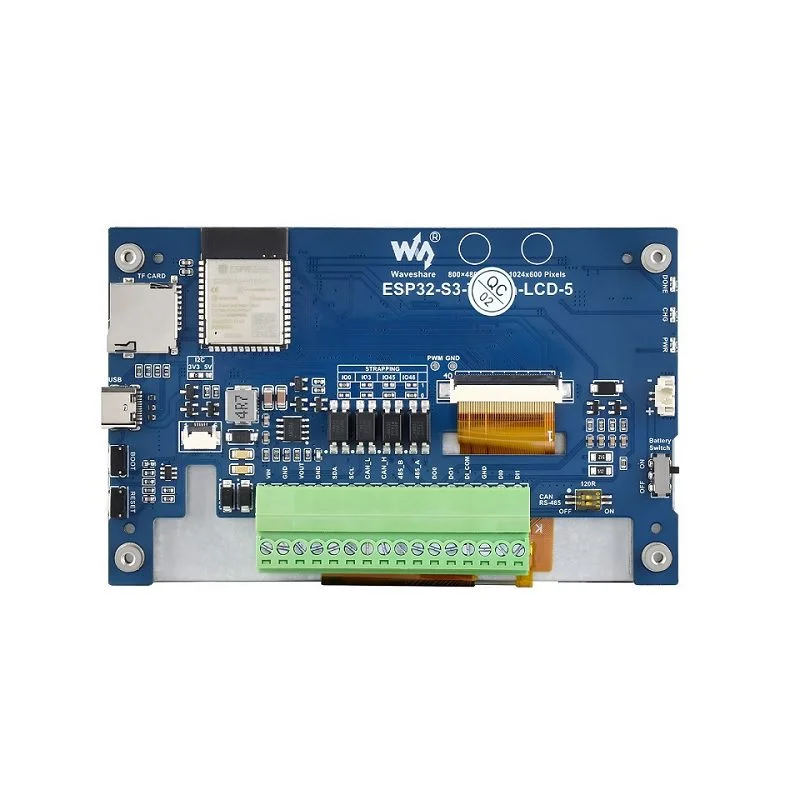
  • Industrial-Grade I/O: Onboard CAN, RS485, I2C, TF card slot, and optically-isolated digital inputs/outputs (up to 450mA sink) for harsh environments.
  • Robust Power & RTC: Wide 7–36V DC input range with onboard regulator and a rechargeable battery-backed RTC for timekeeping during power loss.
  • Integrated Wireless: Supports 2.4GHz Wi-Fi (802.11 b/g/n) and Bluetooth 5.0 LE with an onboard PCB antenna for IoT connectivity.

Out of stock

Description

The Waveshare ESP32-S3 5-inch Display Development Board is engineered for developers building sophisticated Human-Machine Interfaces (HMI) and embedded systems requiring a local display. At its core is the Espressif ESP32-S3, a dual-core LX7 microcontroller capable of 240MHz operation, paired with substantial 16MB Flash and 8MB PSRAM to handle graphics libraries like LVGL and complex application logic.

The board’s industrial design centers on reliability and integration. It accepts a wide 7–36V DC input, making it suitable for automotive, factory automation, and remote telemetry applications. Critical interfaces include isolated CAN and RS485 buses for robust industrial communication, alongside I2C, a microSD slot, and optically-coupled digital I/O channels that provide noise immunity and higher drive capability.

Power management features include flexible clock controls and an independent module supply setting to minimize consumption in battery-powered scenarios. The inclusion of a rechargeable battery for the onboard RTC chip ensures persistent timekeeping, which is essential for data logging and scheduled operations in field deployments.

Key Features

  • High-Capacity Memory Configuration: 16MB Flash and 8MB PSRAM enable storage of large graphics assets and smooth operation of GUI frameworks.
  • Wide Voltage Input with Regulation: Integrated DC-DC converter supports 7–36V input, ideal for direct connection to 12V/24V industrial power rails or battery packs.
  • Optically-Isolated Digital Interfaces: Bi-directional optocoupler isolation on digital I/O lines protects the sensitive microcontroller from voltage spikes and ground loops in industrial settings.
  • Onboard Real-Time Clock (RTC): DS3231 or equivalent precision RTC chip with a rechargeable backup battery maintains accurate timekeeping during main power outages.
  • Comprehensive Development Support: Fully compatible with ESP-IDF, Arduino Core for ESP32, and MicroPython, with all display and peripheral drivers readily available.
  • Low-Power Design Flexibility: Supports deep sleep modes and independent power domain control for the display and peripherals to optimize energy use in field deployments.

Applications

  • Industrial HMI Panels: Deploy as a touch-enabled (with add-on) control interface for PLCs, SCADA systems, and machine operation panels.
  • Smart Agriculture & Environmental Monitors: Build weather stations or soil sensor hubs with local graphical data display and wireless data upload.
  • Fleet Telemetry & Vehicle Displays: Utilize the wide voltage input and CAN bus for in-vehicle dashboards showing diagnostics, GPS location, and sensor data.
  • IoT Gateway with Local UI: Act as a central hub for smart buildings, displaying sensor networks (temperature, occupancy) and providing direct control.
  • Prototyping & Education: Ideal for advanced embedded systems courses and prototyping complex IoT devices requiring a graphical user interface.

Technical Specifications

Microcontroller / SoCEspressif ESP32-S3 (Xtensa LX7 Dual-Core)
CPU FrequencyUp to 240 MHz
Wireless Protocols2.4 GHz Wi-Fi (802.11 b/g/n), Bluetooth 5.0 LE
AntennaOnboard PCB Antenna
Flash Memory16 MB
PSRAM8 MB
Display5-inch IPS LCD, 800 x 480 resolution, RGB interface
Supply Voltage7 – 36 V DC
Key InterfacesCAN, RS485, I2C, TF Card Slot, Optically-Isolated Digital I/O
Isolated Output DriveUp to 450 mA sinking current
Operating TemperatureApprox. -40°C to +85°C (typical for ESP32-S3)
Dimensions (approx.)160 mm x 120 mm (from shipping data)

Frequently Asked Questions

What development frameworks are supported for programming this board?

The board is fully compatible with Espressif's official ESP-IDF framework, the Arduino Core for ESP32 via the Arduino IDE or PlatformIO, and MicroPython. You will need to install the appropriate display driver libraries (e.g., for the RGB interface) and configure the project for the specific PSRAM and flash size. The board's pinout definitions are provided in the Waveshare wiki, which includes example code for the LCD and isolated I/O.

How do I power the board and what is the typical operating current?

Connect a 7–36V DC power source to the board's terminal block. The onboard regulator steps this down for the ESP32-S3 and peripherals. Operating current varies significantly with usage: with the display and Wi-Fi active, expect several hundred mA. For low-power scenarios, you can use software controls to put the ESP32-S3 into deep sleep, turn off the display backlight, and disable peripheral power domains, reducing current to microamps, ideal for battery-backed field deployments.

Can I use touch functionality with this 5-inch display?

This specific variant is listed as 'without touch.' The display interface is RGB only. To add touch, you would need to interface an external resistive or capacitive touch controller via the available I2C or GPIO pins. Waveshare may offer a touch-capable version; check their product line. For this model, you can implement control via physical buttons connected to the isolated digital inputs or a separate touch panel overlay.

How do I connect and use the isolated CAN and RS485 interfaces?

The CAN (Controller Area Network) and RS485 interfaces use standard terminal blocks. For CAN, connect CAN_H and CAN_L to your bus along with a 120-ohm termination resistor if needed. For RS485, connect A (positive) and B (negative) lines. You must initialize the corresponding UART peripherals in your firmware (e.g., using the ESP-IDF TWAI driver for CAN and UART with RE/DE control for RS485). The isolation protects the ESP32 from common-mode voltages on these industrial buses.

Package Includes

  • 1 x Waveshare ESP32-S3 5inch Display Development Board

Additional Information

Weight 0.15 kg
Dimensions 12 × 16 × 3 cm