SKU: SENS-0186
📋 GST Invoice Available

Upside Down Labs DIY Neuroscience Kit – Basic - Biopotential Amplifier Module for ECG, EMG, EEG, EOG

₹7,399.00 (Inclusive of all taxes)
Out of Stock

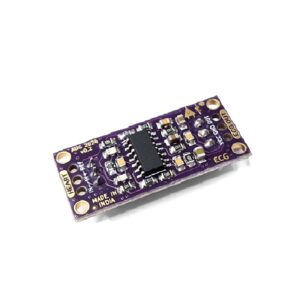
The Upside Down Labs DIY Neuroscience Kit – Basic is a single-channel biopotential amplifier module designed for educational and prototyping applications. It provides configurable bandpass filtering for ECG, EMG, EEG, and EOG signals, interfacing directly with any microcontroller ADC input at 3.3V or 5V logic levels.

Features

  • Ultra-high input impedance (10^12 Ω) for minimal signal loading.
  • Configurable for 2 or 3 electrode setups; default is 3-electrode for EEG/EOG.
  • Open-source hardware and software for full customization and learning.
  • Wide compatibility with any ADC-equipped platform (Arduino, Raspberry Pi, ESP32).
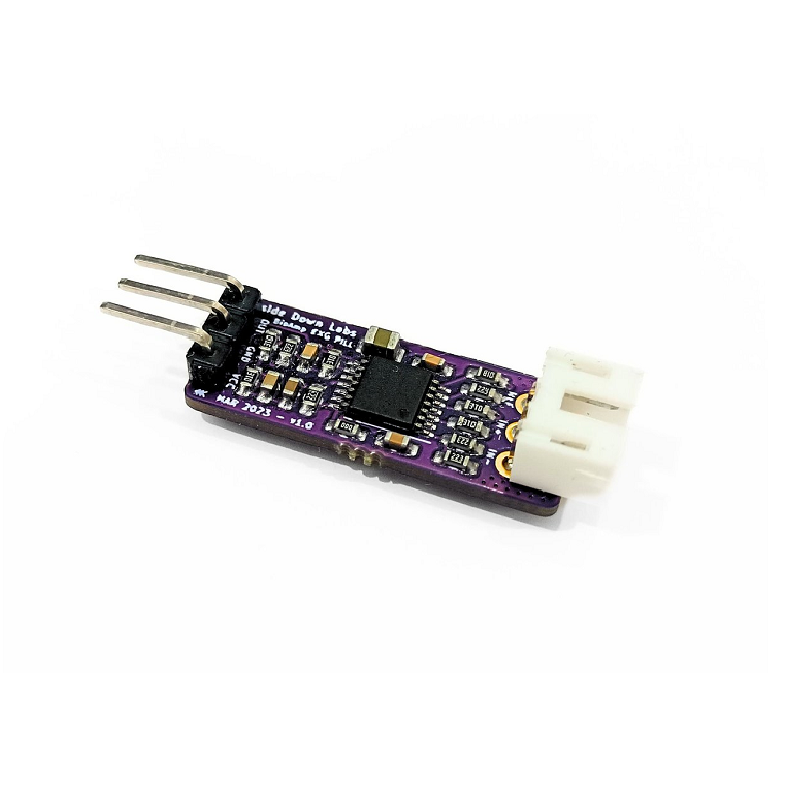
  • Compact PCB footprint (25.4 x 10.0 mm) for integration into wearable projects.

Out of stock

Description

The DIY Neuroscience Kit – Basic is built around a specialized instrumentation amplifier and filter stage, providing clean amplification of microvolt-level biopotential signals. Its configurable bandpass filter allows users to optimize the frequency response for specific physiological signals: low-frequency EEG/EOG or higher-frequency ECG/EMG, making it a versatile tool for biosignal acquisition.

Designed with education and prototyping in mind, the module outputs a conditioned analog voltage ready for digitization. The open-source design encourages experimentation with circuit modifications, filter tuning, and custom firmware development for applications in human-computer interaction (HCI) and basic brain-computer interface (BCI) research.

Key Features

  • High-performance biopotential amplifier with ultra-high input impedance.
  • User-configurable signal conditioning for ECG, EMG, EEG, and EOG.
  • Dual-voltage operation (3.3V or 5V) for broad microcontroller compatibility.
  • Fully open-source design, including schematics, PCB layout, and example code.
  • Compact and solderless-friendly form factor ideal for student and hobbyist projects.
  • Designed for accessible neuroscience exploration and physiological monitoring.

Applications

  • Educational demonstrations of electrocardiography (ECG) and electromyography (EMG).
  • Prototyping basic brain-computer interfaces (BCI) using electroencephalography (EEG).
  • Monitoring muscle activity for rehabilitation or human-computer interaction projects.
  • Academic research into eye movement tracking via electrooculography (EOG).
  • Building wearable biosignal monitors for fitness or wellness applications.

Technical Specifications

Operating Voltage3.3V / 5V DC
Input Impedance10^12 Ω
Compatible InterfaceAnalog Output to ADC
Biopotential SignalsECG, EMG, EEG, EOG (Configurable)
Default ConfigurationEEG & EOG Bandpass, 3 Electrodes
Number of Channels1
Electrode Configuration2 or 3 (Configurable)
Module Dimensions25.4 x 10.0 mm
Open SourceHardware & Software
Item TypeKit

Frequently Asked Questions

What microcontrollers or platforms is this kit compatible with?

The kit is compatible with any development board or data acquisition system featuring an analog-to-digital converter (ADC) input. This includes popular platforms like Arduino (Uno, Nano, Mega), Raspberry Pi (with an external ADC), ESP32, STM32, and many others. It operates on a 3.3V or 5V supply, matching the logic levels of most modern microcontrollers.

How do I configure the kit for different signals like ECG vs. EEG?

The kit's bandpass filter is configurable via onboard component selection or Jumper settings (refer to the open-source documentation). By default, it is configured for the lower frequency ranges typical of EEG and EOG. To optimize for higher-frequency signals like ECG or EMG, you may need to adjust the filter's resistor/capacitor values as per the provided schematics and guidelines.

What type of electrodes should I use, and how do I connect them?

Use standard disposable Ag/AgCl ECG electrodes or reusable gold cup electrodes. The module supports both 2-electrode (differential) and 3-electrode (including a driven-right-leg for noise reduction) configurations. The default setup uses three input connections: IN+, IN-, and RLD (Right Leg Drive). Proper skin preparation and secure electrode placement are critical for obtaining a clean, stable signal.

Package Includes

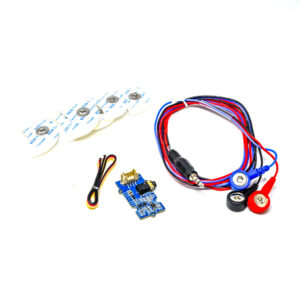
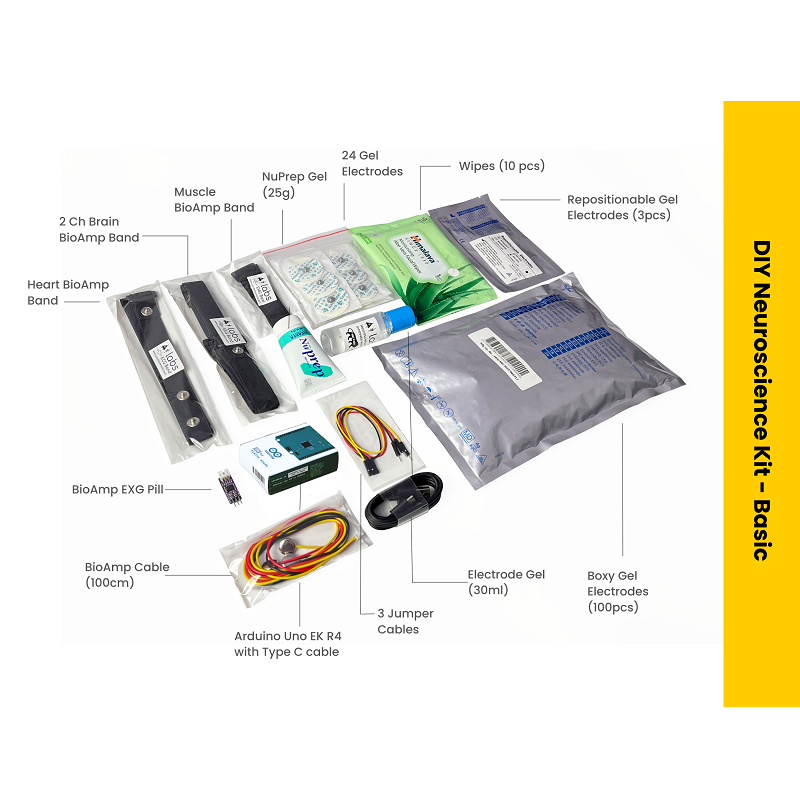
  • 1 x DIY Neuroscience Kit – Basic Module

Additional Information

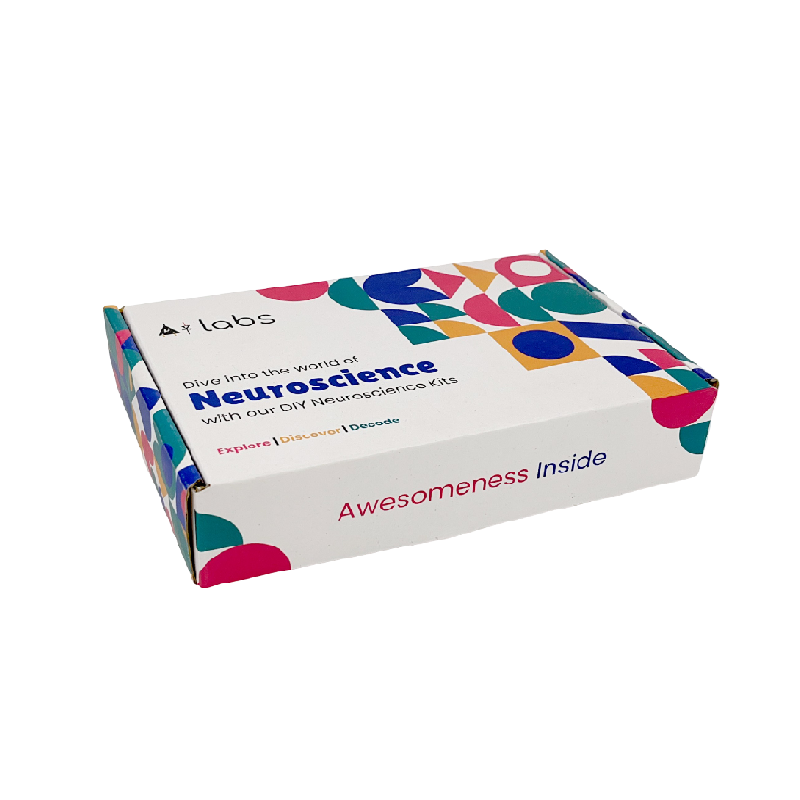
Weight 0.57 kg
Dimensions 28 × 18 × 7 cm