SKU: SENS-0096
📋 GST Invoice Available

SparkFun Qwiic dToF Imager Sensor - TMF8820, Time-of-Flight

₹2,289.00 (Inclusive of all taxes)
Out of Stock

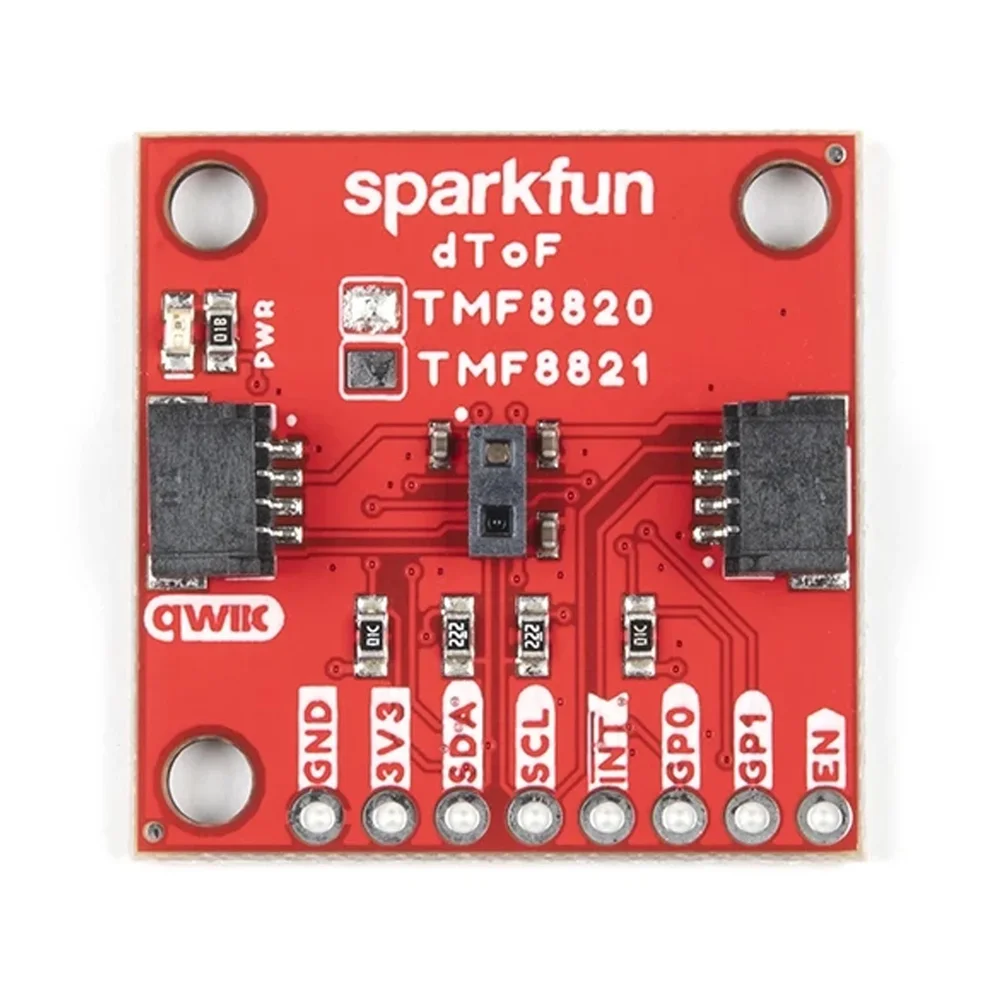
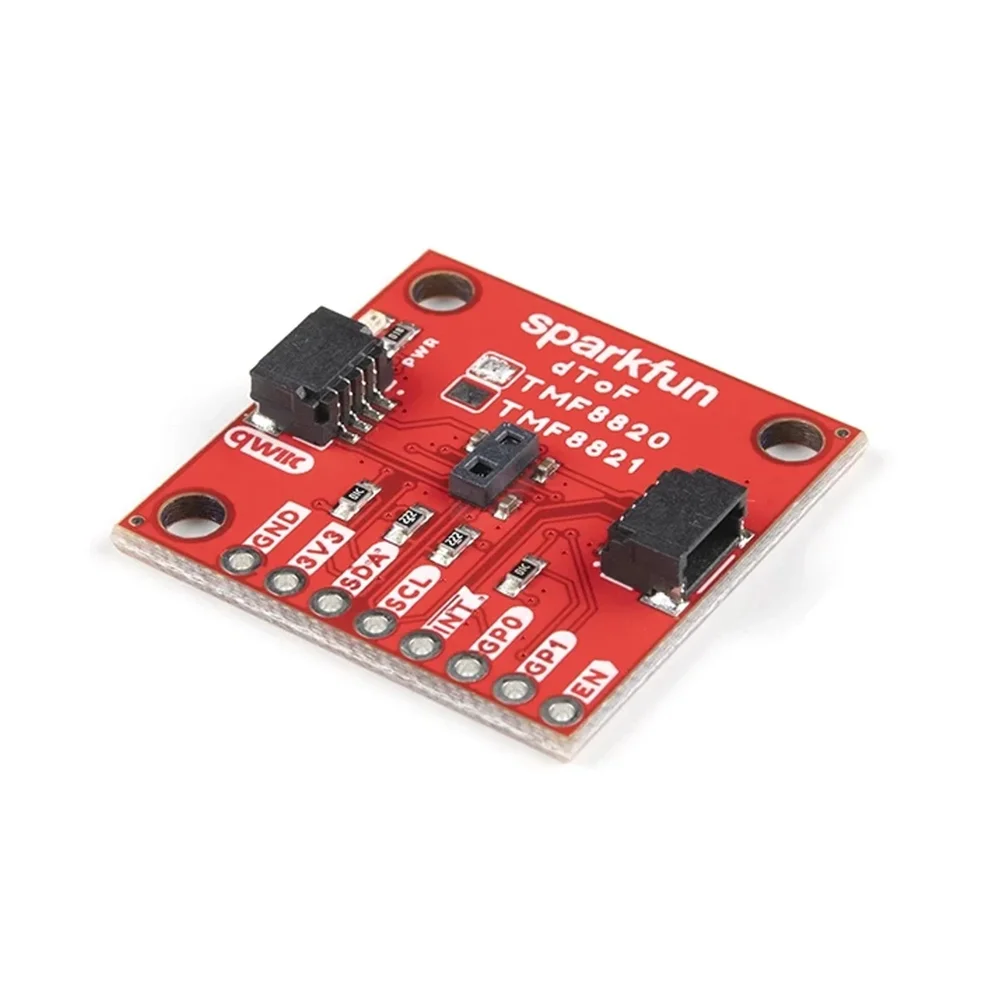
The SparkFun Qwiic dToF Imager Sensor (TMF8820) is a high-precision direct Time-of-Flight distance sensor module featuring a 3×3 multi-zone detection grid. Operating at 3.3V with an I2C/Qwiic interface, it provides accurate ranging from 10mm to 5 meters, ideal for robotics, automation, and smart device integration.

Features

  • Direct Time-of-Flight (dToF) technology with SPAD array and on-chip histogram processing for high accuracy.
  • 3×3 multi-zone distance measurement output for enhanced spatial awareness and object tracking.
  • Long detection range up to 5000 mm (5 meters) with a configurable field of view up to 63°.
  • Integrated Class 1 940nm VCSEL light source with sunlight rejection filter for reliable operation in varied lighting.
  • Plug-and-play Qwiic (I2C) connectivity and compact 26x26mm footprint for rapid prototyping and integration.

Out of stock

Description

The SparkFun Qwiic dToF Imager Sensor leverages the ams OSRAM OSRAM TMF8820 system-on-chip, which integrates a Single-Photon Avalanche Diode (SPAD) array, Time-to-Digital Converter (TDC), and histogram processing engine. This direct Time-of-Flight (dToF) architecture measures the time for emitted 940nm VCSEL pulses to reflect off a target, enabling sub-centimeter precision distance measurements immune to ambient light interference.

The sensor outputs data as a 3×3 zone grid, providing not just distance but also basic spatial context for presence detection, object sizing, and simple gesture recognition. Its on-chip processing handles complex signal conditioning, delivering stable readings at up to 30 Hz. The module is designed for robust performance across an industrial temperature range from -30°C to +70°C.

Integration is streamlined via the Qwiic connector system, offering solderless I2C communication, while broken-out pins support direct connection to microcontrollers like Arduino, Raspberry Pi, and ESP32. The compact form factor and low standby current make it suitable for battery-powered and space-constrained applications.

Key Features

  • Advanced dToF Sensing: Utilizes SPAD array and histogram-based processing for high-precision, ambient-light-robust distance measurement.
  • Multi-Zone Spatial Output: Provides distance data across a configurable 3x3 grid for improved environmental mapping and object discrimination.
  • Wide Operational Range: Measures from 10 mm to 5000 mm with an adjustable field of view up to 63° diagonal.
  • Optimized Optical System: Features a Class 1 eye-safe 940nm VCSEL and integrated optical filter for strong sunlight rejection.
  • Low-Power Operation: Consumes only 8µA in standby mode and 57mA during active measurement, supporting battery-powered designs.
  • Developer-Friendly Interface: Qwiic (I2C) plug-and-play connectivity with optional standard 0.1" headers for breadboard compatibility.
  • Integrated Signal Conditioning: On-chip TDC and histogram processing reduce host microcontroller computational load.
  • Robust Environmental Rating: Operates reliably across an extended temperature range from -30°C to +70°C.

Applications

  • Robotics Navigation & Obstacle Avoidance: Provides precise proximity and object mapping for autonomous mobile robots and drones.
  • Industrial Automation & Presence Detection: Enables non-contact object counting, bin level monitoring, and safety guarding on production lines.
  • Smart Device Gesture Control: Facilitates simple hand gesture recognition and touchless interfaces for appliances and kiosks.
  • Logistics & Dimensional Scanning: Used in parcel sizing systems and automated storage/retrieval systems for volume estimation.
  • AR/VR and User Interaction: Integrates into interactive displays and gaming systems for accurate hand-tracking and spatial input.

Technical Specifications

Manufacturer Part NumberTMF8820
BrandSparkFun
Sensor TechnologyDirect Time-of-Flight (dToF) with SPAD array & histogram
Measurement Range10 mm to 5000 mm
Output Configuration3x3 Multi-zone distance data
Field of View (Diagonal)Adjustable up to 63°
Max Measurement RateUp to 30 Hz
Light SourceClass 1, 940nm VCSEL
Operating Voltage2.7V to 3.6V (Typical 3.3V)
Current Consumption (Active)57 mA
Current Consumption (Standby)8 µA
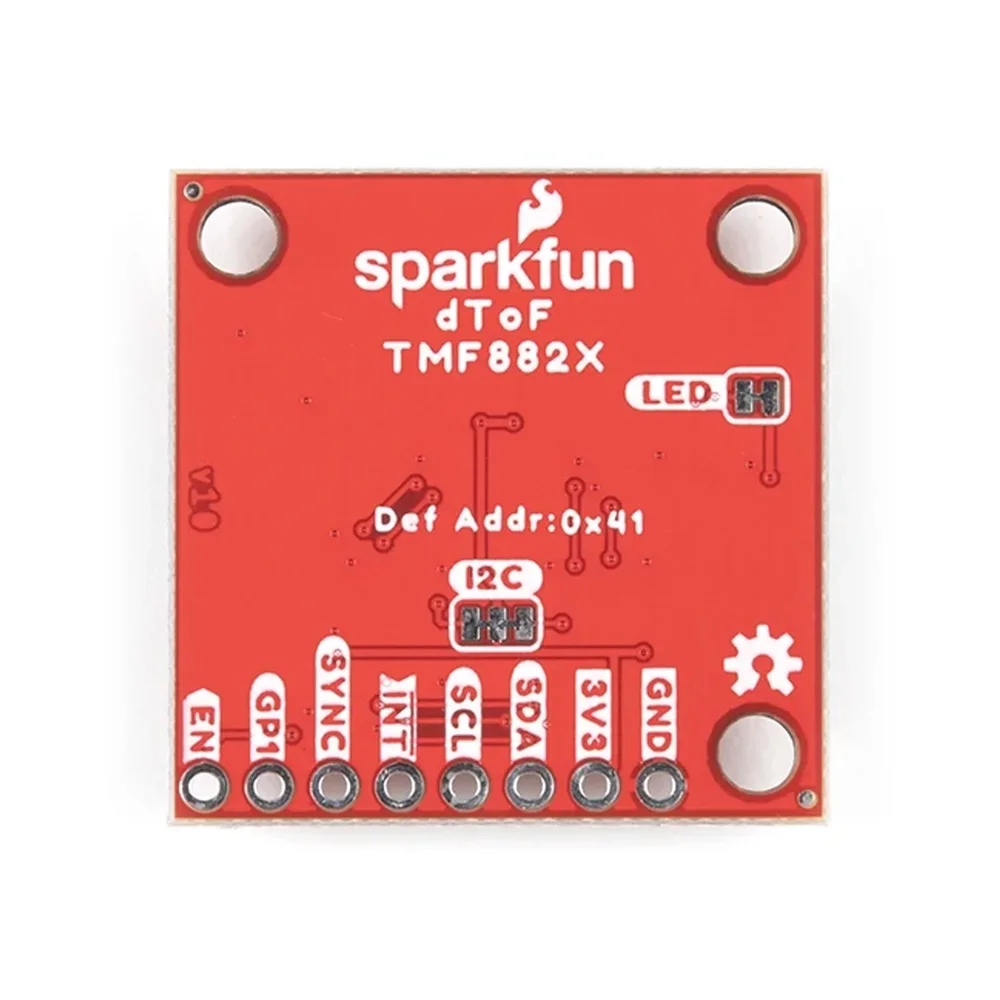
Communication InterfaceI2C (Qwiic), Default Address: 0x41
Connectors2x Qwiic connectors
Breakout PinsGND, 3.3V, SDA, SCL, INT, GPIO1, GPIO2, EN
Operating Temperature-30°C to +70°C
Dimensions (L x W x H)26 mm x 26 mm x 5 mm
Weight3 g

Frequently Asked Questions

What is the operating voltage range for the SparkFun TMF8820 sensor?

The module operates from 2.7V to 3.6V DC, with a typical supply voltage of 3.3V. It is not 5V tolerant. You must use a 3.3V logic-compatible host or a level shifter when connecting to 5V Arduino boards to prevent damage to the I2C lines.

How do I communicate with this sensor and what is its I2C address?

Communication is via the I2C protocol using the Qwiic connector system or the broken-out pins (SDA, SCL). The default I2C address is 0x41. SparkFun provides open-source Arduino and Python libraries to simplify reading distance data and configuring the sensor's parameters like field of view and measurement rate.

What does the 3x3 multi-zone output mean, and how can I use it?

The sensor divides its field of view into a virtual 3x3 grid, providing a separate distance measurement for each zone. This allows for basic object shape detection, size estimation, and determining an object's position within the sensor's view. You can read all nine zones via I2C or configure the sensor to report only the closest or confidence-weighted result.

Can this sensor operate reliably outdoors or in direct sunlight?

Yes, it is designed for challenging lighting conditions. It uses a 940nm VCSEL light source paired with an integrated optical filter that provides strong sunlight rejection. The on-chip histogram processing further discriminates the return signal from ambient noise, making it suitable for both indoor and outdoor applications.

What are the GPIO and interrupt pins used for on this breakout board?

The board breaks out two user-configurable GPIO pins, an interrupt (INT) pin, and an enable (EN) pin. The INT pin can be configured to trigger the host microcontroller when a new measurement is ready. The EN pin allows for hardware power control. The GPIOs can be used for custom functions like triggering an external LED or reading a configuration strap.

Package Includes

  • 1 x SparkFun Qwiic dToF Imager Sensor (TMF8820) Board

Additional Information

Weight 0.003 kg
Dimensions 2.6 × 2.6 × 0.5 cm