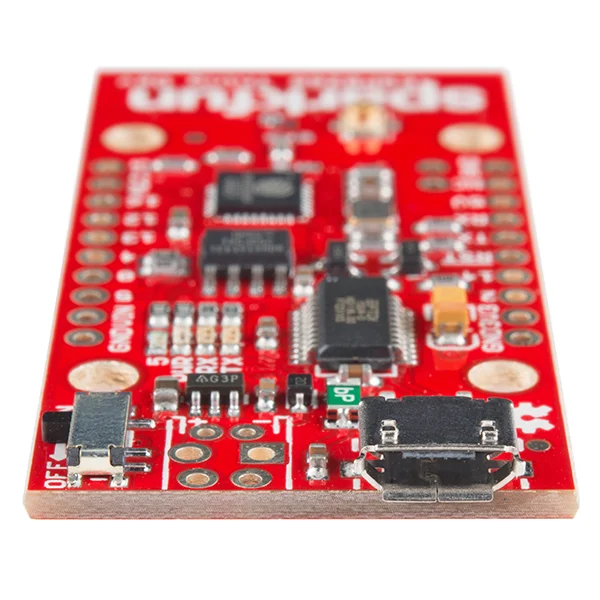
SKU: IOWC-1882
📋 GST Invoice Available

SparkFun ESP8266 Thing Dev Board w/ FTDI USB-to-Serial

₹1,219.00 (Inclusive of all taxes)
Out of Stock

The SparkFun ESP8266 Thing Dev Board is a dedicated development platform for the ESP8266 Wi-Fi SoC, featuring an integrated FTDI USB-to-serial converter for seamless programming via the Arduino IDE. It operates on a 3.3V logic level with a wide 3.3V to 5V supply range, ideal for IoT prototyping and connected device development.

Features

  • Integrated FTDI USB-to-Serial chip eliminates the need for external programmers, enabling direct uploads from the Arduino IDE.
  • Full ESP8266 pin breakout with breadboard-compatible 0.1″ headers for easy peripheral and sensor interfacing.
  • On-board 3.3V regulator ensures stable power delivery from USB or external 3.3V-5V sources via JST, screw terminal, or header.
  • Dual antenna options: default PCB trace antenna and a U.FL connector for external, high-gain Wi-Fi antennas.
  • Supports 802.11 b/g/n Wi-Fi with soft-AP and Wi-Fi Direct (P2P) modes for flexible network topologies.

Out of stock

Description

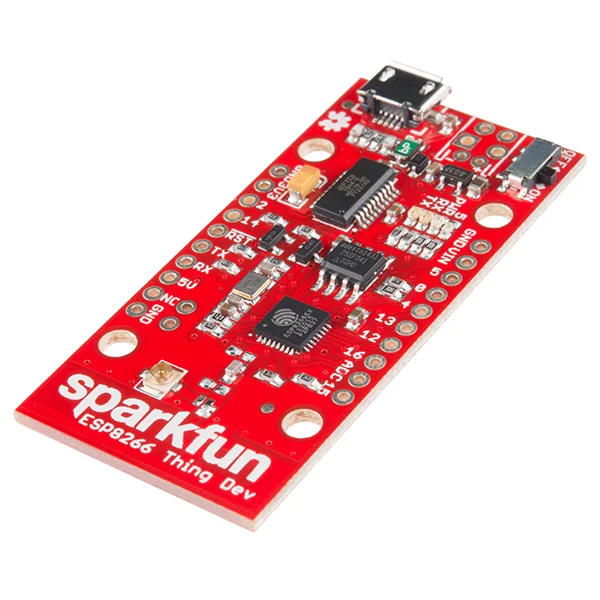
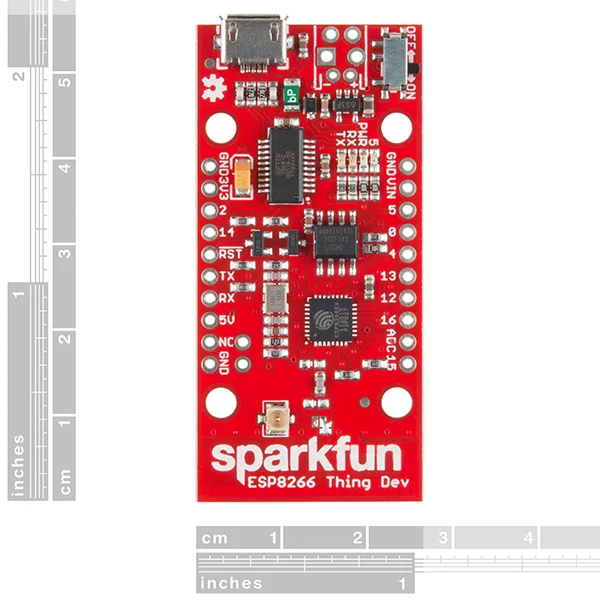
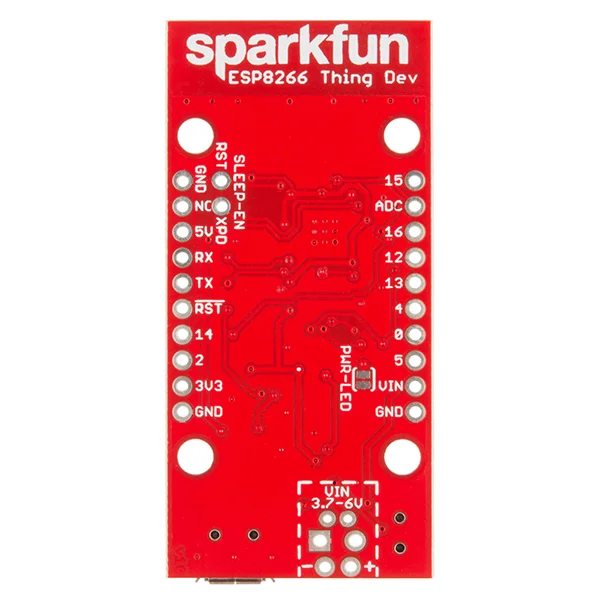
The SparkFun ESP8266 Thing Dev Board is a streamlined development platform centered on the ESP8266, a cost-effective Wi-Fi enabled microcontroller. It integrates an FTDI USB-to-serial converter, allowing firmware development and upload directly via a USB cable without additional hardware. The board breaks out all ESP8266 GPIOs to two parallel rows of 0.1″-pitch headers, making it breadboard-friendly for rapid prototyping.

Power management is handled by an onboard 3.3V regulator, accepting inputs from USB or external sources via multiple connector footprints. The ESP8266 core delivers +19.5dBm output power in 802.11b mode and includes an integrated TCP/IP stack, TR switch, balun, LNA, and power amplifier. For antenna flexibility, the board provides a default PCB trace antenna and a U.FL connector for attaching external antennas to extend range or fit within enclosures.

Key Features

  • Dedicated ESP8266 development board with integrated FTDI USB-to-serial programming interface.
  • Full GPIO breakout with breadboard-compatible 0.1" headers for easy sensor and actuator integration.
  • On-board 3.3V voltage regulator supports power from USB or external 3.3V to 5V sources.
  • Dual antenna system: efficient PCB trace antenna and U.FL connector for external antenna attachment.
  • Supports 802.11 b/g/n Wi-Fi standards with Soft-AP and Wi-Fi Direct (P2P) operation modes.
  • Integrated power management, LNA, balun, and matching network for robust RF performance.
  • Compact form factor with power switch and status LEDs for convenient development and debugging.

Applications

  • IoT prototyping and connected device development for makers and engineers.
  • Smart home automation projects controlling relays, sensors, and lighting.
  • Wireless sensor nodes for environmental monitoring (temperature, humidity, air quality).
  • Wi-Fi enabled data loggers and telemetry systems for remote data collection.
  • Educational platforms for learning embedded systems and IoT connectivity.

Technical Specifications

Microcontroller/SoCESP8266
Wireless Protocols802.11 b/g/n Wi-Fi
Frequency Range2.4GHz
RF Transmit Power+19.5dBm (802.11b mode)
Supply Voltage3.3V to 5V
Operating CurrentApprox. 80mA (average during RF transmission)
InterfacesUSB (via FTDI), UART, GPIO, I2C, SPI
Antenna ConnectorIntegrated PCB trace & U.FL connector
Operating Temperature-40°C to +85°C (typical for ESP8266)
Dimensions56mm (L) x 26.5mm (W)

Frequently Asked Questions

How do I program the SparkFun ESP8266 Thing Dev Board?

Connect the board via USB, install the ESP8266 board package in the Arduino IDE, select 'SparkFun ESP8266 Thing' as your board, and upload your sketch. The integrated FTDI chip handles USB-to-serial conversion, so no external programmer is needed. Ensure you have the correct COM port selected and drivers installed if required.

What is the power supply requirement for this board?

The board includes a 3.3V regulator and can be powered via the USB port or an external 3.3V to 5V source connected to the JST, screw terminal, or 2-pin header footprints. The ESP8266 itself runs at 3.3V, so all I/O pins are 3.3V logic level. You will need level shifters for interfacing with 5V Arduino signals.

Can I use an external antenna with this ESP8266 board?

Yes, the board has a U.FL (IPEX) connector for attaching an external 2.4GHz Wi-Fi antenna. The default antenna is a PCB trace, which works well for most applications. To use an external antenna, carefully connect a compatible U.FL pigtail or antenna. This can improve range, especially when the board is inside an enclosure.

Package Includes

  • 1 x SparkFun ESP8266 Thing - Dev Board

Additional Information

Weight 0.006 kg
Dimensions 5.6 × 2.65 cm