
Raspberry Pi Pico 2 W Microcontroller | Integrated Wi-Fi & Bluetooth | Pre-Soldered Headers
₹525.00₹700.00 (price_including_tax) (-25%)
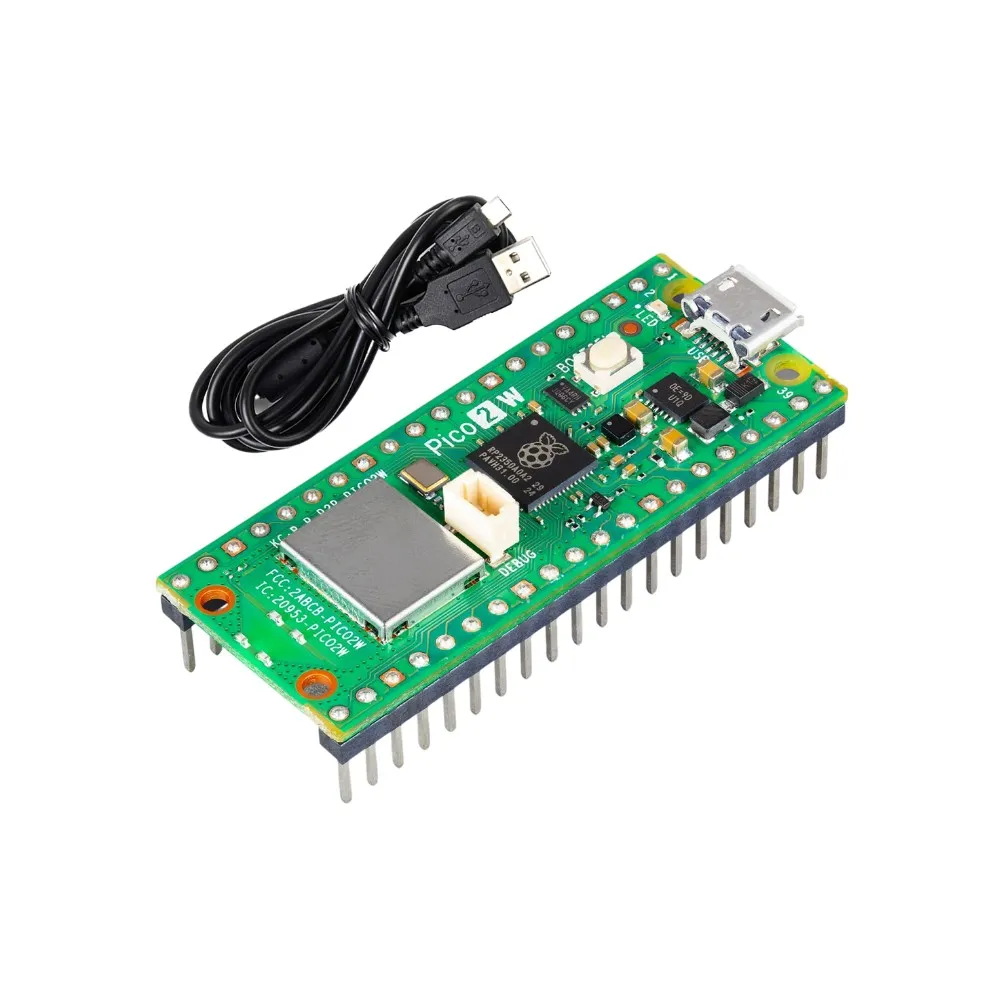
Unleash advanced IoT connectivity with the Raspberry Pi Pico 2 W with Header. This powerful microcontroller transforms your embedded projects with integrated Wi-Fi and Bluetooth 5.2. Experience unparalleled reliability and robust performance for demanding applications.
The Raspberry Pi Pico 2 W with header is a compact, robust microcontroller for advanced IoT and embedded projects.
Integrated Wi-Fi and Bluetooth enable seamless IoT applications with reduced external components.
Pre-soldered headers streamline development, allowing quick integration onto breadboards and projects.
Dual-core processing handles complex algorithms and multitasking efficiently for advanced embedded solutions.
The Engineering Behind Raspberry Pi Pico 2 W
The Raspberry Pi Pico 2 W is a significant evolution in the RP2040 microcontroller line, featuring the powerful RP2040 chip with its dual-core ARM Cortex-M0+ processor clocked at up to 133 MHz. This board integrates advanced wireless connectivity, making it ideal for internet-of-things (IoT) applications, embedded systems, and rapid prototyping. The pre-soldered header variant simplifies integration into breadboards and custom PCBs, reducing setup time and enhancing project flexibility.
Engineered for versatility and durability, the Pico 2 W maintains the robust build quality synonymous with Raspberry Pi products. Its compact form factor, combined with industrial-grade components, ensures reliable operation in diverse environments. The board is designed for continuous use, offering consistent performance for both hobbyist and professional projects.
Integrated Wi-Fi & Bluetooth Connectivity
At its core, the Pico 2 W features an onboard wireless module providing 2.4 GHz Wi-Fi (802.11n) and Bluetooth 5.2 capabilities. This crucial integration eliminates the need for external wireless modules, streamlining design, reducing component count, and enabling seamless communication for network-connected devices, sensor data logging, and remote control systems.
Flexible GPIO and RP2040 Architecture
The RP2040 microcontroller offers a rich set of 26 multi-function GPIO pins, including 2 SPI, 2 I2C, 2 UART, 3 12-bit ADC, and 16 PWM channels, ensuring extensive peripheral compatibility. This highly flexible I/O architecture, coupled with the RP2040’s unique Programmable I/O (PIO) state machines, allows for custom hardware interfaces and precise timing control, solving complex interfacing challenges in real-world applications.
Optimized for Performance & Integration
- Microcontroller: RP2040 (Dual-core ARM Cortex-M0+ @ 133MHz)
- Wireless: 2.4GHz Wi-Fi (802.11n), Bluetooth 5.2
- Flash Memory: 2MB QSPI Flash
- RAM: 264KB SRAM
- GPIO Pins: 26 multi-function (incl. ADC, SPI, I2C, UART, PWM)
- Power Supply: 5V via USB, or 2-5V via VSYS
- Debug Interface: SWD pins
- Header: Pre-soldered male header
Features & Benefits
- Integrated 2.4GHz Wi-Fi & Bluetooth 5.2: Enables robust wireless communication for IoT, home automation, and remote control applications without external modules.
- Dual-Core ARM Cortex-M0+ RP2040: Provides high processing power for demanding tasks, allowing parallel execution and efficient resource management at 133MHz.
- Pre-Soldered Header: Simplifies breadboard prototyping and integration into custom PCBs, saving time and reducing soldering effort for quick project deployment.
- 26 Multi-Function GPIO Pins: Offers extensive connectivity options for sensors, actuators, and other peripherals, maximizing compatibility and design flexibility.
- Programmable I/O (PIO) State Machines: Delivers highly flexible custom peripheral interfaces and precise timing control for unique or complex hardware interactions.
- Compact Form Factor: Ideal for space-constrained projects and portable devices, allowing for seamless integration into various enclosures and systems.
Pro-Grade Advantages
- Integrated wireless capabilities simplify IoT and networking projects significantly.
- Dual-core RP2040 offers powerful processing for complex embedded applications.
- Pre-soldered headers save assembly time and prevent potential soldering errors.
- Excellent documentation and community support for development and troubleshooting.
Technical Considerations
- Limited RAM (264KB) compared to full-fledged SBCs, restricting very large applications.
- No built-in storage beyond QSPI Flash, requiring external solutions for extensive data logging.
What is the primary difference between the Raspberry Pi Pico W and the Pico 2 W?
The Raspberry Pi Pico 2 W is an evolution, typically indicating updated chip revisions, improved wireless modules (e.g., Bluetooth 5.2), or minor performance enhancements compared to the original Pico W, which featured Bluetooth 5.0 and older Wi-Fi revisions. Always check the specific manufacturer datasheet for exact differences.
Can I use MicroPython or CircuitPython with the Raspberry Pi Pico 2 W?
Yes, the Raspberry Pi Pico 2 W is fully compatible with both MicroPython and CircuitPython. These high-level languages offer a simplified development experience, making it accessible for rapid prototyping and educational purposes while leveraging the full capabilities of the RP2040 microcontroller.
What are the power supply requirements for the Pico 2 W?
The Raspberry Pi Pico 2 W can be powered via its micro-USB port at 5V, or directly through the VSYS pin with a voltage range of 2V to 5V. It is crucial to ensure a stable power supply within these limits to guarantee reliable operation and prevent damage.
What are the key features of the RP2040 microcontroller?
The RP2040 features a dual-core ARM Cortex-M0+ processor clocked at up to 133MHz, 264KB of SRAM, 2MB of QSPI Flash, 26 multi-function GPIO pins, and unique Programmable I/O (PIO) state machines for custom hardware interfaces.
How do the pre-soldered headers benefit my project?
Pre-soldered headers significantly reduce the effort and time required for initial setup. They allow for immediate use with breadboards or direct integration into female header sockets on custom PCBs, bypassing the need for manual soldering and reducing the risk of errors.
Is the Raspberry Pi Pico 2 W suitable for industrial applications?
While primarily designed for hobbyist and prototyping use, the robust nature of the RP2040 and the board’s compact, integrated design make it suitable for certain low-power industrial monitoring or control applications where its connectivity and processing capabilities meet the system requirements, especially with appropriate enclosure and power conditioning.
| Specification | Value |
|---|---|
| Microcontroller | RP2040 (Dual ARM Cortex-M0+) |
| Clock Speed | Up to 133 MHz |
| Onboard Memory | 264KB SRAM |
| Flash Memory | 2MB QSPI Flash |
| Wireless Connectivity | 2.4GHz Wi-Fi (802.11n), Bluetooth 5.2 |
| GPIO Pins | 26 multi-function |
| ADC Channels | 3 x 12-bit |
| Operating Temperature | -20°C to +85°C |
| Input Voltage (VSYS) | 2V – 5V |
| USB Interface | Micro-USB B |
| Header Type | Pre-soldered male header |
| Dimensions (PCB) | 51mm x 21mm |
Additional information
| Brand | Raspberry Pi |
|---|---|
| Processor/SoC | RP2040 (Dual-core ARM Cortex-M0+) |
| RAM/Flash Memory | 264KB SRAM, 2MB QSPI Flash |
| Connectivity | Bluetooth 5.2, Wi-Fi 802.11n |
| Operating Voltage | 2V-5V (VSYS), 5V (USB) |
| Control Interface | GPIO, SWD, USB |
| Difficulty Level | Intermediate |

Reviews
There are no reviews yet.