SKU: SENS-2847
📋 GST Invoice Available

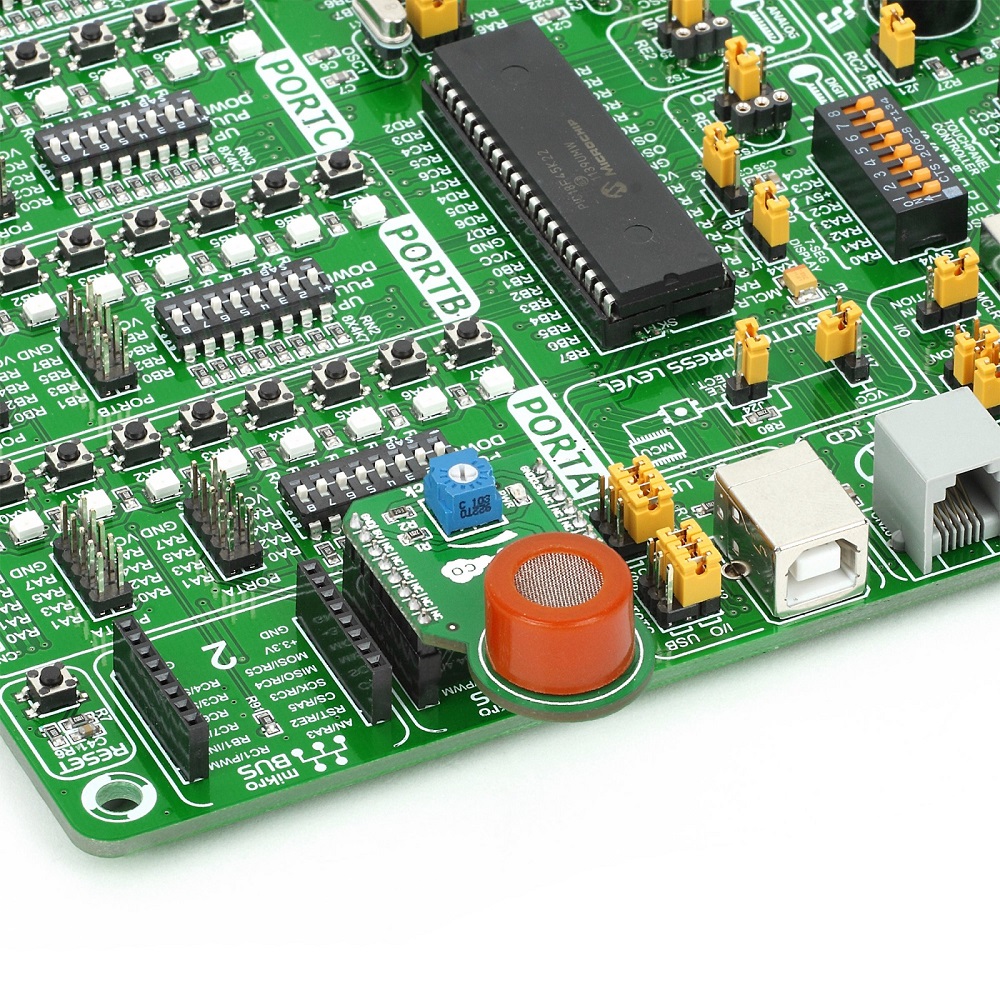
Mikroe CO Click (Mikroe‑1626) – MQ‑7 Carbon Monoxide Gas Sensor Board, Analog, mikroBUS, 20~2000 ppm

₹1,239.00 (Inclusive of all taxes)
Out of Stock

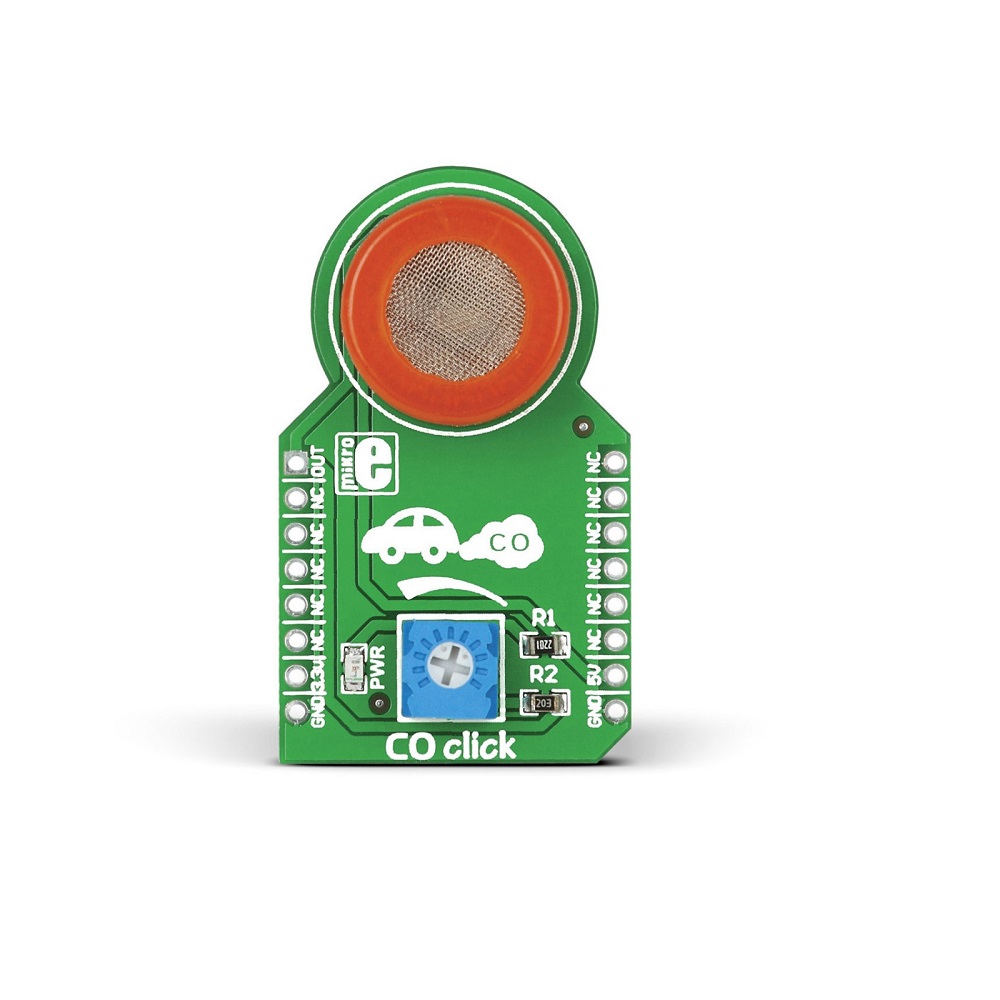
The Mikroe CO Click is a compact, ready-to-use gas detection module featuring the MQ-7 semiconductor sensor for monitoring carbon monoxide (CO) concentrations from 20 to 2000 ppm. Designed for easy integration via the mikroBUS™ socket, it provides an analog output signal compatible with a wide range of microcontrollers like Arduino, Raspberry Pi, and PIC for air quality monitoring and safety applications.

Features

  • Integrates the MQ-7 semiconductor sensor for carbon monoxide (CO) detection.
  • Measures CO concentrations across a wide range of 20 to 2000 ppm.
  • Provides a simple analog voltage output via the mikroBUS™ AN pin for easy microcontroller interfacing.
  • Includes an onboard potentiometer for sensitivity adjustment and output calibration.
  • Operates on a single 5V DC power supply with a power-on indicator LED.

Out of stock

Description

The Mikroe CO Click board utilizes the MQ-7 gas sensor, a tin dioxide (SnO2) semiconductor type. In clean air, the sensor’s conductivity is low. When carbon monoxide is present, it reacts with the sensing surface, causing a measurable increase in conductivity proportional to the gas concentration. This change is converted into a variable analog voltage signal.

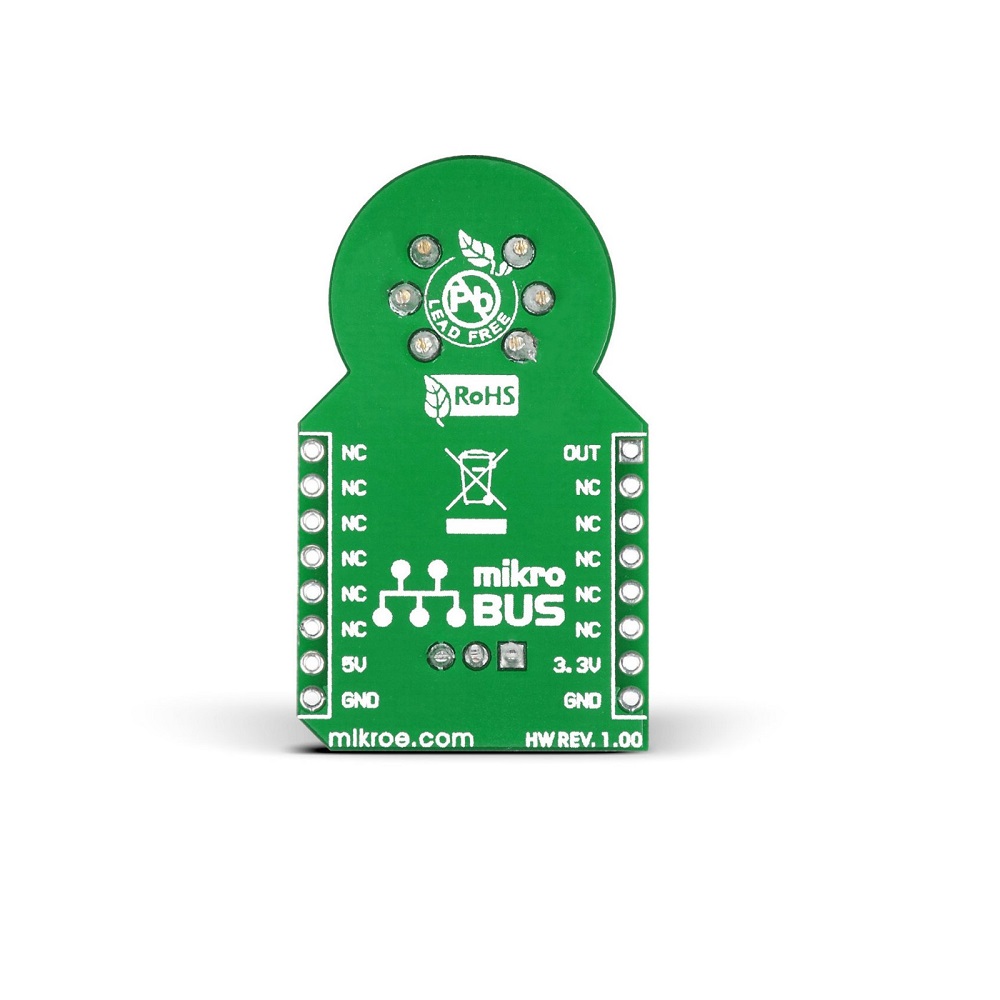
The board is designed for plug-and-play compatibility with any host board featuring the mikroBUS™ standard socket, simplifying hardware integration. The included calibration potentiometer allows for fine-tuning the sensor’s output to match specific application requirements or to compensate for environmental factors, ensuring reliable performance in air quality monitoring systems, industrial safety detectors, and portable CO alarms.

Key Features

  • High-Sensitivity MQ-7 Sensor: Detects carbon monoxide with a broad measurement range suitable for both indoor air quality and industrial leak detection.
  • Analog Output Interface: Delivers a 0-5V analog signal corresponding to gas concentration, easily read by any microcontroller ADC.
  • Onboard Calibration Potentiometer: Enables precise adjustment of the sensor's output signal for accurate baseline setting and span calibration.
  • mikroBUS™ Standard Compatibility: Ensures seamless mechanical and electrical connection to hundreds of compatible development boards for rapid prototyping.
  • Compact and Ready-to-Use Design: Comes fully assembled with all necessary support circuitry, requiring only power and a single analog connection.
  • Clear Power Indication: Features an LED to confirm the 5V power supply is active and the module is operational.

Applications

  • Residential Carbon Monoxide Detectors: Integration into DIY smart home safety systems to monitor for dangerous CO levels from furnaces, water heaters, or stoves.
  • Industrial Safety Monitoring: Deployment in workshops, garages, or boiler rooms to provide early warning of CO accumulation.
  • Air Quality Assessment Units: Use in portable or stationary devices to measure CO as part of comprehensive indoor environmental quality (IEQ) monitoring.
  • Educational and Prototyping Kits: Ideal for electronics and environmental engineering students learning about gas sensing principles and analog signal processing.

Technical Specifications

Manufacturer Part NumberMikroe‑1626
Sensor TypeMQ-7 Semiconductor (SnO2)
Target GasCarbon Monoxide (CO)
Detection Range20 - 2000 ppm
Output SignalAnalog Voltage (via AN pin)
InterfacemikroBUS™ (Analog)
Operating Voltage5 V DC
Onboard FeaturesCalibration Potentiometer, Power LED
Dimensions (Shipping)6 x 4 x 3 cm (L x W x H)
Weight (Shipping)0.05 kg

Frequently Asked Questions

What is the operating voltage for the Mikroe CO Click board?

The Mikroe CO Click requires a strict 5V DC power supply. Applying a voltage outside this specification can damage the onboard MQ-7 sensor and its conditioning circuitry. Ensure your host board or external power source provides a stable 5V output.

How do I interface this sensor with my microcontroller?

The module communicates via a single analog output pin (AN) on the mikroBUS connector. Simply connect this pin to an Analog-to-Digital Converter (ADC) input on your microcontroller (e.g., Arduino, Raspberry Pi with ADC hat, PIC). The output voltage will vary between 0V and 5V based on the detected CO concentration.

What is the purpose of the onboard potentiometer?

The potentiometer allows for calibration of the sensor's analog output signal. You can adjust it to set a specific baseline voltage in clean air or to scale the output range to better match your ADC's resolution and the desired alarm threshold for your application.

Does the MQ-7 sensor require a pre-heating period?

Yes, like most metal-oxide semiconductor (MOS) sensors, the MQ-7 requires an initial warm-up period after power is applied for its internal heater to reach optimal operating temperature and for readings to stabilize. This typically takes 1-2 minutes. For accurate measurements, allow for this stabilization time in your system initialization routine.

Can I use this Click board with non-mikroBUS development boards?

Yes. While designed for mikroBUS, you can connect it directly using Jumper wires. Provide 5V to the VCC pin, ground to GND, and connect the signal from the AN pin to your MCU's ADC. Refer to the board's pinout diagram for the correct pin mapping.

Package Includes

  • 1 x Mikroe CO Click (Mikroe‑1626) Gas Sensor Board

Additional Information

Weight 0.05 kg
Dimensions 6 × 4 × 3 cm