SKU: IOWC-0720
📋 GST Invoice Available

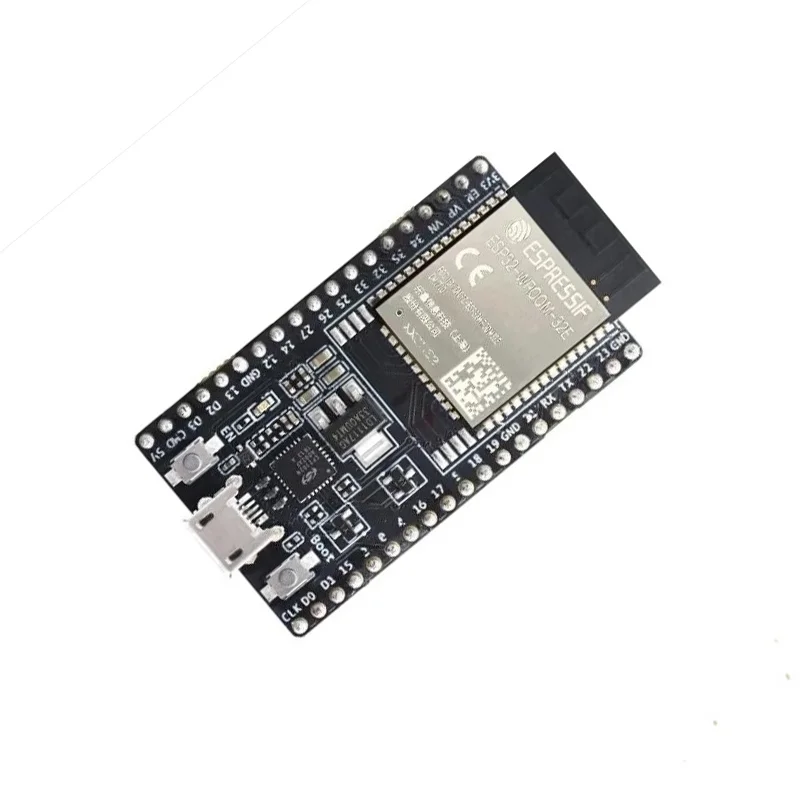
Espressif ESP32-DevKitC-32E Development Board

₹1,129.00 (Inclusive of all taxes)
Out of Stock

The Espressif ESP32-DevKitC-32E is a compact development board built around the ESP32-WROOM-32E module, integrating dual-core processing, 2.4 GHz Wi-Fi, and Bluetooth 4.2 for rapid IoT and embedded system prototyping with Arduino IDE and ESP-IDF.

Features

  • Powered by the ESP32-WROOM-32E module with a dual-core Tensilica LX6 processor for robust IoT application performance.
  • Integrated 2.4 GHz Wi-Fi and Bluetooth 4.2 (BR/EDR/BLE) enables wireless connectivity for smart home and sensor network projects.
  • Comprehensive peripheral set includes multiple GPIOs, ADCs, UART, SPI, and I2C interfaces for extensive hardware expansion.
  • Features hardware security with secure boot and flash encryption to protect firmware and sensitive application data.
  • Flexible antenna options with onboard PCB antenna and provision for an external antenna via IPEX connector to optimize range.

Out of stock

Description

The Espressif ESP32-DevKitC-32E is a foundational development platform for engineers and makers. It hosts the ESP32-WROOM-32E system-in-package, which combines a high-performance dual-core microcontroller with integrated wireless radios. This architecture provides a balanced blend of processing power for complex tasks and low-power modes for battery-operated deployments.

The board’s design emphasizes ease of integration, featuring a USB-to-UART bridge for direct programming and serial communication, alongside a rich array of broken-out I/O pins. Its support for both the onboard antenna and an external connector allows developers to tailor the RF performance to their specific environmental and range requirements, making it suitable for everything from dense urban networks to remote sensor nodes.

Key Features

  • Core module based on the certified ESP32-WROOM-32E, ensuring reliable RF performance and regulatory compliance.
  • Dual-core Xtensa® LX6 microprocessor operating at up to 240 MHz, providing ample headroom for real-time tasks and network stacks.
  • Integrated 2.4 GHz 802.11 b/g/n Wi-Fi and Bluetooth 4.2 with Classic Bluetooth and BLE support for versatile wireless connectivity.
  • Enhanced security features including secure boot and flash encryption, critical for commercial IoT device deployment.
  • Flexible power management with multiple sleep modes, enabling operation in power-constrained, battery-powered scenarios.
  • Comprehensive set of communication interfaces (UART, SPI, I2C) and analog/digital GPIOs readily accessible for peripheral connection.
  • Onboard USB-to-UART chip (CP2102 or similar) simplifies firmware flashing and provides a serial console directly from a PC.
  • Compact form factor with standard 0.1" pin headers, making it compatible with breadboards and standard prototyping systems.

Applications

  • Prototyping IoT devices for smart home automation, sensor hubs, and wireless controllers.
  • Developing connected industrial equipment for telemetry, monitoring, and wireless control systems.
  • Building battery-powered environmental sensors for agriculture, weather stations, and asset tracking.
  • Creating Bluetooth-enabled gadgets, beacons, and human-machine interface (HMI) devices.
  • Serving as an educational platform for learning embedded systems, wireless communication, and IoT security.

Technical Specifications

Microcontroller/SoCESP32 (Dual-Core Tensilica LX6)
Wireless ProtocolsWi-Fi 802.11 b/g/n (2.4 GHz), Bluetooth 4.2 BR/EDR/BLE
Frequency Range2.4 GHz ISM Band
RF Transmit PowerUp to +20 dBm (Wi-Fi), +12 dBm (Bluetooth)
Supply Voltage5V via USB, 3.3V regulated on-board
Operating Current~80 mA (average active), < 5 μA in deep sleep
InterfacesUSB, UART, SPI, I2C, GPIO, ADC
Antenna ConnectorOnboard PCB antenna, IPEX connector for external antenna
Operating Temperature-40°C to +85°C
DimensionsApprox. 55mm x 28mm (module footprint)

Frequently Asked Questions

How do I program the ESP32-DevKitC-32E development board?

The board is programmed via its onboard USB port using the Arduino IDE with the ESP32 board package installed, or via Espressif's official ESP-IDF framework. Connect the board via USB, select the correct COM port and board variant (e.g., ESP32 Dev Module), and upload your compiled firmware. The integrated USB-to-UART bridge handles all serial communication and programming protocol automatically.

What is the difference between the onboard antenna and the external IPEX connector?

The onboard PCB antenna provides convenient, integrated wireless functionality with adequate range for most indoor and short-range applications. The IPEX connector allows you to attach an external antenna (e.g., a 2-5 dBi dipole) to significantly extend wireless range, improve signal reliability in noisy environments, or meet specific directional coverage requirements for industrial or outdoor deployments.

What are the power supply requirements and how can I run it from a battery?

The board can be powered directly via its Micro-USB port at 5V. For battery operation, you can supply a regulated 3.3V DC to the 3V3 pin, ensuring your source can provide sufficient current (up to 500mA peak). To maximize battery life, utilize the ESP32's deep sleep modes, which can reduce current consumption to below 10 microamps, waking periodically for data transmission.

Package Includes

  • 1 x Espressif ESP32-DevKitC-32E Development Board

Additional Information

Weight 0.011 kg
Dimensions 10 × 5 × 3 cm