SKU: IOWC-1389
📋 GST Invoice Available

ESP32-WROVER-E ESP32-DEVKITC V4 Development Board

₹1,739.00 (Inclusive of all taxes)
Out of Stock

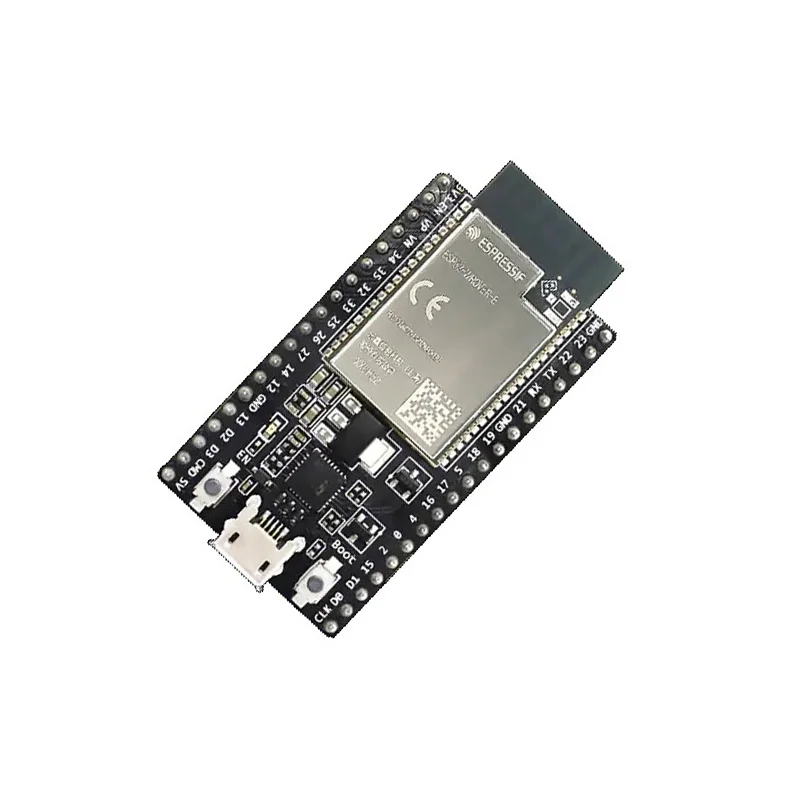
The ESP32-DevKitC V4 is a compact development board featuring the ESP32-WROVER-E module with integrated Wi-Fi, Bluetooth, and BLE. It includes 4 MB SPI flash, 2 MB PSRAM, and is fully compatible with the Arduino IDE, ESP-IDF, and MicroPython for rapid IoT prototyping.

Features

  • Powered by the ESP32-WROVER-E module with dual-core Xtensa LX6 processor and integrated Wi-Fi & Bluetooth.
  • Includes 4 MB of SPI flash and 2 MB of PSRAM for handling complex applications and data buffers.
  • Features a USB-to-UART bridge for easy programming and serial communication via a Micro-USB port.
  • All available GPIOs are broken out to pin headers, supporting SPI, I2C, UART, PWM, touch sensors, and more.
  • Integrated addressable RGB LED (WS2812) and dedicated reset/boot buttons for streamlined development.

Out of stock

Description

The Espressif ESP32-DevKitC V4 is a feature-rich development platform designed for engineers and makers building connected IoT devices. It is built around the ESP32-WROVER-E module, which combines a 240 MHz dual-core processor with full Wi-Fi 802.11 b/g/n and Bluetooth v4.2 BR/EDR/BLE connectivity. The inclusion of 2 MB of PSRAM significantly enhances performance for memory-intensive tasks like audio processing, image buffering, or complex network protocols.

The board provides a complete development environment with a CP2102 USB-to-UART bridge for reliable serial communication and firmware flashing. All critical I/O pins are accessible via the side headers, allowing direct connection to sensors, displays, and actuators. With support for deep sleep modes and a wide operating voltage range, it is suitable for both battery-powered edge nodes and mains-powered smart home gateways.

Key Features

  • High-performance ESP32-WROVER-E module with dual-core processor and integrated wireless radios.
  • Extended memory with 4 MB SPI flash and 2 MB PSRAM for advanced applications.
  • Comprehensive GPIO breakout supporting multiple digital interfaces and analog inputs.
  • Onboard USB-to-UART bridge (CP2102) for seamless programming and debugging.
  • Dedicated reset and boot mode buttons for reliable firmware uploads.
  • Addressable RGB LED (WS2812) connected to GPIO18 for visual feedback and prototyping.
  • Stable 3.3V power regulation from the Micro-USB input, suitable for most peripherals.
  • Full compatibility with Arduino IDE, ESP-IDF, MicroPython, and PlatformIO ecosystems.

Applications

  • Smart home automation hubs and sensor nodes.
  • Industrial IoT (IIoT) telemetry and wireless data gateways.
  • Prototyping for wearable devices and Bluetooth Low Energy beacons.
  • Voice-controlled assistants and audio streaming applications.
  • Robotics control and real-time sensor data processing.

Technical Specifications

Microcontroller / SoCESP32-WROVER-E (Dual-core Xtensa LX6 @ 240 MHz)
Wireless ProtocolsWi-Fi 802.11 b/g/n, Bluetooth 4.2 BR/EDR/BLE
Memory4 MB SPI Flash, 2 MB PSRAM
Supply Voltage5V via Micro-USB, 3.3V regulated on-board
Operating CurrentApprox. 500 mA (max during RF transmission)
InterfacesGPIO, SPI, I2C, UART, I2S, ADC, DAC, Touch Sensors, PWM
USB BridgeCP2102 USB-to-UART
AntennaIntegrated PCB antenna
Operating Temperature-40°C to +85°C
DimensionsApprox. 7 cm x 6 cm

Frequently Asked Questions

How do I program the ESP32-DevKitC V4 using the Arduino IDE?

First, install the ESP32 board support via the Arduino Boards Manager. Connect the board via Micro-USB, select 'ESP32 Dev Module' as your target, and choose the correct COM port. Use the onboard boot button: hold it down, press reset, then release boot to enter download mode before uploading your sketch. The CP2102 USB bridge driver may need to be installed on your computer for serial communication.

What is the purpose of the 2 MB PSRAM on this board?

The Pseudo Static RAM (PSRAM) provides additional volatile memory for data-intensive operations. It is useful for buffering images for camera modules, storing audio samples, handling large network packets, or managing complex graphics on displays. This memory is separate from the internal RAM of the ESP32 chip and is accessed via the SPI bus, helping to prevent memory constraints in advanced applications.

What is the power supply requirement and typical operating current?

The board is powered via the Micro-USB port at 5V, which is then regulated to 3.3V for the ESP32 module and GPIOs. Typical operating current ranges from 80 mA to 120 mA during normal Wi-Fi/BLE activity, but can peak near 500 mA during full RF transmission. For battery operation, ensure your power source can provide sufficient current, and utilize the ESP32's deep sleep modes to minimize average consumption.

Package Includes

  • 1 x ESP32-DevKitC V4 Development Board

Additional Information

Weight 0.04 kg
Dimensions 6 × 7 × 2 cm