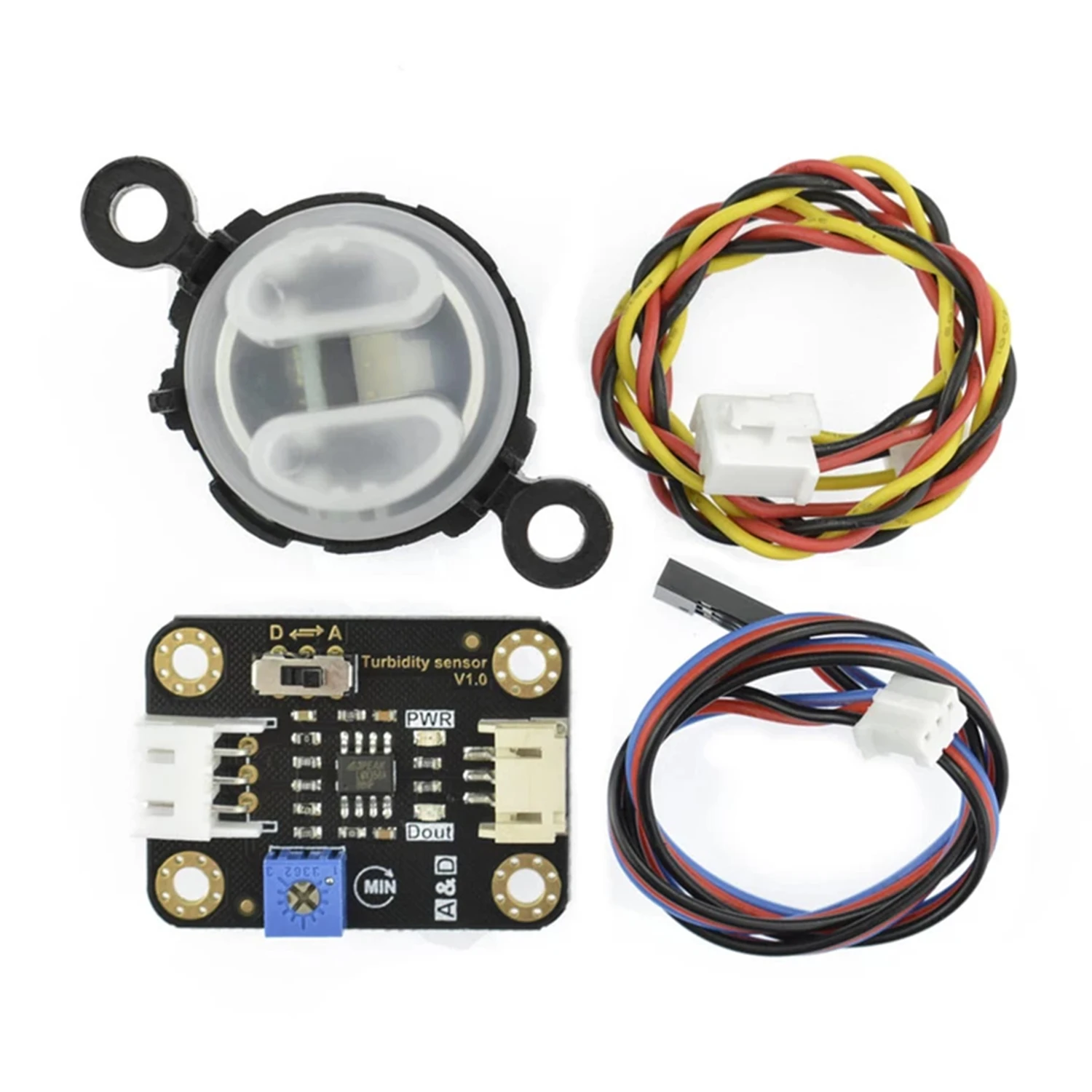
SKU: SENS-3088
📋 GST Invoice Available

DFRobot Gravity Analog Turbidity Sensor for Arduino - Probe w/ Adapter

₹1,359.00 (Inclusive of all taxes)
Out of Stock

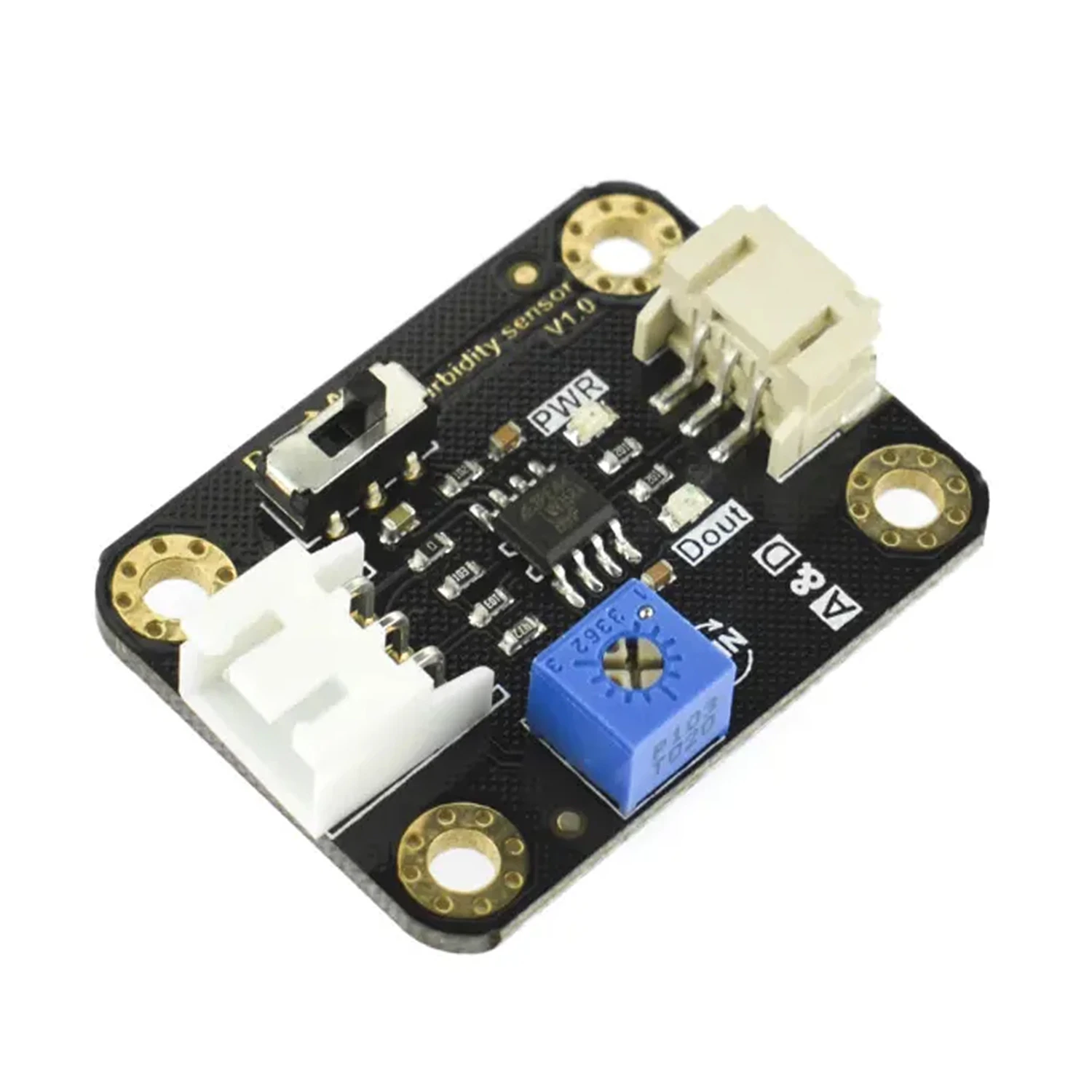
The DFRobot Gravity Analog Turbidity Sensor is a water quality monitoring module compatible with Arduino and other 5V microcontrollers, providing a 0-4.5V analog output proportional to the concentration of suspended solids in a liquid.

Features

  • Measures turbidity via light transmittance and scattering principle.
  • Provides a 0-4.5V analog output signal for direct ADC connection.
  • Features a detachable probe and adapter for flexible installation.
  • Designed for the DFRobot Gravity interface for plug-and-play wiring.
  • Robust construction suitable for water quality monitoring from 5°C to 90°C.

Out of stock

Description

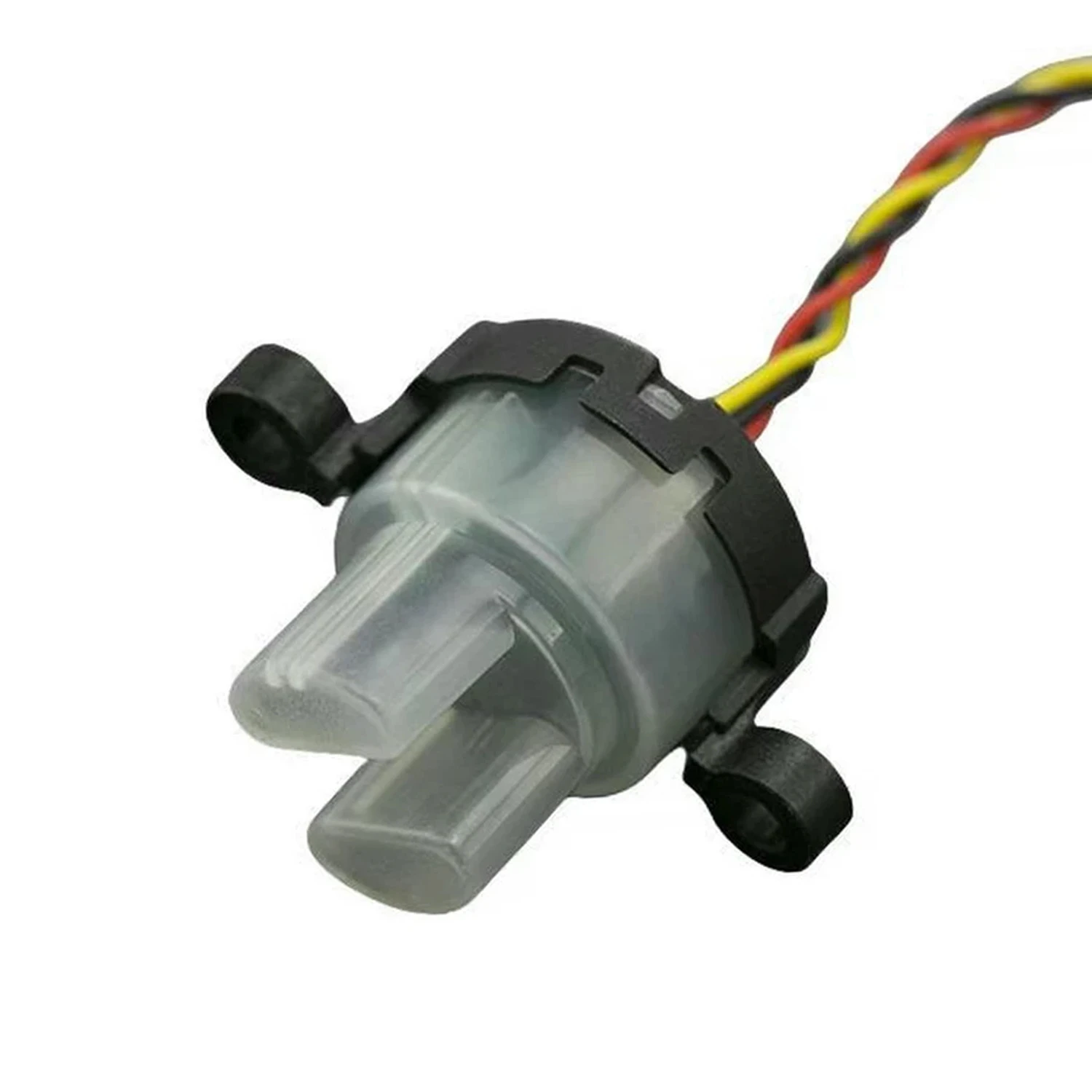
The DFRobot Gravity Turbidity Sensor operates on the principle of optical nephelometry. An internal infrared LED emits light into the liquid sample, and a phototransistor detects the amount of light scattered by suspended particles (Total Suspended Solids – TSS). The resulting analog voltage output is inversely proportional to water clarity, decreasing as turbidity increases.

This sensor is engineered for integration into environmental monitoring systems, aquaculture, and industrial process control. Its 5V DC operation and simple analog interface make it compatible with a wide range of development platforms, including Arduino, ESP32, and Raspberry Pi (with an ADC). The probe and cable assembly allow for submersion in the target liquid while the main electronics module remains protected.

Key Features

  • Optical Sensing Principle: Utilizes infrared LED and phototransistor for reliable turbidity measurement based on light scattering.
  • Gravity Analog Interface: Standard 3-pin Gravity connector (Signal, VCC, GND) ensures quick, foolproof connection to microcontroller ADCs.
  • Detachable Probe Design: Sensor probe connects via a dedicated cable and adapter, enabling remote placement and easier maintenance.
  • Fast Response Time: Delivers a stable output signal with a response time of less than 500 milliseconds for real-time monitoring.
  • Wide Operating Temperature: Functions reliably in aqueous environments with temperatures ranging from 5°C to 90°C.
  • High Insulation Resistance: Features a minimum insulation resistance of 100MΩ, enhancing signal stability and durability in conductive liquids.
  • Compact Form Factor: The compact main module (38mm x 28mm) is easy to integrate into enclosures and project boxes.

Applications

  • River, stream, and lake water quality monitoring stations.
  • Wastewater treatment plant effluent and process control.
  • Aquaculture system water clarity and health monitoring.
  • Laboratory analysis of sediment concentration and Particle transport.
  • Industrial process monitoring for liquids where suspended solids are a critical parameter.

Technical Specifications

Operating Voltage5V DC
Operating Current40mA (Max)
Output SignalAnalog, 0-4.5V
Response Time<500 ms
Insulation Resistance≥100 MΩ
Operating Temperature5°C to 90°C
Storage Temperature-10°C to 90°C
Dimensions (Main Module)38mm (L) x 28mm (W)
Weight (Approx.)30g

Frequently Asked Questions

What is the output signal of this turbidity sensor and how do I connect it to an Arduino?

The sensor provides a 0-4.5V analog output. Connect the sensor's Gravity connector to your Arduino: Red wire (VCC) to 5V, Black wire (GND) to GND, and Blue wire (Signal) to an analog input pin (e.g., A0). Read the voltage using analogRead() and correlate it to turbidity levels via calibration.

Can this sensor be used with 3.3V microcontrollers like the ESP32?

Yes, but careful consideration is needed. The sensor itself requires a 5V supply. You can power it from a 5V source while connecting its 0-4.5V analog output directly to an ESP32's ADC pin, as the ESP32's ADC is 3.3V tolerant. Ensure your power source provides a clean 5V to the sensor's VCC pin.

How do I calibrate the sensor for accurate turbidity measurements?

Calibration requires known turbidity standard solutions. Immerse the probe in a clear standard (low NTU) and record the ADC value, then in a turbid standard (higher NTU). Use these two points to establish a linear correlation between your ADC readings and NTU values. The relationship is not linear across the entire range, so calibration near your target measurement point is recommended.

What is the purpose of the separate probe and adapter?

The detachable probe allows the sensitive optical components to be submerged directly into the liquid stream or tank, while the main electronics module can be mounted in a drier, more protected location. The adapter and cable facilitate this remote connection, improving the sensor's longevity and installation flexibility.

Package Includes

  • 1 x DFRobot Gravity Analog Turbidity Sensor Main Module
  • 1 x Turbidity Sensor Adapter
  • 1 x Turbidity Sensor Probe
  • 1 x Turbidity Sensor Cable

Additional Information

Weight 0.03 kg
Dimensions 3.8 × 2.8 cm