SKU: SENS-3439
📋 GST Invoice Available

Bosch BME680 Digital Temperature Humidity Pressure VOC Gas Sensor Module CJMCU-680 Development Board - I2C/SPI Interface

₹829.00 (Inclusive of all taxes)
Out of Stock

The CJMCU-680 development board integrates the Bosch BME680 digital environmental sensor, providing precise temperature, humidity, barometric pressure, and indoor air quality (VOC) sensing via I2C or SPI interfaces for Arduino, Raspberry Pi, ESP32, and other microcontroller platforms.

Features

  • Bosch BME680 sensor measures temperature (±1.0°C), humidity (±3%), pressure (±1 hPa), and VOC gas index.
  • Dual I2C and SPI digital interfaces for flexible system integration.
  • High-precision barometric pressure enables altitude estimation (±1 meter).
  • Low-power operation suitable for battery-powered environmental monitoring nodes.
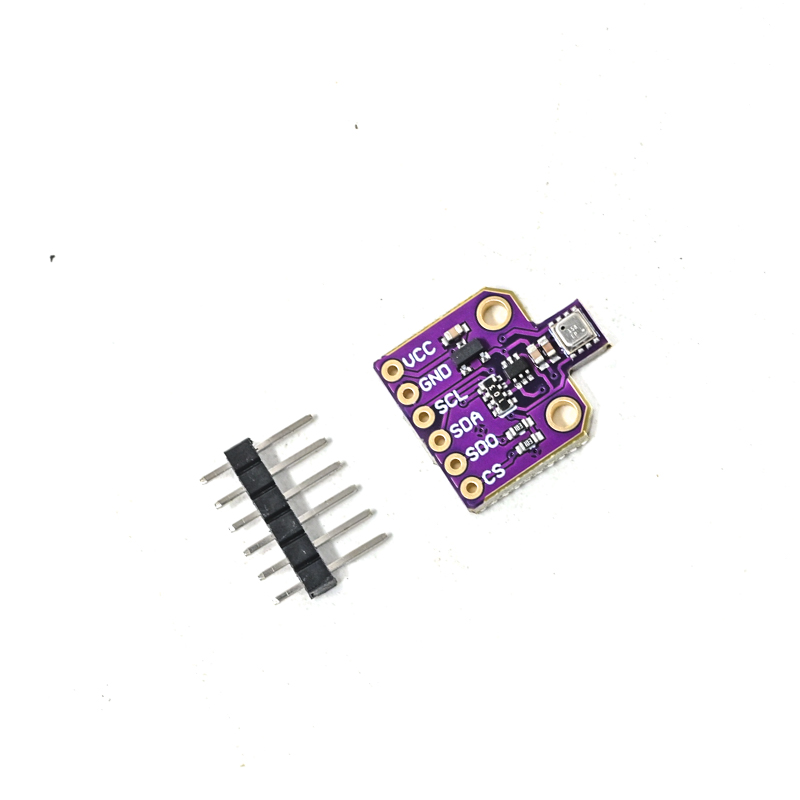
  • Breakout board with pre-soldered 6-pin header for easy breadboard prototyping.

Out of stock

Description

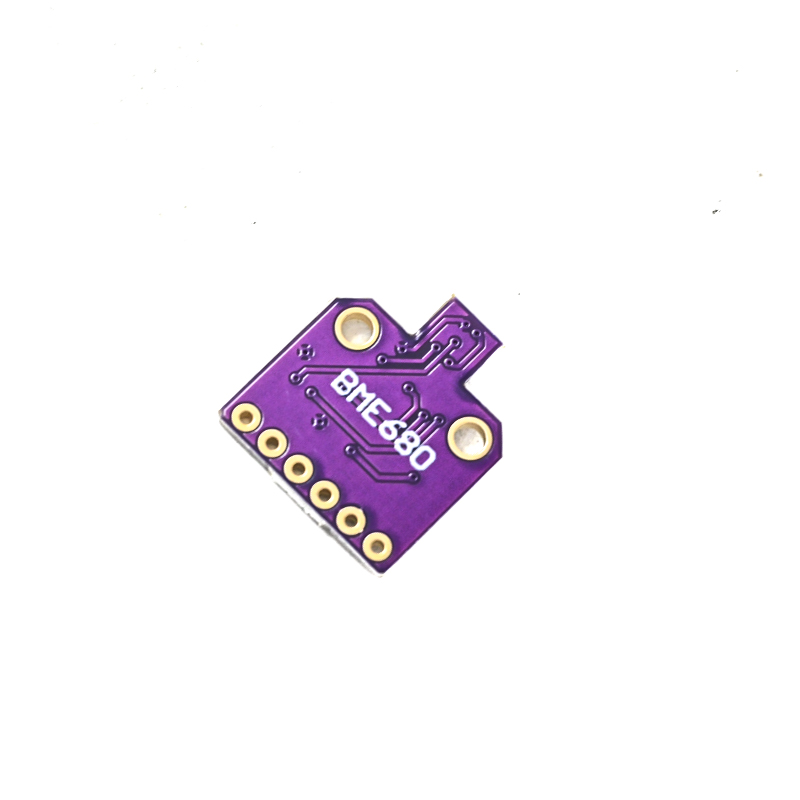
The CJMCU-680 module is a breakout board for the Bosch BME680, a 4-in-1 environmental MEMS sensor. It combines a high-linearity pressure sensor, a dedicated humidity sensing layer, a temperature sensor, and a metal-oxide (MOX) gas sensor sensitive to volatile organic compounds (VOCs) for indoor air quality assessment. The sensor communicates via a fully digital interface, supporting both I2C and SPI protocols for direct connection to microcontrollers and single-board computers.

This module provides a stable 3.3V regulated supply to the BME680 from a 5V input, ensuring reliable operation. The board includes a 6-pin header (VCC, GND, SDA/SDI, SCL/SCK, SDO, CS) for flexible wiring. The BME680’s integrated signal conditioning and 24-bit ADC deliver calibrated digital outputs, minimizing the need for external analog circuitry and simplifying firmware development for environmental data logging, weather stations, and smart home automation.

Key Features

  • Integrated Bosch BME680 MEMS sensor with four simultaneous environmental measurements.
  • Dual digital communication protocol support: I2C (up to 3.4 MHz) and SPI (up to 10 MHz).
  • Onboard low-dropout voltage regulator accepts 5V input for 3.3V sensor operation.
  • High-value build with a 1.6mm thick FR4 PCB and gold-plated header pins for durable prototyping.
  • Optimized performance-to-cost ratio for educational, IoT, and industrial proof-of-concept applications.
  • Gas sensor provides a relative VOC index for tracking air quality trends over time.
  • Ultra-low power consumption with programmable oversampling and standby modes.

Applications

  • Indoor air quality monitoring and smart HVAC control systems.
  • Portable weather stations and altitude tracking for drones/rovers.
  • IoT environmental sensor nodes for building automation.
  • Microclimate monitoring in greenhouses and agricultural setups.
  • Prototyping and educational projects for multi-parameter sensing.

Technical Specifications

Manufacturer Part NumberBME680
Board ModelCJMCU-680
Sensor TypeDigital Temperature, Humidity, Pressure, VOC Gas
Supply Voltage5V DC
Operating Voltage (Sensor)3.3V (regulated onboard)
Communication InterfaceI2C, SPI
Temperature Range-40°C to +85°C
Temperature Accuracy±1.0°C
Humidity Range0% to 100% RH
Humidity Accuracy±3% RH
Pressure Range300 hPa to 1100 hPa
Pressure Accuracy±1 hPa
Gas SensingVOC Sensitivity (Outputs Gas Resistance Index)
Board Dimensions (LxW)18 mm x 16 mm
Package Weight0.01 kg

Frequently Asked Questions

What is the difference between I2C and SPI on the CJMCU-680 BME680 module?

The module supports both interfaces. For I2C, connect SDA and SCL pins, leaving CS high. For SPI, use SDI (MOSI), SDO (MISO), SCK (SCLK), and CS (Chip Select). The interface is selected by the state of the CS pin during power-up. I2C is simpler for multiple devices, while SPI offers higher data rates.

What power supply does the module require, and how do I wire it to an Arduino?

Supply 5V DC to the VCC pin and connect GND. The onboard regulator provides 3.3V to the BME680. For I2C with Arduino, connect SDA to A4 (Uno) or dedicated SDA pin, SCL to A5 (Uno) or SCL pin. Ensure your Arduino logic levels are 5V compatible, or use a logic level converter if running the MCU at 3.3V.

Can this sensor measure specific gas concentrations like CO2 or CO?

No. The BME680's gas sensor is a broad-range metal-oxide (MOX) sensor sensitive to volatile organic compounds (VOCs) and other reducing gases. It outputs a relative gas resistance index, not a specific concentration in ppm for gases like CO2 or CO. It is best used for tracking overall indoor air quality trends.

Does the sensor come calibrated, and how accurate is the altitude estimation?

Yes, the BME680 is factory-calibrated for temperature, humidity, and pressure, providing the accuracies listed. Altitude is derived from barometric pressure using the international barometric formula. The ±1 hPa pressure accuracy translates to an altitude estimation accuracy of approximately ±1 meter under stable atmospheric conditions.

What libraries are available for reading data from the BME680?

Popular libraries include the Bosch Sensortec BME680 driver (BSEC) and the Adafruit BME680 library. The Bosch BSEC library offers advanced signal processing and compensation for optimal accuracy. For Arduino, the Adafruit library provides simple functions to read all four sensor values via I2C or SPI.

Package Includes

  • 1 x CJMCU-680 BME680 Sensor Development Board
  • 1 x 6-pin male header strip (requires soldering)

Additional Information

Weight 0.01 kg
Dimensions 1.8 × 1.6 cm