SKU: IOWC-1626
📋 GST Invoice Available

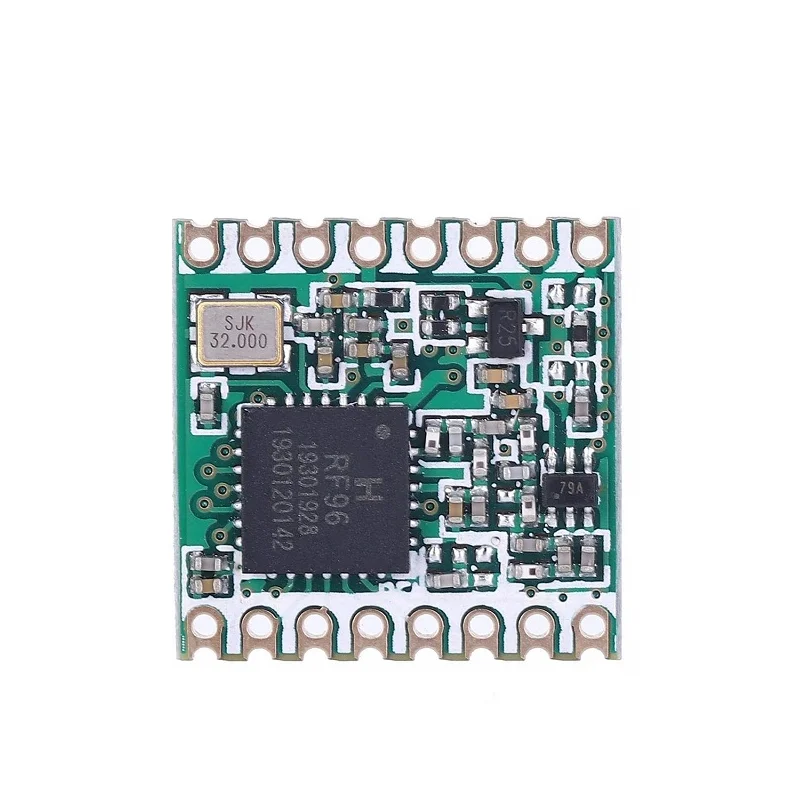
HopeRF RFM96W LoRa Module 433MHz

₹669.00 (Inclusive of all taxes)
Out of Stock

The HopeRF RFM96W is a 433MHz LoRa transceiver module designed for ultra-long-range, low-power wireless communication. It integrates Semtech’s LoRa modem for robust spread-spectrum transmission, making it ideal for Arduino, Raspberry Pi, and custom embedded IoT projects requiring extended range and interference immunity.

Features

  • Ultra-Long Range LoRa Modem: Achieves a maximum link budget of 168 dB with a sensitivity down to -148 dBm, enabling reliable communication over several kilometers in open spaces.
  • High-Efficiency +20 dBm PA: Integrated power amplifier delivers up to 100 mW constant RF output, maximizing transmission range while managing power consumption effectively.
  • Low Power Operation: Features a low RX current of 10.3 mA and a deep sleep register retention current of only 200 nA, perfect for battery-powered sensor nodes and remote monitoring.
  • Robust Modulation & High Data Rate: Supports LoRa, FSK, GFSK, MSK, GMSK, and OOK modulations with a programmable bit rate up to 300 kbps for flexible application design.
  • Compact & Integrated Design: Measures just 15x15x2 mm, incorporating a fully synthesized frequency synthesizer and a bullet-proof front end (IIP3 = -12.5 dBm) for excellent blocking immunity.

Out of stock

Description

The RFM96W module from HopeRF encapsulates Semtech’s SX1276 LoRa transceiver IC, providing a complete, surface-mount solution for implementing long-range, spread-spectrum communication. Its patented LoRa modulation technique offers a significant advantage in selectivity and blocking immunity over traditional FSK methods, resolving the classic trade-off between range, data rate, and power consumption. This makes it exceptionally suited for challenging RF environments with interference.

Engineered for low-current operation, the module is optimized for IoT deployments where devices spend most of their time in sleep mode, waking only to transmit sensor data. The integrated +20 dBm high-efficiency power amplifier ensures maximum energy is converted to RF output, extending battery life in field applications. Its fully integrated frequency synthesizer provides precise frequency control, simplifying firmware development for channel hopping and multi-network deployments.

Key Features

  • Implements Semtech LoRa long-range spread spectrum modem for exceptional range and interference rejection.
  • Industry-leading +20 dBm (100 mW) integrated PA enables long-distance transmission without external amplifiers.
  • Extremely high sensitivity (down to -148 dBm) captures weak signals, maximizing usable range.
  • Ultra-low power consumption with 10.3 mA active receive current and 200 nA sleep current for register retention.
  • Supports multiple modulation schemes: LoRa, FSK, GFSK, MSK, GMSK, and OOK for application flexibility.
  • Built-in bit synchronizer for clock recovery simplifies data packet decoding.
  • Excellent front-end linearity (IIP3 = -12.5 dBm) provides strong immunity to out-of-band interference.
  • Compact 15x15 mm form factor allows for integration into space-constrained designs.

Applications

  • Automated Meter Reading (AMR) for water, gas, and electricity.
  • Home and Building Automation networks for sensors and actuators.
  • Wireless Alarm, Security, and Environmental Monitoring Systems.
  • Industrial Monitoring and Control (IIoT) for telemetry and SCADA.
  • Long-range Agricultural Irrigation and Soil Monitoring Systems.
  • Asset Tracking and Wildlife Monitoring in remote areas.

Technical Specifications

Wireless ProtocolLoRa, FSK, GFSK, MSK, GMSK, OOK
Chipset/ICSemtech SX1276 (via HopeRF RFM96W)
Frequency Range433 MHz
RF Output PowerUp to +20 dBm (100 mW)
Receiver SensitivityDown to -148 dBm (LoRa)
Maximum Link Budget168 dB
Data Rate (Max)300 kbps
Supply Voltage3.3 VDC
Operating Current (RX)10.3 mA
Sleep Current (Register Retention)200 nA
InterfacesSPI
Antenna ConnectorNone (Solder pad for antenna)
Dimensions (L x W x H)15 mm x 15 mm x 2 mm
Weight3 g

Frequently Asked Questions

What is the primary difference between the RFM96W and standard 433MHz FSK modules?

The RFM96W utilizes Semtech's patented LoRa spread spectrum modulation, which provides a significantly higher link budget and interference immunity compared to standard Frequency Shift Keying (FSK). While FSK might offer higher raw data rates, LoRa excels in achieving much longer communication range at lower power levels, making it ideal for remote sensor networks. This is achieved through chirp spread spectrum technology, which is resistant to multipath fading and in-band noise.

How do I connect an antenna to the RFM96W module?

The RFM96W module features an RF output solder pad. You must solder a wire antenna (like a 1/4-wave whip) or an antenna connector (like an SMA edge mount) directly to this pad. For a 433MHz center frequency, a 1/4-wave monopole antenna should be approximately 16.5 cm long. Proper impedance matching (50 ohms) is critical for optimal performance. Always ensure the antenna is connected before applying power to avoid damaging the RF power amplifier.

What software libraries or frameworks support the RFM96W for Arduino development?

The most common library for Arduino IDE is the Sandeep Mistry 'LoRa' library, which provides an easy-to-use API for sending and receiving packets. For more advanced LoRaWAN functionality, you can use libraries like 'MCCI LoRaWAN LMIC' or 'The Things Network Arduino Library'. These libraries handle the SPI communication with the module and implement the LoRa physical layer, allowing you to focus on your application code for sensor data reading and packet formation.

What is the typical real-world range I can expect with the RFM96W at +20 dBm output?

Range is highly dependent on environment, antenna gain, height, and data rate (Spreading Factor). In an urban setting with many obstructions, expect 1-2 km. In suburban areas, 2-5 km is common. In flat, open rural or over-water paths, ranges of 10 km or more are achievable with a good antenna at both ends. Using a higher Spreading Factor (SF) increases range but reduces data rate and increases airtime. Always conduct field tests for your specific deployment scenario.

How do I manage the power consumption of the RFM96W in a battery-powered node?

Maximize battery life by leveraging the module's sleep modes. Between transmissions, put the RFM96W into sleep mode (register retention consumes ~200 nA). Your main microcontroller (e.g., an ATmega328P or ESP32 in deep sleep) should wake periodically, power up the module via a GPIO pin if necessary, send data, and then put everything back to sleep. Use the lowest necessary output power and highest practical data rate (lowest SF) to minimize transmit time and current draw, which can be over 100 mA during transmission at +20 dBm.

Package Includes

  • 1 x RFM96W 433MHz LoRa Wireless Module

Additional Information

Weight 0.003 kg
Dimensions 1.5 × 1.5 × 0.2 cm