SKU: IOWC-1355
📋 GST Invoice Available

Google Coral Dev Board Micro - Edge TPU AI Microcontroller w/ Camera & Mic

₹15,539.00 (Inclusive of all taxes)
Out of Stock

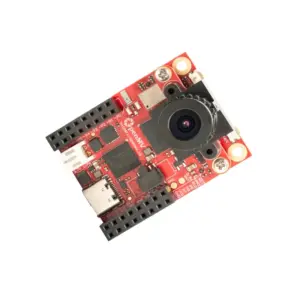
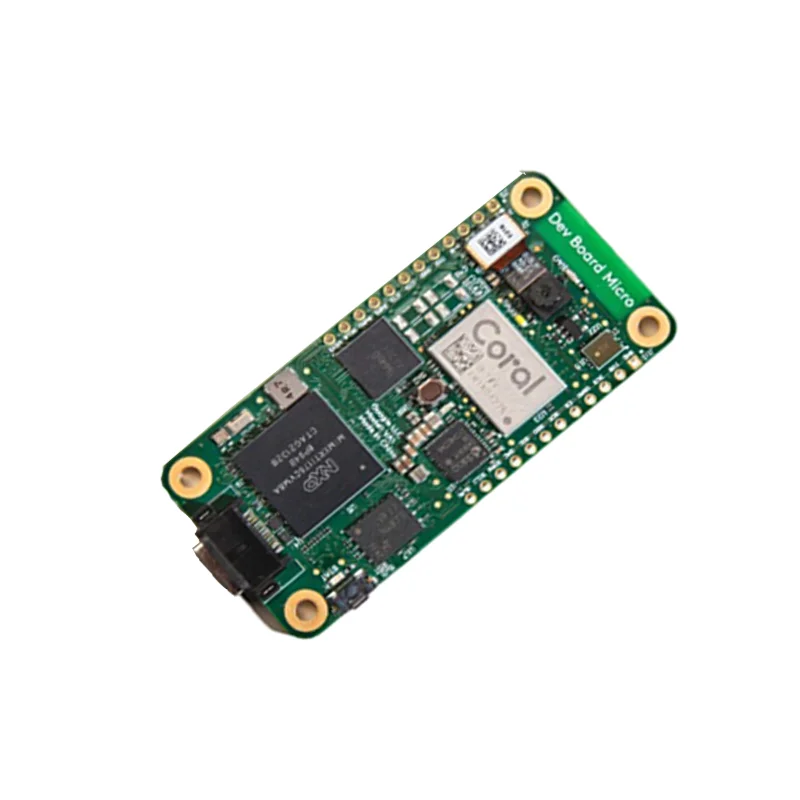
The Google Coral Dev Board Micro is a compact, low-power AI microcontroller board featuring a dual-core Cortex-M7/M4, Google Edge TPU accelerator (4 TOPS), integrated Himax camera, microphone, and Wi-Fi/Bluetooth 5.0, designed for on-device ML inferencing on Mendel Linux.

Features

  • Google Edge TPU coprocessor delivers 4 TOPS (int8) for high-speed, power-efficient TensorFlow Lite model inferencing directly on the device.
  • Dual-core Arm Cortex-M7 and Cortex-M4 MCU architecture enables flexible, low-power processing for embedded AI and sensor fusion applications.
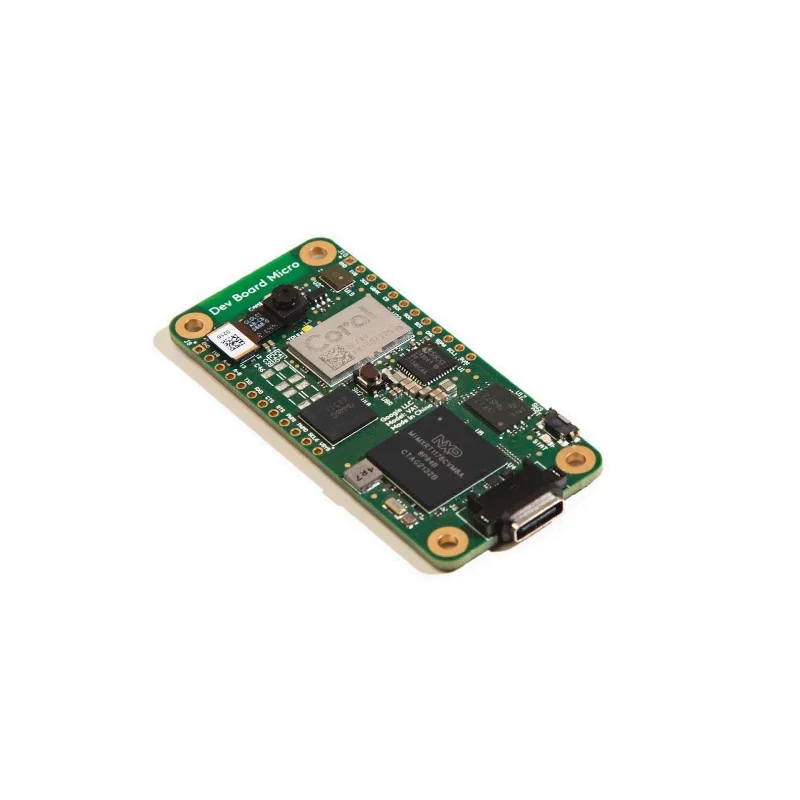
  • Integrated 324×324 pixel Himax color camera and PDM mono microphone for immediate vision and audio ML prototyping without external peripherals.
  • Onboard Wi-Fi 802.11b/g/n/ac (2.4/5GHz) and Bluetooth 5.0 module provides robust wireless connectivity for data transfer and remote management.
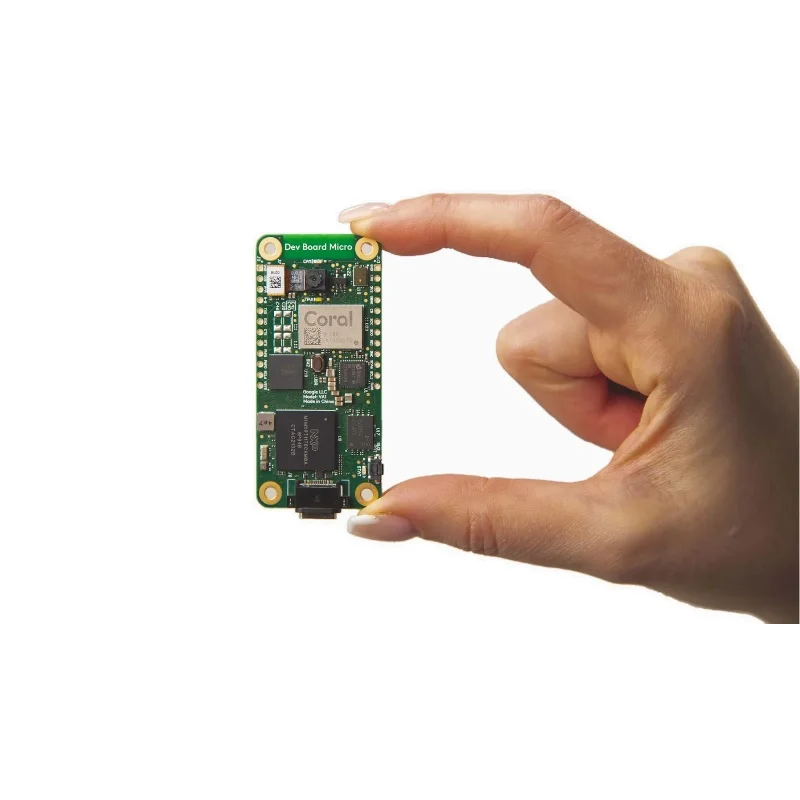
  • Compact 27mm x 42mm x 4mm form factor with 64MB RAM and extensive I/O via dual 100-pin board-to-board connectors for scalable hardware expansion.

Out of stock

Description

The Google Coral Dev Board Micro is a purpose-built embedded system platform that integrates a Google Edge TPU machine learning accelerator with a dual-core Arm microcontroller, creating a low-power hub for edge AI applications. Its architecture allows ML workloads to cascade efficiently between the Cortex-M cores and the dedicated TPU, balancing performance with minimal energy consumption ideal for battery-operated devices.

Equipped with a Himax CMOS image sensor and a digital microphone, the board is ready for vision-based and audio-based TinyML projects out of the box, supporting frameworks like TensorFlow Lite and AutoML Vision Edge on the pre-installed Mendel Linux OS. The inclusion of a Google Coral Wi-Fi/Bluetooth module board ensures seamless wireless data pipeline integration for IoT deployments.

Key Features

  • Google Edge TPU ASIC provides dedicated 4 TOPS (int8) inference acceleration for rapid, private on-device ML without cloud dependency.
  • Dual-core Arm Cortex-M7 (high-performance) and Cortex-M4 (low-power) enable efficient task partitioning and ultra-low-power sleep states.
  • Integrated Himax HM01B0 color camera (324x324) and PDM microphone simplify prototyping of computer vision and audio sensing applications.
  • Pre-configured Mendel Linux (Debian-based) OS with full TensorFlow Lite support accelerates software development and model deployment.
  • High-density dual 100-pin board-to-board connectors offer extensive hardware expandability for custom carrier boards and peripherals.
  • Low-power Wi-Fi 802.11ac/Bluetooth 5.0 wireless module supports dual-band 2.4GHz/5GHz networks for flexible connectivity.
  • Compact, sub-30g form factor is designed for space-constrained embedded systems, drones, and portable smart devices.

Applications

  • On-device vision AI for smart security cameras, product inspection, and gesture recognition systems.
  • Low-power audio processing for keyword spotting, sound classification, and voice command interfaces.
  • Embedded TinyML deployments in drones, robotics, and portable IoT devices requiring local inferencing.
  • Edge AI prototyping and education for computer vision, sensor fusion, and ML model optimization.
  • Industrial IoT predictive maintenance and quality control with real-time, private sensor analytics.

Technical Specifications

AI AcceleratorGoogle Edge TPU Coprocessor (4 TOPS int8)
MicrocontrollerDual-core Arm Cortex-M7 & Cortex-M4
RAM64 MB
Camera SensorHimax HM01B0 Color (324 x 324 px)
MicrophonePDM Mono
Wireless ProtocolsWi-Fi 802.11b/g/n/ac, Bluetooth 5.0
InterfacesUSB Type-C (USB 2.0), 2x 12-pin GPIO headers, 2x 100-pin board-to-board connectors
User Interface4x LEDs, 2x switch buttons
Operating SystemMendel Linux (Debian derivative)
Dimensions27 mm x 42 mm x 4 mm
Weight10 g

Frequently Asked Questions

What is the primary function of the Google Edge TPU on the Google Coral Dev Board Micro?

The integrated Google Edge TPU is a dedicated ASIC accelerator capable of 4 trillion operations per second (4 TOPS) for 8-bit integer (int8) computations. It executes pre-compiled TensorFlow Lite models with high efficiency, drastically speeding up inference tasks like image classification or object detection while consuming minimal power, enabling real-time AI directly on the edge device without a cloud connection.

How do I power and program the Google Coral Dev Board Micro?

Power is supplied via the onboard USB Type-C port (USB 2.0), which also serves as the primary data link for programming and serial communication. The board runs Mendel Linux, a Debian-based OS. You typically develop your application (in Python/C++) on a host computer, compile TensorFlow Lite models for the Edge TPU, and then transfer the executable files to the board over SSH or via the USB connection for execution.

Can I expand the hardware capabilities of the Dev Board Micro?

Yes, expansion is a core feature via two 100-pin high-density board-to-board connectors on the bottom. These expose numerous GPIOs, I2C, SPI, UART, and other MCU interfaces. You can design or use custom carrier boards (like the optional Google Coral Ethernet/PoE board) to add functionalities such as wired networking, additional sensors, displays, or industrial communication protocols like RS-485 for specific project requirements.

What software tools and frameworks are supported for ML development?

The board supports Google's TensorFlow Lite framework and the Edge TPU Compiler for converting and deploying models. The Mendel Linux OS includes Python and C++ development environments. You can use AutoML Vision Edge for no-code model training or the Google Coral SDK for advanced workflows. All development typically occurs on a PC, with the final optimized model deployed to the board's file system for execution.

Package Includes

  • 1 x Google Coral Dev Board Micro

Additional Information

Weight 0.01 kg
Dimensions 2.7 × 4.2 × 0.4 cm