SKU: IOWC-1280
📋 GST Invoice Available

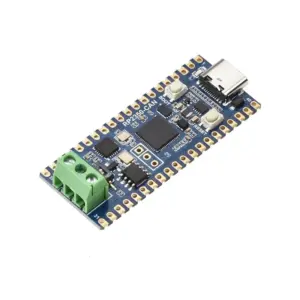
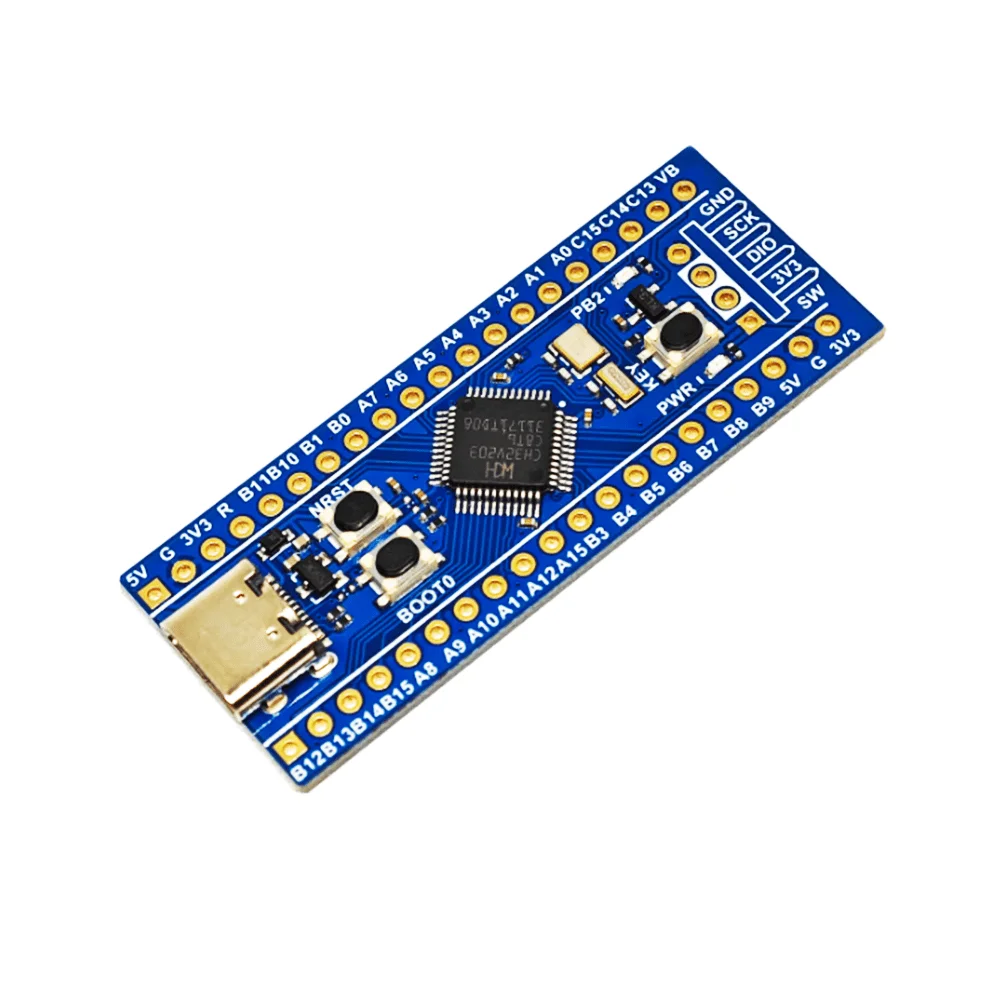
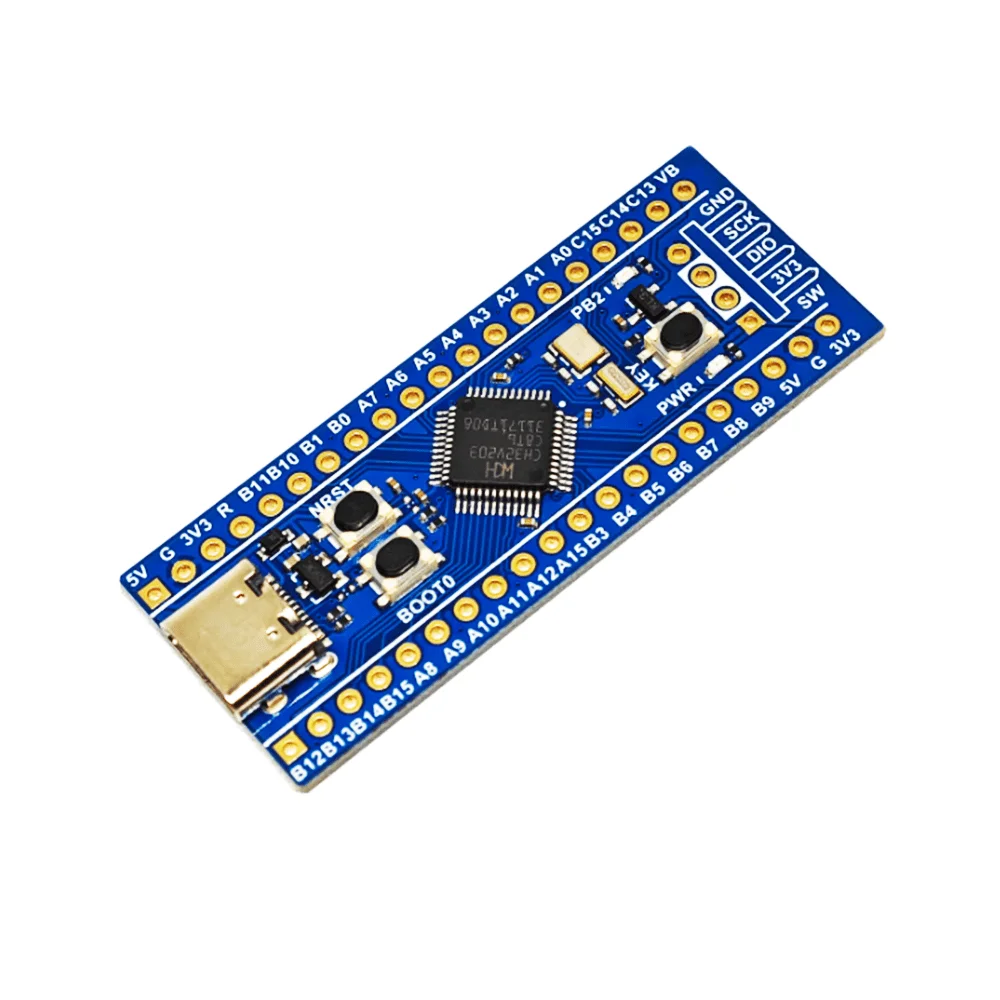
WeAct Studio CH32V203C8T6 RISC-V Low Power Core Demo Board

₹319.00 (Inclusive of all taxes)
Out of Stock

The WeAct Studio CH32V203C8T6 demo board is a RISC-V development platform powered by the Qingke V4B core, running at up to 144MHz with 64KB Flash and 20KB SRAM. It operates at 3.3V and features ultra-low power modes, USB 2.0 host/device, CAN, and multiple serial interfaces for embedded IoT and control applications.

Features

  • RISC-V Qingke V4B Core: High-performance 32-bit processor operating at up to 144MHz for efficient embedded computation.
  • Ultra-Low Power Operation: Features sleep, stop, and standby modes with consumption as low as 17.90uA/MHz in Sleep mode for battery-powered designs.
  • Rich Peripheral Set: Integrates USB 2.0 host/device, 4x UARTs, CAN, 2x I2C, 2x SPI, and an 18-channel DMA controller for complex system interfacing.
  • Integrated Analog & Touch: Includes a 10-channel 12-bit ADC, 10-channel TouchKey controller, and 2 amplifiers for sensor and HMI applications.
  • Compact Development Platform: Provides 37 GPIOs, a 96-bit unique ID, and a 2-wire debug interface on a board ready for prototyping.

Out of stock

Description

The WeAct Studio CH32V203C8T6 demo board is a feature-rich development platform centered on the WCH CH32V203 microcontroller, which utilizes the open-source Qingke V4B RISC-V core. It delivers a balance of high performance, reaching clock speeds of 144MHz, and remarkably low power consumption, making it suitable for a wide range of embedded IoT, industrial control, and consumer electronics projects.

Beyond its computational core, the board is equipped with a comprehensive suite of communication peripherals, including full-speed USB 2.0 with both host and device capabilities, a CAN interface for industrial networks, and multiple UART, I2C, and SPI buses. The independent 3.3V GPIO power domain and integrated analog front-end with ADC and touch sensing simplify interfacing with external sensors, actuators, and user interfaces.

Key Features

  • High-Performance RISC-V Core: The Qingke V4B processor provides efficient 32-bit computing at frequencies up to 144MHz, supported by 64KB Flash and 20KB SRAM.
  • Advanced Power Management: Supports multiple low-power modes (sleep, stop, standby) with ultra-low run and sleep currents, extending battery life in portable applications.
  • Versatile Connectivity Suite: Offers USB 2.0 (Host/Device), CAN 2.0B, four UARTs, two I2C, and two SPI interfaces for connecting to a vast array of peripherals and networks.
  • Integrated Analog & Touch Sensing: Features a 10-channel 12-bit ADC, a 10-channel TouchKey controller, and two operational amplifiers for direct sensor signal conditioning and capacitive touch input.
  • Enhanced Data Transfer: Incorporates an 18-channel general-purpose DMA controller to offload data movement from the CPU, improving system efficiency.
  • Robust System Features: Includes power-on/power-down reset (POR/PDR), a programmable voltage detector (PVD), a CRC calculation unit, and a 96-bit unique chip ID.
  • Developer-Friendly Debugging: Provides a serial 2-wire debug interface (SWD) for easy programming and in-circuit debugging.

Applications

  • Low-Power IoT Sensor Nodes: Ideal for battery-operated environmental monitors, smart agriculture sensors, and wearable devices leveraging its ultra-low sleep currents.
  • Industrial Control & Automation: Suitable for PLCs, motor control interfaces, and CAN bus-based network nodes in factory settings.
  • Consumer Electronics & HMI: Powers interactive devices with capacitive touch interfaces, USB-connected peripherals, and embedded control systems.
  • Embedded Prototyping & Education: Serves as a versatile platform for learning RISC-V architecture and developing proof-of-concept prototypes.

Technical Specifications

Microcontroller / SoCWCH CH32V203C8T6 (Qingke V4B RISC-V Core)
CPU FrequencyUp to 144 MHz
Flash Memory64 KB
SRAM20 KB
Supply Voltage3.3V
Operating Current (Run Mode)~44.65 uA/MHz
Low-Power ModesSleep, Stop, Standby
Digital InterfacesUSB 2.0 Host/Device, 4x UART, CAN, 2x I2C, 2x SPI
Analog Interfaces10-channel 12-bit ADC, 10-channel TouchKey, 2x Amplifier
DMA Channels18-channel General DMA
GPIO / I/O Pins37 (with 16 external interrupts)
Debug Interface2-wire Serial Debug (SWD)
Unique Identifier96-bit Unique ID

Frequently Asked Questions

What development environment and toolchain are used for programming the CH32V203C8T6 board?

You can program this board using the official WCH development tools, including the MounRiver Studio IDE (RISC-V GCC based) or the open-source RISC-V GNU toolchain. The board supports programming and debugging via its 2-wire Serial Wire Debug (SWD) interface using a compatible WCH-Link or other SWD debugger. Example projects and libraries are available from WeAct Studio and WCH's official repositories.

How do I utilize the USB host and device functionality on this board?

The CH32V203 microcontroller has a full-speed USB 2.0 controller that can be configured as either a host or a device. You must select the desired mode in your firmware. The USB peripheral library provided by WCH includes drivers and examples for common device classes (CDC, HID) and basic host functionality. Physical connection is via the board's micro-USB port, which also can be used for power and serial communication (CDC).

What is the procedure for entering and waking from the low-power sleep or stop modes?

To enter a low-power mode, you call the corresponding library function (e.g., PWR_EnterSleepMode, PWR_EnterStopMode) after configuring any necessary wake-up sources. Wake-up can be triggered by specific external interrupts, the RTC, or a watchdog timer. Upon wake-up, code execution resumes from the point following the sleep instruction. It's critical to reconfigure any peripherals disabled during stop mode before resuming normal operation.

Package Includes

  • 1 x WeAct Studio CH32V203C8T6 RISC-V Low Power Core Demo Board

Additional Information

Weight 0.01 kg
Dimensions 4 × 5 × 2 cm